Zhengzhou Qianweiyangchu Food (001215)

Search documents
36氪精选:罗永浩大战贾国龙,预制菜闷声发大财
日经中文网· 2025-09-20 00:33
Core Viewpoint - The recent surge in stock prices of pre-prepared food companies in A-shares is attributed to the upcoming national food safety standards for pre-prepared dishes, which will provide a unified identity and safety baseline for the industry [12][13]. Industry Overview - The pre-prepared food industry in China has a history dating back to the 1990s, with significant developments occurring between 2000 and 2005 when many current leading companies were established [13]. - Regulatory frameworks for pre-prepared foods have only begun to take shape in recent years, with standards being introduced by various governmental bodies [13][14]. Market Dynamics - The stock prices of companies such as Deli Foods, Longda Food, and Huifa Foods have seen increases of over 5%, with Deli Foods hitting a 10.10% rise [7][11]. - The rise in stock prices is linked to the public's renewed interest in the pre-prepared food debate, sparked by recent comments from industry figures [12]. Consumer Perception - There is a disconnect between the regulatory definition of pre-prepared foods and consumer understanding, leading to concerns about food safety and transparency [14]. - Consumers express frustration over the lack of knowledge regarding the preparation of their meals, reflecting a deeper societal issue of time constraints and the desire for authentic dining experiences [14][17]. Operational Trends - The adoption of pre-prepared foods is becoming widespread among restaurants, as they are more cost-effective than hiring chefs and allow for a diverse menu without extensive culinary skills [16]. - The rise of central kitchens and cold chain logistics post-2008 has facilitated the expansion of pre-prepared foods, standardizing offerings across various dining establishments [16].



智通A股限售解禁一览|9月19日


智通财经网· 2025-09-19 01:04
Core Viewpoint - On September 19, a total of 8 listed companies had their restricted shares unlocked, with a total market value of approximately 6.228 billion yuan [1] Group 1: Company Specifics - Xingxing Technology (Stock Code: 300256) had 625 million shares unlocked, categorized as "Other" [1] - Haitong Development (Stock Code: 603162) had 957,900 shares unlocked, categorized as "Equity Incentive Restricted Circulation" [1] - Tianyi Ma (Stock Code: 301178) had 256,000 shares unlocked, also under "Equity Incentive Restricted Circulation" [1] - Zhejiang Zhengte (Stock Code: 001238) had 76.9215 million shares unlocked, categorized as "Pre-Issue Shares Restricted Circulation" [1] - Huabao New Energy (Stock Code: 301327) had 20.0958 million shares unlocked, also under "Pre-Issue Shares Restricted Circulation" [1] - Qianwei Yangchu (Stock Code: 001215) had 21,100 shares unlocked, categorized as "Equity Incentive Restricted Circulation" [1] - Xinbo Co., Ltd. (Stock Code: 003038) had 663,300 shares unlocked, also under "Equity Incentive Restricted Circulation" [1] - Debang Technology (Stock Code: 688035) had 53.4224 million shares unlocked, with no specific category mentioned [1]
风口浪尖下的预制菜|千味央厨成餐饮寒流中的供应链承压者 主业承压、业绩双降
Xin Lang Zheng Quan· 2025-09-18 09:38
Core Viewpoint - In the first half of 2025, Qianwei Yangchun faced significant challenges in the restaurant supply chain industry, reporting a revenue decline of 0.7% year-on-year to 886 million yuan and a net profit drop of 39.7% to 35.79 million yuan, indicating stagnation in core business growth and shrinking profit margins [1] Group 1: Product Iteration Challenges - The company's reliance on traditional product lines, particularly staple and snack categories, has led to a decline in sales as core products like fried dough sticks and sesame balls lose market appeal [2] - Efforts to develop new products in baking and prepared dishes have not yielded significant results, with these segments still too small to drive substantial revenue growth [2] - The shift towards lower-margin products has further pressured overall profitability, revealing a gap in product transition between old and new offerings [2] Group 2: Channel Distribution Pressures - The company maintains a weak recovery in its direct sales channel, primarily due to strong ties with major clients like Yum China and Hema, but faces pressure as these clients demand better pricing [3] - The decline in the distribution channel is more alarming, with over 300 channel partners lost in six months, leading to a significant drop in sales from distributors [3] - Rising costs of raw materials, such as flour and oils, have made it difficult for the company to pass on these costs to customers, resulting in profit erosion [3] Group 3: Trust Crisis and Industry Transparency - The prepared food industry is experiencing a trust crisis, with increasing consumer scrutiny over ingredient processing, compelling restaurant clients to enforce stricter supply chain standards [4] - The company must invest more in quality control, traceability, and transparency, but these efforts are unlikely to yield immediate financial returns [4] Group 4: Need for Strategic Reform - The company's performance reflects the broader challenges faced by restaurant supply chain businesses during industry adjustments, with traditional business pressures and new business investment pains [5] - To regain balance, the company needs to focus on three areas: product innovation, optimizing distribution channels, and developing dynamic cost adjustment capabilities [5] - However, market patience is waning due to regulatory changes, shifting consumer preferences, and capital valuation adjustments, necessitating urgent internal reforms [5]
食品加工板块9月18日跌0.83%,得利斯领跌,主力资金净流出1.41亿元
Zheng Xing Xing Ye Ri Bao· 2025-09-18 08:52
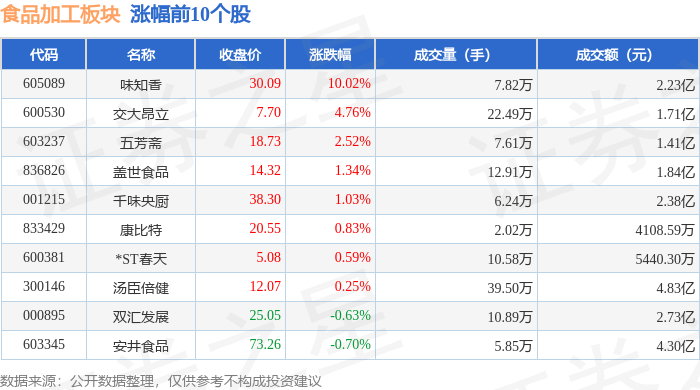
Market Overview - On September 18, the food processing sector declined by 0.83%, with Delisi leading the drop [1] - The Shanghai Composite Index closed at 3831.66, down 1.15%, while the Shenzhen Component Index closed at 13075.66, down 1.06% [1] Stock Performance - Notable gainers in the food processing sector included: - Weizhi Xiang (605089) with a closing price of 30.09, up 10.02% [1] - Jiaoda Anli (600530) at 7.70, up 4.76% [1] - Wufangzhai (603237) at 18.73, up 2.52% [1] - Major decliners included: - Delisi (002330) at 5.14, down 4.64% [2] - Huifa Food (603536) at 10.40, down 3.79% [2] - Jinzi Ham (002515) at 7.33, down 3.43% [2] Trading Volume and Capital Flow - The food processing sector experienced a net outflow of 141 million yuan from institutional investors, while retail investors saw a net inflow of 91.52 million yuan [2] - The total trading volume for the sector was significant, with Weizhi Xiang recording a trading volume of 78,200 hands and a transaction amount of 223 million yuan [1] Individual Stock Capital Flow - Weizhi Xiang had a net outflow of 50.67 million yuan from institutional investors, while retail investors contributed a net inflow of 26.51 million yuan [3] - Tangchen Beijian (300146) saw a net inflow of 25.10 million yuan from institutional investors, but a net outflow of 33.94 million yuan from retail investors [3] - Other stocks like Jiaoda Anli (600530) and Qianwei Yangchu (001215) also showed mixed capital flows, indicating varied investor sentiment [3]


再度被关注的预制菜,市场空间有多大
Di Yi Cai Jing· 2025-09-18 03:04
Core Viewpoint - The reliance of the restaurant industry on pre-prepared dishes is decreasing, as evidenced by the shift towards fresher, made-to-order food options among leading restaurant chains like Jiumaojiu Group's Taier Sour Fish [1] Group 1: Market Trends - The pre-prepared dish concept sector saw initial strength, with stocks like Delisi and Huifa Foods hitting the limit up, but later experienced a decline of 1.51% on September 17 [2] - Analysts suggest that the long-term trend for pre-prepared dishes remains positive due to increasing restaurant chain standardization, rising labor costs, and faster consumer lifestyles, indicating growth potential in both B2B and B2C markets [2][3] - The demand for pre-prepared products such as cleaned vegetables and processed seafood is rising among chain restaurants, driven by considerations of cost, supply chain stability, and safety [2][3] Group 2: Industry Dynamics - The increasing chain restaurant ratio, currently around 30%, is expected to drive growth in pre-prepared dishes, creating a mutually beneficial cycle between industry concentration and supply chain strength [3] - Unlike the cooling B2C market, B2B sectors like cleaned vegetables and seafood processing continue to expand their market share [4] - The pre-prepared dish industry is still in its early to mid-development stage, with a fragmented competitive landscape and a focus on B2B efficiency and standardization [4] Group 3: Investment Landscape - Several provinces have previously launched supportive policies for the pre-prepared dish industry, focusing on local agricultural products, but many face challenges in attracting investment [6] - Investment in the pre-prepared dish sector has seen a decline since 2022, with a notable drop in financing activity in 2023 and 2024 [7]

千味央厨:目前暂无产品供应西贝
Ge Long Hui· 2025-09-17 07:51
Group 1 - The core point of the article is that Qianwei Yangchu (001215.SZ) currently does not supply products to Xibei [1] Group 2 - The company made this statement on its investor interaction platform [1]
千味央厨(001215.SZ):目前暂无产品供应西贝
Ge Long Hui· 2025-09-17 07:30
Group 1 - The company Qianwei Yangchu (001215.SZ) currently has no product supply to Xibei [1]
千味央厨股价涨5.06%,汇添富基金旗下1只基金位居十大流通股东,持有70万股浮盈赚取128.11万元
Xin Lang Cai Jing· 2025-09-17 05:25
Group 1 - The core viewpoint of the news is that Qianwei Yangchu has experienced a significant stock price increase, rising 5.06% to 37.98 CNY per share, with a total market capitalization of 3.69 billion CNY and a cumulative increase of 11.3% over four consecutive days [1] - Qianwei Yangchu, established on April 25, 2012, and listed on September 6, 2021, specializes in the research, production, and sales of frozen noodle and rice products for the catering industry [1] - The company's main business revenue composition includes staple foods at 46.57%, baked goods at 23.15%, snacks at 22.21%, frozen prepared dishes and others at 7.36%, and other supplementary products at 0.71% [1] Group 2 - Among the top ten circulating shareholders of Qianwei Yangchu, Huatai Fund's consumer industry mixed fund holds 700,000 shares, unchanged from the previous period, representing 0.72% of the circulating shares [2] - The estimated floating profit for the fund today is approximately 1.2811 million CNY, with a total floating profit of 2.5691 million CNY during the four-day increase [2] - The Huatai Consumer Industry Mixed Fund, established on May 3, 2013, has a current scale of 9.983 billion CNY, with a year-to-date return of 6.21% and a one-year return of 23.76% [2]
千味央厨(001215) - 关于2021年限制性股票激励计划预留授予部分第二个解除限售期解除限售股份上市流通的提示性公告
2025-09-16 13:04
证券代码:001215 证券简称:千味央厨 公告编号:2025-064 郑州千味央厨食品股份有限公司 关于 2021 年限制性股票激励计划预留授予部分 第二个解除限售期解除限售股份上市流通的提示性公告 本公司及董事会全体成员保证信息披露的内容真实、准确、完整,没有虚假 记载、误导性陈述或重大遗漏。 特别提示: 2、2021 年 11 月 9 日,公司召开第二届董事会第二十一次会议、第二届监 事会第十五次会议,审议通过了《郑州千味央厨食品股份有限公司 2021 年限制 性股票激励计划(草案修订稿)》及其摘要等相关议案。律师出具了《北京市竞 天公诚律师事务所关于郑州千味央厨食品股份有限公司 2021 年限制性股票激励 计划之法律意见书》。 3、2021 年 11 月 19 日,公司召开第二届董事会第二十二次会议、第二届监 事会第十六次会议,审议通过了《郑州千味央厨食品股份有限公司 2021 年限制 性股票激励计划(草案二次修订稿)》(以下简称"《激励计划》")及其摘要、 《郑州千味央厨食品股份有限公司 2021 年限制性股票激励计划实施考核管理办 法(修订稿)》等相关议案。律师出具了《北京市竞天公诚律师事务所关于 ...
食品加工板块9月16日跌0.69%,盖世食品领跌,主力资金净流出2.51亿元
Zheng Xing Xing Ye Ri Bao· 2025-09-16 08:46
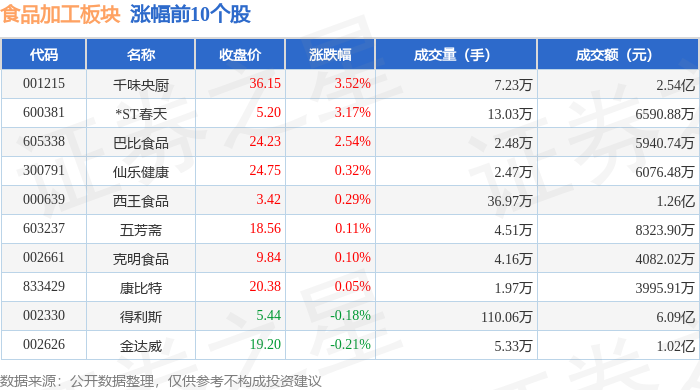
Market Overview - On September 16, the food processing sector declined by 0.69%, with Gais Food leading the drop [1] - The Shanghai Composite Index closed at 3861.87, up 0.04%, while the Shenzhen Component Index closed at 13063.97, up 0.45% [1] Stock Performance - Notable gainers in the food processing sector included: - Qianwei Yangchu (001215) with a closing price of 36.15, up 3.52% and a trading volume of 72,300 shares, totaling 254 million yuan [1] - ST Chuntian (600381) with a closing price of 5.20, up 3.17% and a trading volume of 130,300 shares, totaling 65.9 million yuan [1] - Baba Food (605338) with a closing price of 24.23, up 2.54% and a trading volume of 24,800 shares, totaling 59.4 million yuan [1] - Major decliners included: - Gais Food (836826) with a closing price of 14.35, down 4.52% and a trading volume of 155,500 shares, totaling 225 million yuan [2] - Huadong Shares (002840) with a closing price of 11.92, down 2.77% and a trading volume of 312,700 shares, totaling 373 million yuan [2] - Huifa Food (603536) with a closing price of 11.11, down 2.54% and a trading volume of 354,400 shares, totaling 394 million yuan [2] Capital Flow - The food processing sector experienced a net outflow of 251 million yuan from institutional investors, while retail investors saw a net inflow of 217 million yuan [2] - The detailed capital flow for selected stocks showed: - ST Chuntian (600381) had a net inflow of 10.68% from institutional investors [3] - Qianwei Yangchu (001215) had a net inflow of 2.25% from institutional investors [3] - Gais Food (836826) had a net outflow of 0.41% from institutional investors [3]