
ROYALFLUSH INFO(300033)

Search documents
计算机行业资金流入榜:岩山科技等22股净流入资金超亿元
Zheng Quan Shi Bao Wang· 2026-01-08 08:48
Group 1 - The Shanghai Composite Index fell by 0.07% on January 8, with 20 industries rising, led by defense and military industry at 4.18% and media at 2.00% [1] - The computer industry increased by 1.27%, with a net inflow of 39.17 billion yuan in main funds [2] - The non-bank financial and non-ferrous metals industries experienced the largest declines, at 2.81% and 1.56% respectively [1] Group 2 - The defense and military industry had the highest net inflow of main funds, totaling 67.73 billion yuan, contributing to its 4.18% rise [1] - A total of 336 stocks are in the computer industry, with 267 stocks rising and 6 hitting the daily limit, while 64 stocks fell [2] - The top three stocks with the highest net inflow in the computer industry were Yanshan Technology (9.74 billion yuan), Hand Information (8.50 billion yuan), and Aerospace Information (6.16 billion yuan) [2] Group 3 - The electronic industry had the largest net outflow of main funds, totaling 171.07 billion yuan, followed by non-ferrous metals with 106.78 billion yuan [1] - The top three stocks with the highest net outflow in the computer industry were Tonghuashun (-4.41 billion yuan), Zhina Compass (-4.31 billion yuan), and Chunz中科技 (-3.75 billion yuan) [4] - The overall market saw a net outflow of 453.04 billion yuan in main funds across the two exchanges [1]



同花顺股价跌5%,长城基金旗下1只基金重仓,持有6.83万股浮亏损失124.1万元
Xin Lang Cai Jing· 2026-01-08 06:30
Group 1 - The core point of the news is that Tonghuashun's stock price dropped by 5% to 345.13 CNY per share, with a trading volume of 3.88 billion CNY and a turnover rate of 4.04%, resulting in a total market capitalization of 185.54 billion CNY [1] - Tonghuashun, established on August 24, 2001, and listed on December 25, 2009, provides software products, system maintenance services, financial data services, and investment tools for individual investors [1] - The company's revenue composition includes 48.33% from value-added telecommunications services, 36.01% from advertising and internet promotion services, 9.43% from fund sales and other businesses, and 6.22% from software sales and maintenance [1] Group 2 - According to data, Changcheng Fund has one fund heavily invested in Tonghuashun, specifically the Changcheng Growth Enterprise Index Enhanced Fund A (001879), which held 68,300 shares, accounting for 1.76% of the fund's net value, ranking as the ninth largest holding [2] - The estimated floating loss for the fund today is approximately 1.241 million CNY [2] - The Changcheng Growth Enterprise Index Enhanced Fund A (001879) was established on June 1, 2017, with a current scale of 762 million CNY, and has achieved a year-to-date return of 3.52% [2]
创业50ETF(159682)跌0.92%,半日成交额1.40亿元
Xin Lang Cai Jing· 2026-01-08 03:44
Core Viewpoint - The article discusses the performance of the ChiNext 50 ETF (159682) as of January 8, highlighting a decline in its value and the performance of its major holdings [1] Group 1: ETF Performance - As of the midday close, the ChiNext 50 ETF (159682) decreased by 0.92%, priced at 1.515 yuan, with a trading volume of 140 million yuan [1] - Since its inception on December 23, 2022, the fund has achieved a return of 53.15%, with a monthly return of 6.35% [1] Group 2: Major Holdings Performance - Key stocks within the ChiNext 50 ETF include: - Ningde Times: down 0.12% - Zhongji Xuchuang: down 2.72% - Dongfang Wealth: down 2.00% - Xinyi Sheng: down 1.74% - Sunshine Power: down 2.38% - Shenghong Technology: down 2.58% - Huichuan Technology: down 0.15% - Mindray Medical: up 0.33% - Yiwei Lithium Energy: down 0.72% - Tonghuashun: down 4.28% [1]





回调获资金布局,金融科技ETF华夏(516100)单日吸金超5300万
Sou Hu Cai Jing· 2026-01-08 02:03
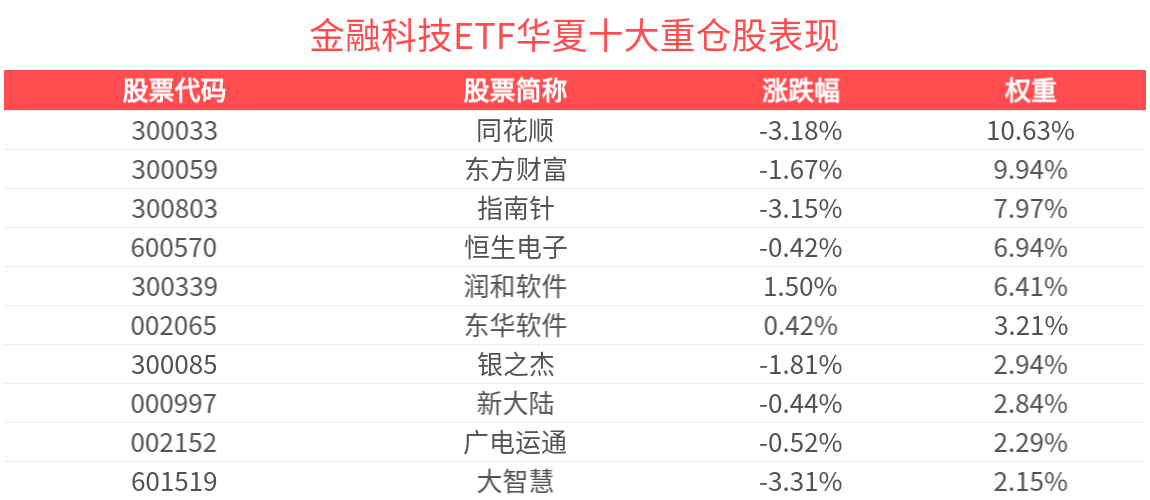
| 股票代码 | 股票简称 | 涨跌幅 | 权重 | | --- | --- | --- | --- | | 300033 | 同花顺 | -3.18% | 10.63% | | 300059 | 东方财富 | -1.67% | 9.94% | | 300803 | 指南针 | -3.15% | 7.97% | | 600570 | 恒生电子 | -0.42% | 6.94% | | 300339 | 润和软件 | 1.50% | 6.41% | | 002065 | 东华软件 | 0.42% | 3.21% | | 300085 | 银之杰 | -1.81% | 2.94% | | 000997 | 新大陆 | -0.44% | 2.84% | | 002152 | 广电运通 | -0.52% | 2.29% | | e01519 | 大智慧 | -3.31% | 2.15% | 2026年1月8日,三大指数集体走低,大金融板块延续调整,截至9:42,金融科技ETF华夏(516100)下跌1.39%,其持仓股跌多涨少,仅润和软件、博睿数据、 普元信息等股小幅飘红;星环科技、税友股份、大智慧等股纷纷回撤。 资 ...


申万宏源证券晨会报告-20260108
Shenwan Hongyuan Securities· 2026-01-08 00:42
Core Insights - The report maintains a "Buy" rating for Tonghuashun (300033), projecting net profits for 2025-2027 at 28.54 billion, 35.13 billion, and 43.08 billion yuan, with growth rates of 57%, 23%, and 23% respectively, indicating a significant upward revision from previous estimates [2][11] - The report highlights four key growth factors for Tonghuashun: strategic determination, product technology core, comprehensive layout, and C-end advantages, which contribute to its resilience in both bull and bear markets [11] - The report identifies three major incremental growth areas: increased market attraction from long-term capital inflows, technological breakthroughs in AI data and the WenCai platform, and customer expansion through competitive pricing and overseas market strategies [11] Summary by Sections Company Overview - Tonghuashun has a strong strategic focus on building a comprehensive and intelligent financial information service platform, maintaining a leading position in mobile app market share with a 21% market share in the securities service application market [11] - The company has shown resilience during market downturns by actively exploring new fields, including product innovation and customer expansion [11] Financial Projections - The projected net profits for Tonghuashun for 2025-2027 are significantly higher than previous estimates, with a current PE ratio of 51x for 2026, suggesting over 20% upside potential [2][11] Market Dynamics - The report notes that the capital market's attractiveness has improved significantly, with higher returns and investment value compared to previous years, which is expected to drive increased market participation [11] - The report emphasizes the importance of AI technology in enhancing Tonghuashun's data capabilities, with significant investments in AI since 2006, leading to successful monetization of both C-end and B-end AI applications [11] Strategic Initiatives - The report discusses the company's competitive pricing strategy for its iFinD platform, which is positioned to benefit from the industry's trend towards cost reduction and efficiency [11] - Tonghuashun's overseas market expansion is highlighted, with a significant pricing advantage over competitors like Bloomberg, indicating a strong potential for growth in international markets [11]
虚拟机器人板块领跌,下跌2.9%




Di Yi Cai Jing· 2026-01-07 10:11
Group 1 - The virtual robot sector experienced a decline of 2.9% [1] - Among the companies, Winshang fell by 7.66%, Jinzheng shares dropped by 3.88%, and Tonghuashun decreased by 3.77% [1] - Other companies such as Dongfang Caifu, Dingjie Zhizhi, and Dazhihui also saw declines exceeding 2% [1]
研报掘金丨申万宏源研究:维持同花顺“买入”评级,兼具牛市弹性与平淡期韧性
Ge Long Hui A P P· 2026-01-07 07:51
Core Viewpoint - The performance of Tonghuashun is significantly influenced by the activity level of the capital market, but it also demonstrates resilience during market downturns due to strategic initiatives and its strong market position [1] Group 1: Company Performance - Tonghuashun's revenue is heavily impacted by the capital market's activity, but it has shown resilience during quieter market periods [1] - The resilience is attributed to proactive strategies in new areas such as product innovation, customer expansion, and technology development [1] - According to data from Analysys Qianfan, Tonghuashun leads the securities app market with a market share of 21%, significantly ahead of its closest competitor, Dongfang Caifu [1] Group 2: Business Strategy - The company possesses four key elements: strategic determination, core product technology, comprehensive layout, and advantages in the consumer end [1] - Both C-end and B-end AI initiatives have started to generate revenue, with recent B-end contracts, such as a major deal with Guotai Junan, showcasing its technical capabilities [1] - The C-end AI service, "WenCai AI," has begun implementing tiered pricing [1] Group 3: Financial Projections - Based on a reassessment of Tonghuashun's business, the projected net profit attributable to shareholders for 2025-2027 is estimated to be 2.854 billion, 3.513 billion, and 4.308 billion yuan, with growth rates of 57%, 23%, and 23% respectively [1] - Previous profit expectations were lower, at 2.286 billion, 2.749 billion, and 3.159 billion yuan [1] - The current PE ratio for 2026 is 51x, indicating over 20% potential upside, maintaining a "buy" rating [1]

金融科技概念股走弱,金融科技相关ETF跌超2%
Sou Hu Cai Jing· 2026-01-07 06:17
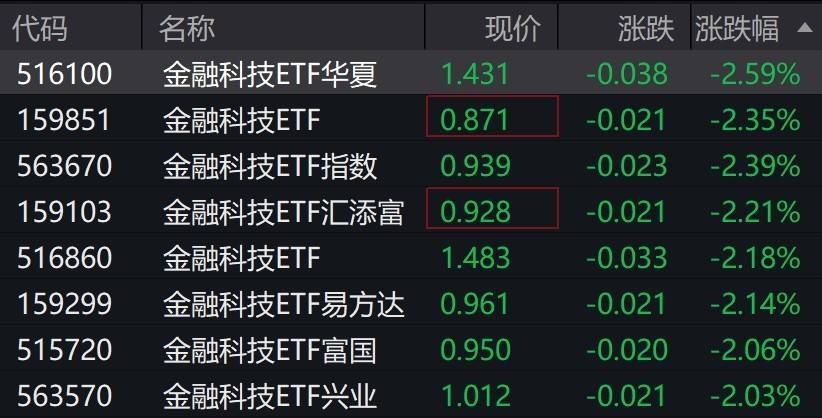
Group 1 - The core viewpoint of the news indicates a decline in fintech concept stocks, with significant drops in companies such as Zhina Zhen and Yinzhijie, which fell over 3%, while Tonghuashun, Dongfang Caifu, and Hengsheng Electronics dropped over 2% [1] - Affected by the adjustment of heavy-weight stocks, fintech-related ETFs experienced a decline of over 2% [1] Group 2 - Specific ETF performance shows that the Huaxia Fintech ETF decreased by 2.59% to 1.431, while the Fintech ETF dropped by 2.35% to 0.871 [2] - Other ETFs also reported declines, with the Fintech ETF Index down 2.39% to 0.939, and the Huizheng Fintech ETF down 2.21% to 0.928 [2] - Institutions suggest that with policy support and a stable macro environment, the financial sector's fundamentals are improving, and the income of financial IT companies is expected to grow gradually [2] - The acceleration of revolutionary stablecoins and the anticipated release of significant financial policies may present investment opportunities in the financial IT sector [2]

同花顺(300033):四大成长要素与三大增量
Shenwan Hongyuan Securities· 2026-01-06 13:41
Investment Rating - The report maintains a "Buy" rating for the company, indicating a positive outlook on its future performance [5][6]. Core Insights - The report emphasizes four key growth factors driving the company's success: strategic determination, core product technology, comprehensive layout, and advantages in the C-end market [5][13]. - The company demonstrates resilience during market downturns by actively innovating products, expanding customer bases, and enhancing technology [5][28]. - The report highlights the potential for increased market attractiveness due to the influx of medium to long-term capital into the market, supported by favorable policy changes [5][6]. Financial Data and Profit Forecast - Total revenue projections for the company are as follows: 4,187 million in 2024, 5,717 million in 2025, 6,751 million in 2026, and 7,882 million in 2027, with year-on-year growth rates of 17.5%, 36.5%, 18.1%, and 16.8% respectively [4]. - The forecasted net profit attributable to the parent company is expected to be 1,823 million in 2024, 2,854 million in 2025, 3,513 million in 2026, and 4,308 million in 2027, with growth rates of 30.0%, 56.5%, 23.1%, and 22.6% respectively [4]. - The report notes that the company's price-to-earnings ratio (PE) for 2026 is projected at 51x, which is below the average PE of 63x for comparable companies, indicating over 20% upside potential [6]. Business Model and Market Position - The company operates a diversified business model that includes value-added telecommunications services, software sales, advertising, and fund distribution, with a significant portion of revenue derived from C-end traffic monetization [14][20]. - The report identifies the company's strong strategic focus on long-term business and technology development, which has allowed it to maintain a competitive edge in the financial information services sector [39][42]. - The company has a robust cash flow model, with operating cash flow typically exceeding net profit, indicating a strong financial position [33][34]. Market Dynamics and Competitive Landscape - The report highlights that the company's revenue is significantly influenced by the activity level of the capital markets, with a noted correlation between revenue growth and market trading volumes [21][26]. - The company has successfully maintained revenue growth even during periods of declining market activity, showcasing its operational resilience [26][28]. - The competitive landscape includes major players such as Wind and Eastmoney, with the company positioned favorably due to its comprehensive product offerings and market share [17][20].
73股特大单净流入超2亿元
Xin Lang Cai Jing· 2026-01-06 12:30
Core Viewpoint - A total of 73 stocks experienced a net inflow of over 200 million yuan, indicating significant investment interest in these companies [1] Group 1: Stocks with High Net Inflows - Dongfang Caifu led with a net inflow of 2.943 billion yuan, the highest among the stocks [1] - Shanzi Gaoke followed with a net inflow of 1.766 billion yuan, ranking second [1] - Other notable companies with high net inflows include Aerospace Electronics, TCL Technology, and Tonghuashun [1] Group 2: Stocks with High Net Outflows - Zhongji Xuchuang had the highest net outflow, with 2.292 billion yuan [1] - Xinyi Sheng and China Satellite Communications ranked second and third in net outflows, with 2.198 billion yuan and 994 million yuan respectively [1]


