
Sangfor Technologies (300454)

Search documents
计算机行业周报20260124:Token需求“通胀”:从CPU到云服务
Guolian Minsheng Securities· 2026-01-24 13:25
Investment Rating - The report maintains a "Recommended" rating for the industry [4] Core Insights - The demand for Tokens is driving inflation across the AI industry chain, with price increases being observed from storage to CPUs and now extending to cloud services, marking a significant shift in the pricing dynamics of the cloud computing sector [14][30] - AWS has initiated a price increase for its EC2 machine learning capacity blocks by approximately 15%, breaking a long-standing trend of declining prices in the cloud services industry, which may lead to a revaluation of cloud computing and related service providers [14] - The report highlights potential investment opportunities in cloud computing, CPUs, and databases, suggesting companies such as Alibaba, Kingsoft Cloud, and Inspur for cloud computing; Haiguang Information and Longxin for CPUs; and companies like StarRing Technology and DM Database for databases [30] Summary by Sections 1. Cloud Computing Price Trends - The report indicates that the AI industry chain is experiencing a price transmission trend, with cloud computing being the next area to see price increases following storage and CPU price hikes [14] - AWS's price adjustment reflects anticipated supply-demand dynamics, suggesting that successful price increases could lead to further adjustments in the future [14] 2. CPU Market Dynamics - The report notes a persistent supply-demand imbalance in the CPU market, particularly with Intel facing production limitations that may lead to continued shortages into 2026 [16] - The importance of CPUs is expected to rise significantly due to the increasing demand from AI applications, with the report emphasizing the need for optimization across both CPU and GPU resources [24][25] 3. Database Sector Growth - The report anticipates a rapid increase in the number of database PCU nodes driven by the demand for AI agents, which could lead to significant revenue growth for database providers [26] - The emergence of AI-native databases is highlighted as a key trend, with companies like Alibaba's PolarDB gaining traction in the market [29] 4. Investment Recommendations - The report suggests focusing on companies in the cloud computing sector such as Alibaba, Kingsoft Cloud, and UCloud, as well as CPU manufacturers like Haiguang Information and Longxin, and database firms like StarRing Technology and DM Database [30]




计算机行业周报20260119-20260124:计算机板块持仓分析!CPU、沙箱、Agent全面分析-20260124
Shenwan Hongyuan Securities· 2026-01-24 12:26
Investment Rating - The report maintains a positive outlook on the computer industry, indicating a "Buy" rating for the sector [2]. Core Insights - The computer sector is supported by strong fundamentals, with expectations of increased allocations to high-performing stocks. The sector's public fund allocation is currently at 1.6%, down 0.8 percentage points from the previous quarter, marking a low point since 2010 [2][3]. - Valuation metrics such as PE, PS, and PCF suggest that there is still room for growth in the computer sector, despite high current levels. The PE (TTM) is at 94.6x, in the 94.80% historical percentile, while PS (TTM) is at 4.0x and PCF (TTM) is at 51.6x, indicating a divergence that could be resolved as market sentiment improves [2][11]. - Anticipated price increases for server CPUs due to supply constraints and rising demand driven by AI applications are highlighted. Major players like Intel and AMD may raise CPU prices by 10% to 15% in Q1 2026 [2][18]. - The report emphasizes the importance of sandbox environments for agents, which enhance system performance and security by isolating tasks, thus improving user experience in high-concurrency scenarios [24][32]. Summary by Sections 1. Fund Holdings Analysis - The computer sector's public fund allocation decreased to 1.6% in Q4 2025, ranking 14th among 30 sectors, reflecting a decline in investor confidence [3][4]. - The top ten holdings in the computer sector include Inspur Information, Kingsoft Office, and Sangfor Technologies, with notable changes in positions among these stocks [5][6]. 2. Valuation Metrics - The report notes that the current PE (TTM) of 94.6x exceeds previous peaks in 2020 and 2023, indicating market optimism about future earnings potential [11][12]. - The divergence between PE and PS/PCF suggests that as the macroeconomic environment stabilizes, the sector's valuations may realign, leading to potential market cap growth [11][12]. 3. CPU Price Expectations - The report anticipates a supply-demand mismatch for CPUs, with significant price increases expected due to locked-in capacities and rising AI-driven demand [18][23]. - The role of CPUs is evolving, with increased responsibilities in managing complex workflows driven by AI agents, necessitating higher performance specifications [21][42]. 4. Sandbox Technology - The report discusses the growing importance of sandbox environments for AI agents, which enhance performance and security by isolating tasks and managing resources effectively [24][32]. - The sandbox model is seen as crucial for handling high concurrency and ensuring system stability, particularly in AI applications [32][40]. 5. Key Investment Themes - The report identifies several key investment themes, including digital economy leadership, AIGC applications, and new industrialization, with specific companies highlighted for each theme [45].




【最全】2025年防火墙行业上市公司全方位对比(附业务布局汇总、业绩对比、业务规划等)
Qian Zhan Wang· 2026-01-24 06:09
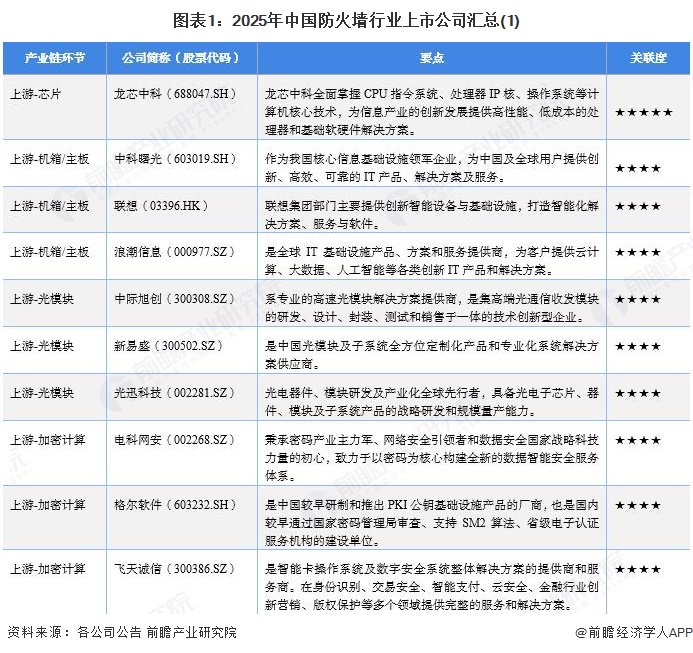
Core Insights - The firewall industry in China is a critical component of the network security system, serving as the first line of defense for enterprises and individuals. The industry is characterized by a diverse range of listed companies, primarily concentrated in the upstream and midstream segments of the supply chain [1][5]. Group 1: Company Overview - Major companies in the firewall industry include Sangfor (300454.SZ), Tianrongxin (002212.SZ), Hillstone Networks (688030.SH), Deepin Technology (300768.SZ), Ruijie Networks (301165.SZ), Venustech (002439.SZ), Qihoo 360 (688561.SH), and NSFOCUS (300369.SZ) [1]. - The highest revenue in the firewall industry for 2024 is projected to be from Lenovo, with revenue reaching 114.77 billion yuan, followed closely by Inspur with the same revenue figure [4]. - The registered capital is highest for NSFOCUS, while Tianrongxin is the oldest company in the industry. Ruijie Networks has the most bidding information, totaling 7,141 entries [8]. Group 2: Revenue and Profitability - In terms of revenue from firewall-related business, Sangfor is expected to generate 3.629 billion yuan in 2024, ranking second in the domestic market for unified threat management. Qihoo 360 follows with an expected revenue of 2.653 billion yuan [9]. - The gross profit margin for representative companies in the firewall industry is projected to be around 60% in 2024, with Sangfor achieving the highest margin at 79.31% and Hillstone Networks at 71.97% [11]. Group 3: Business Layout - The firewall business layout of listed companies shows a combination of regional focus and nationwide outreach, with technological innovation and scenario deepening being key characteristics. Sangfor focuses on South China, covering over 30 countries and regions, while Qihoo 360 is centered in Beijing, targeting government and state-owned enterprises [13][15]. - Companies like Tianrongxin and Venustech are also focusing on specific sectors such as industrial internet and government services, respectively, to enhance their market presence [15]. Group 4: Business Planning - Future business plans for firewall companies emphasize technological iteration and scenario deepening. Sangfor aims to integrate network security with cloud computing and transition to a subscription model by 2026 [17]. - Qihoo 360 plans to allocate 25% of its R&D budget to encryption firewall research, while Tianrongxin is focusing on smart solutions for industrial firewalls [17].


龙虎榜 | 湖南白银遭6.59亿抛售,城管希爆买雪人集团!
Ge Long Hui A P P· 2026-01-22 09:59
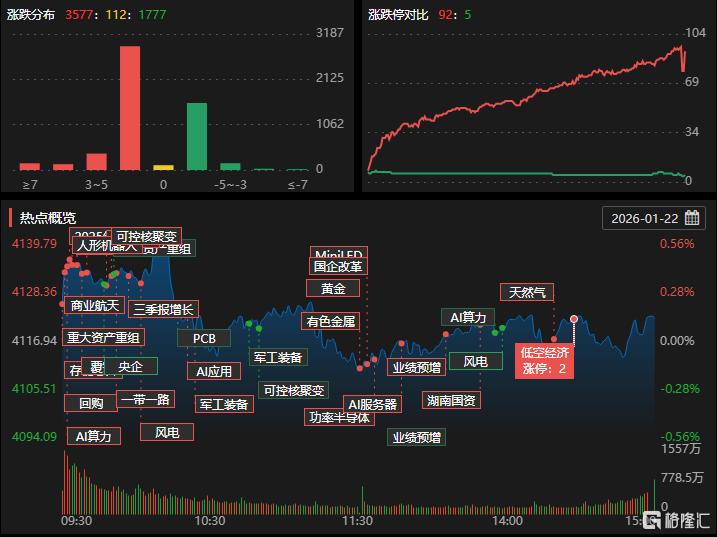
Market Overview - On January 22, the Shanghai Composite Index rose by 0.14% to 4122 points, the Shenzhen Component Index increased by 0.5%, and the ChiNext Index gained 1.01% with a total market turnover of 2.72 trillion yuan, over 3500 stocks rising [1] Stock Highlights - Jia Mei Packaging (002969) surged by 49.99% to 21.35 yuan, driven by a change in control and its leading position in three-piece cans [2] - Fenglong Co., Ltd. (002931) increased by 10.01% to 90.48 yuan, benefiting from a major investment by UBTECH and its association with robotics [2] - Jiuding New Materials (002201) rose by 10.00% to 13.86 yuan, linked to fiberglass new materials and commercial aerospace [2] - Jianghua Micro (603078) gained 9.99% to 28.51 yuan, following a state-owned enterprise takeover and its focus on chip materials [2] - Aviation Power Technology (600391) increased by 10.00% to 53.36 yuan, associated with military equipment and central enterprise backing [2] Trading Dynamics - The top three net buying stocks on the day were Pengding Holdings (002938) with 325 million yuan, Snowman Group (002639) with 316 million yuan, and Baiyin Nonferrous Metals (601212) with 257 million yuan [3] - The top three net selling stocks were Hunan Baiyin (002716) with 659 million yuan, Founder Electric (002196) with 281 million yuan, and Yifan Transmission (301023) with 152 million yuan [6] Industry Trends - The commercial aerospace industry is experiencing significant growth, with a report from Galaxy Securities indicating a dual push from both demand and supply sides [11] - SpaceX is reportedly advancing its IPO plans, aiming for completion by July this year, which could further stimulate interest in the commercial aerospace sector [10] Company Developments - Shenxinfu (300454) saw a trading halt with a 20.00% increase, with a turnover of 38.28 billion yuan and a net institutional buy of 269.31 million yuan [12] - The company has established a strong presence in AI computing and security solutions, with significant user adoption and market share [15] Notable Stocks - Guohua Technology (001389) and Qiaoyuan Co., Ltd. (002131) both saw significant trading activity, with Guohua Technology rising by 10.00% and Qiaoyuan Co., Ltd. declining by 10.04% [16][19] - The stock of Hunan Baiyin (002716) experienced a notable increase of 9.97% with a high turnover rate of 32.27% [17]




深信服1月22日龙虎榜数据
Zheng Quan Shi Bao Wang· 2026-01-22 09:13
Group 1 - The stock of Shenxinfu reached the daily limit, with a turnover rate of 8.89% and a transaction amount of 3.828 billion yuan, showing a volatility of 18.43% [2] - Institutional investors net bought 26.93 million yuan, while the Shenzhen Stock Connect saw a net sell of 146 million yuan, with total net buying from brokerage seats amounting to 204 million yuan [2] - The top five brokerage seats accounted for a total transaction of 1.681 billion yuan, with a net buying amount of 84.42 million yuan [2] Group 2 - The latest margin trading data shows a total margin balance of 857 million yuan, with a financing balance of 839 million yuan and a securities lending balance of 1.786 million yuan [3] - Over the past five days, the financing balance decreased by 361 million yuan, representing a decline of 30.08%, while the securities lending balance decreased by 307.99 million yuan, a decline of 14.71% [3] - On January 22, the top buying and selling brokerage seats included the Shenzhen Stock Connect, which had a buying amount of 362.95 million yuan and a selling amount of 509.39 million yuan [4]
软件开发板块1月22日涨1.04%,深信服领涨,主力资金净流出2.3亿元
Zheng Xing Xing Ye Ri Bao· 2026-01-22 09:01
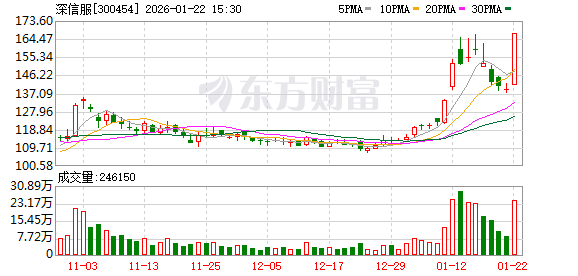
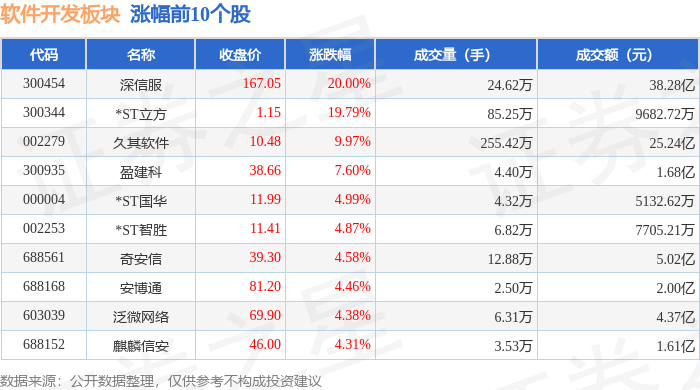
Market Performance - The software development sector increased by 1.04% on January 22, with Shenxinfu leading the gains [1] - The Shanghai Composite Index closed at 4122.58, up 0.14%, while the Shenzhen Component Index closed at 14327.05, up 0.5% [1] Top Gainers in Software Development Sector - Shenxinfu (300454) closed at 167.05, up 20.00% with a trading volume of 246,200 shares and a transaction value of 3.828 billion [1] - ST Lifang (300344) closed at 1.15, up 19.79% with a trading volume of 852,500 shares [1] - Jiuqi Software (002279) closed at 10.48, up 9.97% with a trading volume of 2,554,200 shares and a transaction value of 2.524 billion [1] - Other notable gainers include Lei Jianke (300935) up 7.60% and Qi Anxin (688561) up 4.58% [1] Market Capital Flow - The software development sector experienced a net outflow of 230 million from institutional investors, while retail investors saw a net inflow of 264 million [2] - Retail investors had a net outflow of 34.18 million [2] Individual Stock Capital Flow - Jiuqi Software (002279) had a net inflow of 301 million from institutional investors, while it faced a net outflow of 126 million from retail investors [3] - Shenxinfu (300454) saw a net inflow of 184 million from institutional investors but a net outflow of 45.1 million from retail investors [3] - Other stocks like Keda Guochuang (300520) and Wanxing Technology (300624) also showed significant net inflows from institutional investors [3]


龙虎榜丨深信服今日20cm涨停 2家机构专用席位净买入1.03亿元
Ge Long Hui A P P· 2026-01-22 08:47
格隆汇1月22日|深信服今日20cm涨停,成交额38.28亿元,换手率8.89%,盘后龙虎榜数据显示,深股 通专用席位买入3.63亿元并卖出5.09亿元,2家机构专用席位净买入1.03亿元,有2家机构专用席位净卖 出7603.88万元。 ...
深信服今日20cm涨停,2家机构专用席位净买入1.03亿元
Xin Lang Cai Jing· 2026-01-22 08:39
深信服今日20cm涨停,成交额38.28亿元,换手率8.89%,盘后龙虎榜数据显示,深股通专用席位买入 3.63亿元并卖出5.09亿元,2家机构专用席位净买入1.03亿元,有2家机构专用席位净卖出7603.88万元。 ...
GenAI系列报告之68:2026大模型幻觉能被抑制吗?
Shenwan Hongyuan Securities· 2026-01-22 08:27
Investment Rating - The report maintains a positive outlook on the industry, specifically highlighting the potential for effective control of AI model hallucinations by 2026 [2]. Core Insights - The report emphasizes that while hallucinations in AI models are inevitable, advancements in algorithms, data quality, and engineering practices can significantly reduce their occurrence. The top 25 global models have achieved a hallucination rate below 8% [5][6]. - The report identifies three key areas for investment: mature AI applications, marketing AI that is less sensitive to hallucinations, and data plus AI infrastructure [6]. Summary by Sections 1. Hallucinations - The Lower Bound of Model Capability - The report defines hallucinations as overconfident errors produced by language models, which can include fabrications, factual inaccuracies, contextual misunderstandings, and logical fallacies. For instance, GPT-3.5 had a hallucination rate of approximately 40%, while GPT-4's rate was 28.6% [14][15]. 2. Sources of Hallucinations - Hallucinations arise from several factors, including model architecture, toxic data, lack of accuracy in reward objectives, and context window limitations. Addressing these factors is crucial for controlling hallucinations [7][8]. 3. Reducing Hallucinations: From Models, Data, Engineering, and Agents - The report discusses various strategies to mitigate hallucinations, such as using larger training datasets, extending context windows, and incorporating human feedback through reinforcement learning (RLHF) [25][26]. - Engineering practices like Retrieval-Augmented Generation (RAG) are becoming standard, with Gartner predicting a 68% adoption rate by 2025 [56][57]. 4. 2B Application Penetration and Evolution - The report notes that the control of hallucinations in mainstream models has made significant progress, with the top 25 models in the Vectara HHEM ranking achieving hallucination rates below 8%. For example, the Finix model developed by Ant Group has a hallucination rate of only 1.8% [72].


黄仁勋驳斥“AI泡沫论”,低费率创业板人工智能ETF华夏(159381)午后拉升涨近3%,深信服涨停
Xin Lang Cai Jing· 2026-01-22 06:39
Group 1 - The AI industry is experiencing significant growth, with NVIDIA's CEO Jensen Huang stating that it is not a bubble but a transformative technology leading to massive infrastructure investments [1][1][1] - Huang mentioned that thousands of billions of dollars have already been invested in AI, with trillions more needed for infrastructure development [1][1][1] - The demand for GPU rental is increasing, with spot prices rising for both new and older models due to the influx of new AI companies and shifts in R&D budgets from major corporations [1][1][1] Group 2 - The low-fee AI ETF, Huaxia (159381), has seen a nearly 3% increase, indicating strong market interest in AI-related investments [1][1][1] - The ETF tracks an index with over 50% weight in CPO and includes domestic software and AI application companies, providing high elasticity [1][1][1] - The top three holdings of the ETF are Zhongji Xuchuang, Xinyi Sheng, and Tianfu Communication, with a low comprehensive fee rate of only 0.20% [1][1][1]