UMC(UMC)

Search documents
TrendForce集邦咨询:2Q25晶圆代工营收超417亿美元 季增14.6%创新高
智通财经网· 2025-09-01 06:36
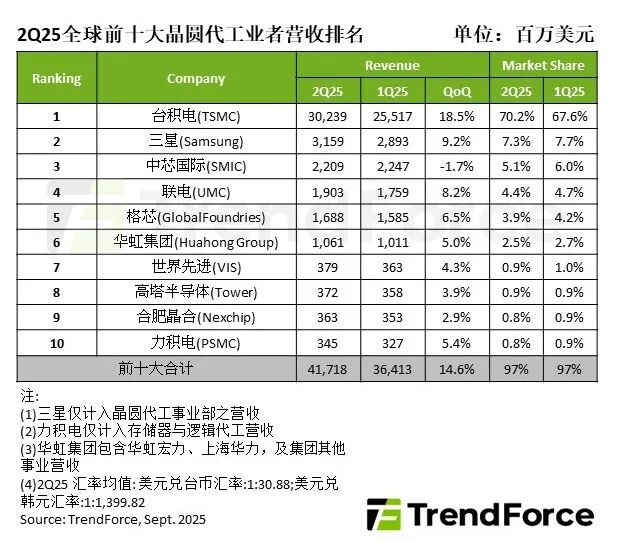
Core Viewpoint - The global top ten foundries are expected to see revenue exceed $41.7 billion in Q2 2025, marking a record high with a quarter-on-quarter increase of 14.6% driven by pre-stockpiling effects from consumer subsidies in China and new product launches in smartphones, laptops/PCs, and servers [1] Industry Summary - The overall wafer foundry capacity utilization and shipment volume are projected to strengthen in Q2 2025, supported by seasonal demand for new products and high-priced wafers [1] - The industry is expected to maintain a continuous quarter-on-quarter revenue increase due to improved capacity utilization [1] Company Performance Summary - **TSMC**: Revenue reached $30.24 billion in Q2 2025, a quarter-on-quarter increase of 18.5%, with a market share of 70.2%, solidifying its position as the market leader [5] - **Samsung**: Revenue was approximately $3.16 billion, up 9.2% quarter-on-quarter, with a market share of 7.3% [6] - **SMIC**: Revenue slightly decreased by 1.7% to around $2.21 billion, with a market share of 5.1% [7] - **UMC**: Revenue grew by 8.2% to $1.90 billion, with a market share of 4.4% [8] - **GlobalFoundries**: Revenue increased by 6.5% to nearly $1.69 billion, holding a market share of 3.9% [9] - **Huahong Group**: Revenue rose by approximately 5% to $1.06 billion, maintaining a market share of 2.5% [10] - **Vanguard**: Revenue was nearly $0.38 billion, up 4.3% quarter-on-quarter, ranking seventh [11] - **Tower**: Revenue increased by 3.9% to $0.37 billion, maintaining an eighth-place market share [12] - **Nexchip**: Revenue reached $0.36 billion, a quarter-on-quarter increase of nearly 3% [13] - **PSMC**: Revenue grew by 5.4% to $0.35 billion, ranking tenth [14]




半导体制造,到底怎么用水?
半导体芯闻· 2025-08-25 10:24
Core Viewpoint - The article emphasizes the complexity of water usage in semiconductor manufacturing, highlighting that while fabs consume millions of gallons of water daily, much of it is recycled and reused within the facility, with actual consumption primarily occurring through evaporation in cooling systems [2][3][29]. Water Usage in Semiconductor Fabs - Water is essential for advanced chip architecture, lithography, and backend packaging, serving multiple roles including cooling and waste transport [2]. - The average daily water usage in semiconductor fabs can reach millions of gallons, with cooling towers being the primary source of water loss due to evaporation [2][4]. - In hot and arid regions, evaporation plays a dominant role in water loss, while in cooler climates, the loss is significantly lower [2][4]. Water Management Strategies - Fabs are increasingly implementing smarter wastewater classification, reuse, and heat recovery technologies to reduce water demand [2][5]. - The water intake for a large fab can be equivalent to the water usage of a city with a population of one million, but most of this water is treated and reused within the facility [3][4]. - The water system in modern fabs consists of interconnected cycles, where raw or recycled water is treated to become ultra-pure water (UPW) for wafer processing [4][5]. Reuse and Recycling - Water undergoes multiple usage cycles within the fab, with ultra-pure water typically used only once, while other water types are collected for reuse in less sensitive applications [5][12]. - Companies like UMC have achieved high water recovery rates, with UMC reporting an overall process water recovery rate of 84.3% [12][13]. - The use of recycled water is prioritized, with UMC's Singapore facility using approximately 97.6% recycled water in 2024 [13]. Infrastructure and Planning - Municipal water suppliers must demonstrate their capacity to meet long-term water needs for industrial projects, as seen in Phoenix, Arizona [3][7]. - Effective water management requires long-term planning and infrastructure development to support semiconductor manufacturing [7][8]. Challenges and Innovations - The purity of water is a critical factor that limits reuse; maintaining high purity levels is essential for advanced manufacturing processes [9][10]. - Digital twin technology is being utilized to optimize water and chemical flows, allowing for real-time monitoring and predictive maintenance [16][17]. - The industry faces challenges in measuring persistent chemicals at trillionth-level concentrations, which complicates water management strategies [26][27]. Conclusion - The key issue is not the volume of water used by fabs, but rather how much is recycled and how much is truly consumed, with evaporation being a significant factor in water balance [29]. - Effective water management strategies, including classification, routing, and monitoring, are essential for sustainable semiconductor manufacturing [29].
茶饮出海趋势、算力需求拉动光伏消纳、两融重返两万亿关口
Tebon Securities· 2025-08-11 04:37
Market Overview - The A-share market has shown strong upward momentum, with the index successfully surpassing the 3600-point mark, and the margin financing balance returning to the 2 trillion yuan level for the first time since May 2015[3] - The current tea beverage industry is experiencing intensified competition, with a significant shift towards overseas markets, particularly the United States, indicating substantial growth potential[3] Industry Trends - In the energy and technology integration sector, AI data centers are paving new paths for centralized photovoltaic consumption, supported by continuous policy efforts to promote the synergy between computing power and electricity[3] - The semiconductor industry is entering a new cycle driven by strong AI demand, with high-end segments like silicon wafers and MLCCs seeing notable demand differentiation[3] Structural Changes - The analysis of the Fortune China 500 list from 2015 to 2025 reveals a shift in China's industrial structure, with high-tech industries like electronics and modern services like finance becoming new growth drivers, while traditional sectors like real estate face deep adjustments[6] - The number of companies in the real estate sector has decreased from 45 to 29 over the past decade, reflecting significant industry contraction due to regulatory changes and market dynamics[7] Consumer Insights - The domestic tea beverage market has seen a slowdown in expansion, with the total number of stores increasing by only 0.74% in the first half of 2025, indicating a shift towards quality competition[23] - Major tea brands are increasingly looking to expand internationally, particularly in the U.S. market, which is projected to grow at a CAGR of 9.1% from 2019 to 2024, with significant potential for new store openings[26] High-End Manufacturing - The "East Data West Calculation" project is expected to enhance the coupling effect between photovoltaic power consumption and computing power industry development, with an estimated average annual energy consumption increase of approximately 9.8 GW for data centers over the next three years[34] - Global semiconductor sales reached $59.9 billion in June 2025, marking a year-on-year increase of 19.6%, driven primarily by business-to-business AI demand rather than consumer electronics[3]

成熟制程,风险大增
半导体行业观察· 2025-08-01 01:12
Core Viewpoint - The article discusses the potential impact of the U.S. imposing high tariffs on semiconductor imports from Taiwan, particularly on mature process chips, which could lead to significant adjustments in Taiwan's semiconductor industry and supply chain dynamics [2][3]. Group 1: Tariff Implications - The U.S. is expected to announce results of a national security investigation regarding semiconductor imports, with potential tariffs on mature process chips from Taiwan reaching up to 20% [2]. - Taiwan's semiconductor industry, heavily reliant on exports to the U.S., faces heightened uncertainty due to these potential tariffs, which could disrupt existing supply chains [2][3]. - The article suggests that while the tariffs may not completely destabilize the semiconductor sector, they will likely prompt strategic adjustments, including increased overseas investments and manufacturing [3]. Group 2: Market Conditions - The semiconductor industry is experiencing a downturn, with major IC design firms significantly reducing wafer production for mature processes by 20% to 30% in Q3 compared to Q2, due to various negative factors including weak demand in mobile, networking, and automotive sectors [5][6][7]. - The automotive market is particularly struggling, impacting demand for mature process chips, with major companies like NXP and STMicroelectronics warning of poor market conditions [7]. - The capacity utilization rates for wafer foundries are expected to decline from around 70% in the first half of the year to approximately 60% or lower in the second half, which will adversely affect profit margins [7]. Group 3: Company Strategies - Companies like UMC are investing in R&D to focus on advanced technologies for 5G, AI, IoT, and automotive electronics, with UMC having invested NT$15.6 billion in R&D last year [9]. - UMC is exploring potential collaborations with Intel to enhance process technologies, while World Advanced is focusing on its 8-inch production and plans to build a 12-inch fab in Singapore with a total investment of $7.8 billion [10]. - Powerchip is targeting AI applications and has begun mass production of silicon interposers, contributing to revenue generation [11].
美股异动|联电盘前跌近2% Q2盈利同比下滑36%低于预期
Ge Long Hui· 2025-07-31 08:48
Core Viewpoint - UMC reported a 3.5% year-on-year revenue increase in Q2, reaching NT$58.76 billion, exceeding analyst expectations of NT$57.26 billion. However, the earnings per ADS fell by 36% to NT$3.55, below the expected NT$4.13 [1] Financial Performance - Q2 revenue increased by 3.5% year-on-year to NT$58.76 billion [1] - Earnings per ADS decreased by 36% to NT$3.55, missing analyst expectations [1] Future Outlook - UMC anticipates low single-digit growth in wafer shipments for Q3 [1] - The company expects stable dollar pricing and a capacity utilization rate to remain in the mid-70% range [1]
联电第二季度营收587.6亿元新台币
Xin Lang Cai Jing· 2025-07-30 14:39
联电7月30日公布2025年第二季度财报显示,合并营收587.6亿元新台币,净利润89亿元新台币,每股收 益0.71元新台币。 来源:智通财经 ...
联电(UMC.US)Q2营收同比增14.9%但不及预期 22/28nm制程占比40%创新高
智通财经网· 2025-07-30 11:51
Core Viewpoint - UMC's Q2 financial results showed a revenue of $2.01 billion, a 14.9% year-over-year increase, but fell short of market expectations [1] - The company's earnings per American Depositary Share (EPADS) was $0.12, significantly below the expected $0.89 [1] - UMC's net profit attributable to shareholders was approximately NT$8.9 billion (around $304 million) [1] Financial Performance - UMC maintained a gross margin of 28.7% and an operating margin of 18.4%, indicating strong cost control [1] - The revenue contribution from the 22/28nm process reached a record high of 40% [1] - Wafer shipments increased by 6.2% quarter-over-quarter, with capacity utilization rising from 69% to 76% [1] Industry Positioning - UMC focuses on a differentiated strategy in the mature process technology, particularly the 22/28nm nodes, which are seen as key for long-term competitiveness [2] - The company is solidifying its market share in mature processes through specialized applications like OLED driver ICs and RF chips [2] Market Challenges - UMC's management highlighted two main risks: currency fluctuations, particularly the appreciation of the New Taiwan Dollar, which could compress revenue margins [3] - The uncertainty in the supply chain due to U.S. tariff adjustments is prompting UMC to negotiate with clients for production relocation and to expedite the establishment of a new facility in Singapore [3] Future Outlook - For Q3, UMC expects low single-digit growth in wafer shipments, stable dollar pricing, and a capacity utilization rate around 70% [4] - The company plans to invest $1.8 billion in capital expenditures in 2025, focusing on expanding the Singapore facility and developing 12nm technology in collaboration with Intel [4] - The new Singapore facility is expected to begin production in early 2026, enhancing supply chain resilience and meeting diverse geographic customer needs [4] Summary - UMC's Q2 results reflect solid competitiveness in mature processes, with a 40% revenue share from the 22/28nm segment [5] - The semiconductor industry is recovering due to demand from AI and automotive electronics, but geopolitical issues and reliance on high-end equipment remain challenges [5] - UMC's stock price fell by 1.54% to $7.01 following the disappointing Q2 financial performance [5]
UMC(UMC) - 2025 Q2 - Earnings Call Transcript
2025-07-30 10:02
Financial Data and Key Metrics Changes - In Q2 2025, consolidated revenue was NT$ 8.9 billion with a gross margin of approximately 28.7% [7] - Net income attributable to shareholders was NT$ 8.9 billion, with earnings per share (EPS) of NT$ 0.71, up from NT$ 0.62 in the previous quarter [10] - Utilization rate increased from 59% in Q1 to 76% in Q2, contributing to a 1.6% sequential revenue increase [8][14] - For the first half of 2025, revenue increased by 4.7% year-over-year, while gross margin decreased from 33.1% in the same period of 2024 to 27.7% [10] Business Line Data and Key Metrics Changes - Revenue from the 22 and 28 nanometer portfolio accounted for 40% of total sales, marking a record high [15] - Consumer application revenue decreased to 33%, while communication application revenue increased to 41% [11] - The revenue contribution from below 40 nanometer technology represented more than half of total revenue, reaching 55% in Q2 [12] Market Data and Key Metrics Changes - Revenue from Europe increased to 8%, while Asia accounted for approximately 67% of total revenue [11] - The company observed a sound demand upside in Q2, partly driven by inventory buildup in anticipation of potential U.S. tariffs [28] Company Strategy and Development Direction - UMC aims to enhance supply chain resilience through the new Phase III facility at the Singapore Fab12i, set to start production in 2026 [15] - The company is focused on maintaining and improving ASP resilience through technology differentiation and product mix [20][21] - UMC plans to actively manage foreign exchange exposure and maintain financial flexibility to navigate macroeconomic uncertainties [16] Management's Comments on Operating Environment and Future Outlook - Management noted that adverse foreign exchange movements could lead to a decline in NT dollar revenue, with a 5% appreciation in the NT dollar resulting in a corresponding 5% reduction in reported revenue [16] - The semiconductor industry is experiencing lower visibility, with expectations for growth in 2025 remaining unchanged despite macroeconomic uncertainties [34][36] - Management expressed confidence in the continued growth of the 22 and 28 nanometer business, supported by strong demand and differentiated technology [57] Other Important Information - The cash-based capital expenditure (CapEx) budget for 2025 remains unchanged at US$ 1.8 billion [12][17] - The company is closely monitoring the inventory situation, which is currently healthy, particularly in the automotive and industrial segments [51] Q&A Session Summary Question: What is the initial outlook on the ASP trend in 2026? - Management stated that they do not provide guidance beyond 2025 but aim to maintain ASP resilience through technology differentiation and product mix [20] Question: How is the tariff impacting customer behavior? - Management observed an inventory buildup in anticipation of potential U.S. tariffs, affecting demand in Q2 and Q3 [28] Question: What is the current pace of ramp-up for the Singapore fab? - The ramp-up for the Singapore facility is projected to start in January 2026, focusing on communication applications [42] Question: What is the outlook for gross margins? - Management aims to improve gross margins back to reasonable levels through technology development and improved product mix [46][48] Question: How is the pricing behavior in the communications segment? - Pricing remains a topic of discussion, influenced by capacity availability, with current pricing behavior being subject to market conditions [82] Question: What is the status of the Intel partnership? - The collaboration with Intel is progressing well, with milestones on track for the 12 nanometer program [61]
UMC(UMC) - 2025 Q2 - Earnings Call Transcript
2025-07-30 10:00
Financial Data and Key Metrics Changes - In Q2 2025, consolidated revenue was NT$ 8.9 billion with a gross margin of approximately 28.7% [6][8] - Net income attributable to shareholders was NT$ 8.9 billion, with earnings per share (EPS) of NT$ 0.71, up from NT$ 0.62 in the previous quarter [8][12] - Utilization rate increased from 59% in Q1 to 76% in Q2, contributing to a 1.6% sequential revenue increase [7][12] - For the first half of 2025, revenue increased by 4.7% year-over-year, while gross margin decreased from 33.1% in the same period of 2024 to 27.7% [8][9] Business Line Data and Key Metrics Changes - Revenue from the 22 and 28 nanometer portfolio accounted for 40% of total sales, marking a record high [12][13] - The consumer segment's revenue contribution decreased to 33%, while the communication segment increased to 41% [9][10] - The revenue from below 40 nanometer technology represented more than half of total revenue, reaching 55% in Q2 [10] Market Data and Key Metrics Changes - Revenue breakdown showed Europe at 8%, Asia at 67%, and ICM at 19%, with slight changes from the previous quarter [9] - The company noted a healthy demand in the automotive and industrial segments, while consumer and communication segments remained stable [35][36] Company Strategy and Development Direction - The company plans to enhance supply chain resilience through the new Phase III facility in Singapore, set to start production in 2026 [13][14] - UMC aims to maintain and improve ASP resilience by differentiating technology offerings and increasing revenue contributions from advanced nodes [20][21] - The focus remains on specialty technology solutions, particularly in high voltage and low power applications, to reduce competition with Chinese foundries [70][71] Management's Comments on Operating Environment and Future Outlook - Management expressed caution regarding the impact of U.S. tariff policies and geopolitical uncertainties on demand [14][29] - The company anticipates a mild increase in wafer shipments for Q3, but expects NT dollar revenue to decline due to adverse foreign exchange movements [15][16] - The overall growth outlook for 2025 remains unchanged, with expectations to outgrow the addressable market [54][55] Other Important Information - The cash-based capital expenditure budget for 2025 remains unchanged at US$ 1.8 billion [10][17] - The company is closely monitoring foreign exchange exposure and maintaining financial flexibility to enhance resilience [14][15] Q&A Session Summary Question: ASP trend outlook for 2026 - Management does not provide guidance beyond 2025 but aims to maintain ASP resilience through technology differentiation and product mix [20][21] Question: Tariff impacts on customer behavior - There is observed demand upside in Q2 and Q3, partly driven by inventory buildup in anticipation of potential U.S. tariffs [28][29] Question: Advanced packaging technology development - UMC is preparing advanced packaging solutions to address energy consumption needs in cloud AI and edge AI markets [31][32] Question: Gross margin recovery pathway - Management aims to improve gross margins through technology development and improved product mix, with a realistic goal to return to mid-30s gross margins [45][48] Question: Utilization rates in China - The China facility is running at full capacity, above corporate average, with no pricing differentiation between locations [94]
随便聊聊 | 我为什么坚定看好未来半导体市场发展趋势
傅里叶的猫· 2025-07-30 09:28
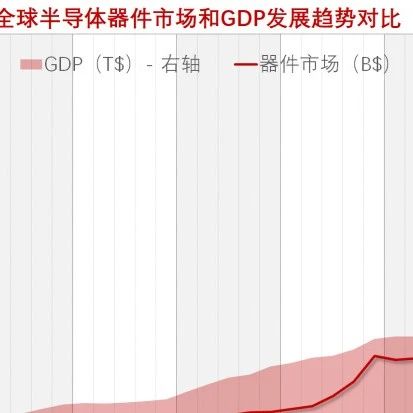
Core Viewpoint - The semiconductor industry has experienced significant growth, with global semiconductor device sales projected to reach $617.9 billion by 2024, a 162-fold increase since 1977, outpacing global GDP growth [1][3]. Summary by Sections Industry Phases - Phase 1 (1977-1994): The semiconductor industry experienced explosive growth as it filled market demand gaps [5]. - Phase 2 (1995-2009): The market reached saturation, with semiconductor sales growth aligning closely with GDP growth, stabilizing around 0.45% of GDP [5]. - Phase 3 (2010 onwards): The emergence of smartphones and mobile internet led to renewed growth, with an average annual growth rate of approximately 6% [6]. Characteristics Driving Growth - The semiconductor industry serves as the foundation for the information sector, with increasing data generation driving demand for chips [6]. - The existence of Moore's Law ensures continuous performance improvements in chips, fostering rapid technological advancements that benefit the entire semiconductor supply chain [6]. Current Market Dynamics - The semiconductor industry is currently in a phase driven by artificial intelligence (AI), marking the beginning of a fourth growth stage [10]. - The demand for high-performance computing chips has surged due to AI advancements, leading to increased average prices despite stable wafer output [10][14]. Future Outlook - The AI sector is expected to provide long-term growth opportunities for the semiconductor industry, similar to the mobile communications boom [14]. - The anticipated explosion in data generation from AI applications will significantly increase the demand for various types of chips [16].