宁波银行

Search documents
部分银行上调存款利率
第一财经· 2025-12-05 11:47
Core Viewpoint - Recent adjustments in deposit interest rates by banks such as Hangzhou Bank indicate a strategic move to attract deposits, despite an overall trend of declining rates in the banking sector [1]. Group 1: Deposit Rate Adjustments - Hangzhou Bank has raised its deposit rates, with new funds for a 3-year term set at 1.9% for amounts starting from 200,000 yuan, while non-new funds for the same term are at 1.8% [1]. - For smaller deposits, the 3-year term rate is 1.75% for amounts starting from 50,000 yuan, with rates decreasing to 1.6% for 2-year terms and 1.5% for 1-year terms [1]. - Similar rate increases have been observed at Ningbo Bank and Shengjing Bank, suggesting a broader trend among certain banks to adjust rates [1]. Group 2: Industry Trends - The increase in deposit rates by some banks is viewed as a temporary measure aimed at boosting deposit inflows [1]. - Despite these isolated increases, the general trend in the banking industry remains towards lower deposit rates overall [1].




12月5日金融指数(399240)涨2.22%,成份股瑞达期货(002961)领涨
Sou Hu Cai Jing· 2025-12-05 10:24
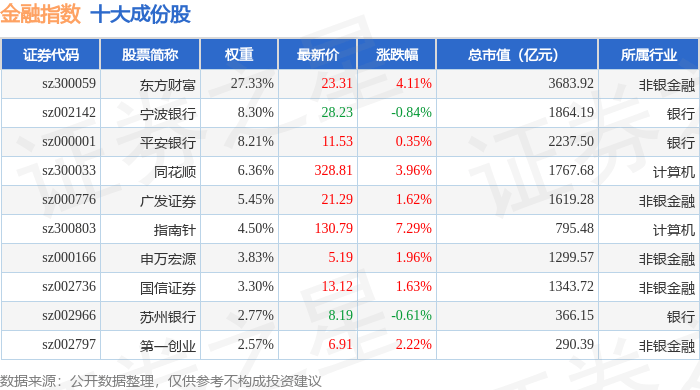
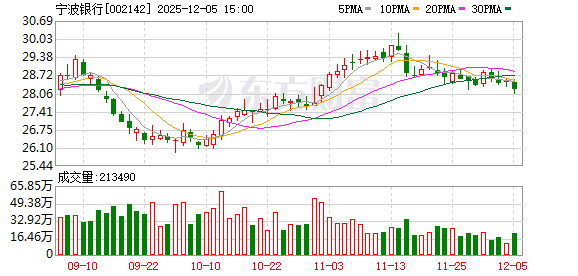
Core Insights - The financial index (399240) closed at 1590.59 points, up 2.22%, with a trading volume of 38.556 billion yuan and a turnover rate of 1.29% [1] - Among the index constituents, 27 stocks rose, led by Ruida Futures with a 10.01% increase, while 6 stocks fell, with Qingdao Bank leading the decline at 2.06% [1] Financial Index Performance - The top ten constituents of the financial index include: - Dongfang Fortune: 27.33% weight, latest price 23.31, up 4.11%, market cap 368.392 billion yuan [1] - Ningbo Bank: 8.30% weight, latest price 28.23, down 0.84%, market cap 186.419 billion yuan [1] - Ping An Bank: 8.21% weight, latest price 11.53, up 0.35%, market cap 223.750 billion yuan [1] - Tonghuashun: 6.36% weight, latest price 328.81, up 3.96%, market cap 176.768 billion yuan [1] - Guotai Junan: 5.45% weight, latest price 21.29, up 1.62%, market cap 161.928 billion yuan [1] - Zhinanzhen: 4.50% weight, latest price 130.79, up 7.29%, market cap 79.548 billion yuan [1] - Shenwan Hongyuan: 3.83% weight, latest price 5.19, up 1.96%, market cap 129.957 billion yuan [1] - Guosen Securities: 3.30% weight, latest price 13.12, up 1.63%, market cap 134.372 billion yuan [1] - Suzhou Bank: 2.77% weight, latest price 8.19, down 0.61%, market cap 36.615 billion yuan [1] - First Venture: 2.57% weight, latest price 6.91, up 2.22%, market cap 29.039 billion yuan [1] Capital Flow Analysis - The net inflow of main funds into the financial index constituents totaled 2.177 billion yuan, while retail funds saw a net outflow of 1.563 billion yuan [3] - Detailed capital flow for key stocks includes: - Dongfang Fortune: 532 million yuan net inflow from main funds, 125 million yuan net outflow from retail [3] - Zhinanzhen: 532 million yuan net inflow from main funds, 392 million yuan net outflow from retail [3] - Guotai Junan: 132 million yuan net inflow from main funds, 868.578 million yuan net outflow from retail [3] - Other notable stocks include Tonghuashun and Ruida Futures, with varying net inflows and outflows [3]




国信证券:货币政策相机抉择 净息差下降尾声
智通财经网· 2025-12-05 08:53
Core Viewpoint - The report from Guosen Securities indicates that the decline in net interest margin (NIM) is expected to significantly slow down by 2026, suggesting that the current downtrend cycle for NIM may be nearing its end, contrasting sharply with the previous two years of uncertainty in the industry [1]. Group 1: Net Interest Margin Analysis - The current bottom line for major banks' NIM is estimated to be around 1.2% to 1.3%, indicating that it is close to the lower limit [2]. - The necessity of maintaining a reasonable NIM is emphasized as a condition for sustaining economic growth and financial stability, considering factors like capital balance and risk pricing mechanisms [2]. - A model predicts that if the Loan Prime Rate (LPR) decreases by 10 basis points (bps) while deposit rates remain unchanged, the NIM is expected to decline by approximately 5 to 8 bps year-on-year in 2026 [3]. Group 2: Monetary Policy Outlook - The monetary policy for 2026 is projected to be "reasonably ample and responsive," with an anticipated LPR decrease of about 10 bps and a reserve requirement ratio (RRR) cut of 50 bps [4]. - The report suggests that the People's Bank of China (PBOC) will likely maintain stability in monetary policy, with a cautious approach to interest rate cuts, unless economic recovery is hindered [4]. - A projected M2 growth rate of 7.0% to 8.0% indicates a basic currency gap of approximately 2.7 to 3.0 trillion yuan for 2026, with measures such as a 0.5% RRR cut expected to release around 1 trillion yuan [4]. Group 3: Investment Recommendations - The report recommends focusing on quality stocks with improving NIM and attractive dividend yields, specifically highlighting Ningbo Bank and Changshu Bank, while also suggesting attention to Changsha Bank and Chongqing Rural Commercial Bank for potential excess returns [4]. - Major banks such as China Merchants Bank, Industrial and Commercial Bank of China, and Jiangsu Bank are also recommended for investment [4].

员工持股计划落地!6200亿公募新增三大股东
证券时报· 2025-12-05 08:24
Core Viewpoint - Yongying Fund has implemented an employee stock ownership plan, becoming the first fund company to do so following the release of the "Action Plan for Promoting High-Quality Development of Public Funds" by the CSRC [2][6]. Summary by Sections Shareholder Structure - Yongying Fund has added three limited partnership enterprises as shareholders, collectively holding 3.51% of the equity, transferred from Oversea-Chinese Banking Corporation Limited (OCBC) [2][4]. - After the equity change, Ningbo Bank's shareholding remains at 71.49%, maintaining its position as the largest shareholder, while OCBC's stake adjusts to 25% [6]. Employee Stock Ownership Plan - The equity change supports the employee stock ownership plan, involving approximately 100 personnel and covering a broad range of employees [2][6]. - This initiative aligns with the CSRC's "Action Plan," which encourages fund companies to implement long-term incentive measures like employee stock ownership to enhance team stability [6]. Fund Management Scale and Growth - Yongying Fund, established in 2013, has seen rapid growth in its management scale, exceeding 620 billion CNY as of the end of Q3 this year, with nearly 430 billion CNY in non-monetary assets, an increase of approximately 78 billion CNY since the beginning of the year [7][8]. - The fund's active equity product scale reached 93.464 billion CNY, with a year-to-date increase of 76.6 billion CNY, leading the market in growth [8]. - Yongying Fund aims to build a platform-based asset management company with capabilities in diversified asset allocation, supported by a balanced product structure of nearly 180 fund products [8].

鑫宏业:为子公司江苏华光提供不超过3000万元连带责任保证
Zheng Quan Ri Bao· 2025-12-05 07:15
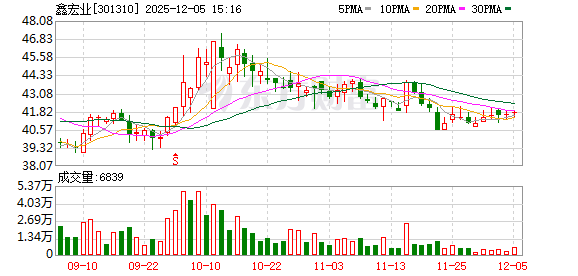
Core Viewpoint - Xin Hongye announced the signing of a maximum guarantee contract with China Everbright Bank and Ningbo Bank, providing a total principal limit of up to RMB 30 million for its wholly-owned subsidiary Jiangsu Huaguang's debts [2] Group 1 - The total amount of guarantees provided by the company and its subsidiaries is RMB 130 million, which accounts for 5.70% of the company's most recent audited net assets [2]
解锁绿色金融“新玩法”!宁波银行为企业低碳转型输血又赋能
2 1 Shi Ji Jing Ji Bao Dao· 2025-12-05 07:00
Core Viewpoint - Green finance is a core financial force to achieve the "dual carbon" goals and promote high-quality economic and social development, serving as a key path for commercial banks to fulfill social responsibilities and achieve sustainable transformation [2] Group 1: Institutional Development - Ningbo Bank has elevated green finance to a strategic level, continuously improving institutional construction and policy support [3] - In 2024, Ningbo Bank has established the "Ningbo Bank Green Finance Management Measures" and the "Green Finance Medium and Long-term Development Plan (2024-2028)" to enhance refined management and clarify short-term and long-term goals [3] - The short-term goal is to ensure that the annual growth rate of green loans is not less than the overall loan growth rate, while the long-term goal is to achieve a 100% increase in green loan balance by the end of 2028 compared to 2023 [3] Group 2: Product Innovation - The diversity of green projects leads to differentiated financing needs, prompting banks to innovate products to provide customized solutions for various types and stages of enterprises [5] - For long-term projects in renewable energy and environmental protection, Ningbo Bank offers green medium- and long-term loans and green bond underwriting to match the full life cycle funding needs of projects [6] - The bank has introduced innovative green credit loans and green supply chain financing for small and micro enterprises, lowering entry barriers through environmental credit ratings and backing from core enterprises [6] Group 3: Technological Empowerment - Ningbo Bank utilizes digital technology as a core support for green financial services, launching the "Bobo Zhiliao" digital service platform for comprehensive carbon management [8] - The platform helps enterprises manage carbon tariffs and provides real-time energy efficiency monitoring, significantly reducing costs and improving operational efficiency [8][9] - The bank's initiatives have already helped nearly a hundred enterprises in Jiaxing with carbon tariff declarations and energy services, saving over ten million yuan [8] Group 4: Regional Development - Ningbo Bank's branches innovate diverse green financial products and service models based on regional industrial characteristics, forming a service pattern of "one place, one feature, one enterprise, one policy" [6] - The Wenzhou branch has developed a "4+N" green financial product system, including unique offerings like pollution rights mortgage loans and green low-carbon loans [6] - The Jinhua branch focuses on renewable energy and has established differentiated green credit models, providing priority approval and funding channels for green projects [6][7]
员工持股计划落地,6200亿公募新增三大股东
Zheng Quan Shi Bao· 2025-12-05 06:37
据悉,此次股权变更用于支持员工持股计划。股权变更完成后,宁波银行持股比例维持71.49%不变, 仍为永赢基金第一大股东;新加坡华侨银行持股比例调整为25%,继续作为公司主要股东。一体化的股 东结构,或让永赢基金推进持股计划更高效与顺畅。 永赢基金员工持股计划落地! 近日,公开信息显示,永赢基金新增3家有限合伙企业为股东,合计持有股权3.51%,其股权系由股东 Oversea-Chinese Banking Corporation Limited(新加坡华侨银行)转让。股权变更完成后,宁波银行持股 比例维持71.49%不变,仍为永赢基金第一大股东;新加坡华侨银行持股比例调整为25%,继续作为公司 主要股东。 据悉,此次股权变更用于支持员工持股计划,涉及人员约百人,覆盖较为广泛。 值得一提的是,这是自《推动公募基金高质量发展行动方案》发布后,首家实施员工持股计划的基金公 司。2025年5月7日证监会发布的《推动公募基金高质量发展行动方案》中明确,支持基金公司依法实施 员工持股等长效激励措施,提升核心团队稳定性。 永赢基金员工持股计划落地 公开信息显示,永赢基金新增三家有限合伙企业为股东,分别为上海稳进同赢企业管理 ...
员工持股计划落地!6200亿公募新增三大股东
券商中国· 2025-12-05 04:03
Core Viewpoint - Yongying Fund has implemented an employee stock ownership plan (ESOP), becoming the first fund company to do so following the release of the "Action Plan for Promoting the High-Quality Development of Public Funds" by the CSRC in May 2025 [4][5]. Group 1: Shareholding Structure - Yongying Fund has added three limited partnership enterprises as shareholders, collectively holding 3.51% of the equity, which was transferred from Oversea-Chinese Banking Corporation Limited (OCBC) [1][2]. - After the shareholding change, Ningbo Bank maintains a 71.49% stake, remaining the largest shareholder, while OCBC's stake adjusts to 25% [3][6]. Group 2: Employee Stock Ownership Plan - The shareholding change is aimed at supporting the employee stock ownership plan, involving approximately 100 personnel and covering a broad range [1][5]. - The implementation of the ESOP is expected to enhance the stability of the core team and promote the long-term healthy development of the company [5]. Group 3: Company Growth and Strategy - As of the end of Q3 this year, Yongying Fund's asset scale exceeds 620 billion CNY, with nearly 430 billion CNY in non-monetary assets, marking an increase of nearly 78 billion CNY since the beginning of the year [6]. - The company has seen significant growth in its active equity products, with a scale of 93.464 billion CNY, an increase of 76.6 billion CNY this year, leading the market in growth [6]. - Yongying Fund aims to build a platform-type asset management company with capabilities in diversified asset allocation, supported by a balanced product structure of nearly 180 funds [6].

银行业 2026 年经营展望:价格篇:货币政策相机抉择,净息差下降尾声
Guoxin Securities· 2025-12-05 03:11
Investment Rating - The report maintains an "Outperform" rating for the banking industry [5][6]. Core Insights - The banking industry's net interest margin (NIM) is expected to reach its bottom level around 1.2% to 1.3%, indicating a potential end to the current downtrend in NIM [1][42]. - The report predicts a decline in the Loan Prime Rate (LPR) by approximately 10 basis points (bps) in 2026, which will likely lead to a year-on-year decrease in NIM of about 5 to 8 bps [2][3]. - The monetary policy for 2026 is characterized as "reasonable and ample" with a focus on precise adjustments, aiming to balance economic growth and financial stability [3][67]. Summary by Sections Investment Recommendations - Focus on high-quality stocks that are expected to see an inflection point in NIM, such as Ningbo Bank and Changshu Bank, while also considering stocks with attractive dividend yields like China Merchants Bank and Industrial and Commercial Bank of China [4][5]. NIM Analysis - The report estimates that the NIM for 2026 will narrow by approximately 2 to 5 bps, marking the likely end of the current downtrend cycle [66]. - The projected decline in loan rates is about 24 bps, which will negatively impact NIM by approximately 15 bps, while deposit rates are expected to decrease by 14 to 17 bps, providing a positive impact on NIM of about 10 to 13 bps [66][60]. Monetary Policy Outlook - The monetary policy framework for 2026 emphasizes a balanced approach, with the LPR expected to decrease by 10 bps, contingent on economic conditions [3][68]. - The report highlights that maintaining stability in NIM and deposit rates will be a key objective for the People's Bank of China in 2026 [71][72].



大佬说了什么
投资界· 2025-12-05 02:34
Core Insights - The 25th China Venture Capital & Private Equity Annual Forum highlighted the recovery of the secondary market, with the value of newly invested Chinese companies' IPO shares held by VC/PE institutions exceeding 410 billion yuan, marking a three-year high [6] - The forum emphasized the importance of inclusivity in the private equity market to drive innovation, aligning with the central government's strategy to enhance the attractiveness and inclusivity of domestic capital markets [9] - There is a strong belief in maintaining a steady investment pace in early-stage ventures, as innovation opportunities are more influenced by industry development trends than by the current investment environment [14] Investment Trends - The AI, energy, and biomedicine sectors are viewed as promising areas for future investment [30] - The upcoming year is expected to see a surge in mergers and acquisitions, supported by new financial policies and increased bank lending for such activities [36] - There is a recognition that the current valuation discrepancies in the IPO market could create a false perception of company values, particularly in the Hong Kong market [27] Market Dynamics - The current low debt levels of listed companies in China present a favorable environment for mergers and acquisitions, indicating strong demand for such activities [47] - The forum discussed the cyclical nature of financial bubbles, suggesting that past technological revolutions have often been preceded by periods of speculative excess [39] - The importance of maintaining reasonable valuations and strong cash flow to support leverage and dividends was highlighted as critical for controlling risks in merger investments [45] Future Outlook - The next five years are deemed crucial for companies like Kingdee, which aims to significantly increase revenue from AI, focusing on large-scale acquisitions of overseas AI startups [52] - The rapid development of generative AI is expected to accelerate application growth in the coming year, despite current slower-than-expected adoption rates [78] - The competition in the AI field is characterized as a race between Chinese and overseas talents, with ongoing learning and adaptation between the two [75]