
中信建投证券

Search documents
投资于人、改善收入分配……多位专家献策“扩内需”
Sou Hu Cai Jing· 2025-12-21 06:12
Group 1 - The central economic work conference emphasized "domestic demand as the main driver" as the top priority for next year's economic tasks [1] - Experts predict that there will be a significant enhancement in demand next year, with expectations for a more balanced economic structure and improved growth quality over the next five years [1] - The chief economist from CITIC Securities highlighted that the transition from "investment in goods" to "investment in people" is crucial for future policies, suggesting a shift in subsidies from durable goods to services [4] Group 2 - The chief economist from Zhongxin JianTou Securities noted that China's per capita GDP is expected to reach $14,000 by the end of this year, indicating a shift from goods consumption to service consumption [4] - Improving income distribution is identified as key to breaking consumption constraints, with recommendations for enhancing human capital and optimizing educational resources [4] - Morgan Stanley's chief economist in China suggested gradually increasing social security subsidies for farmers and migrant workers from 220 yuan to 1,000 yuan to encourage consumption among low-income groups [5]


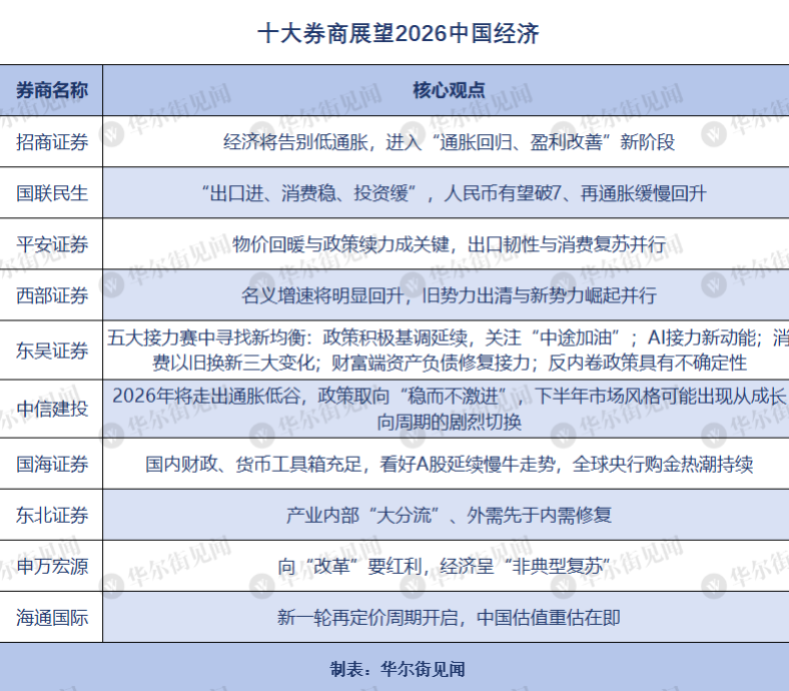
告别低通胀、AI接力新需求叙事,改革红利提振消费率......十大券商一文展望2026中国经济
Hua Er Jie Jian Wen· 2025-12-21 01:13
Core Viewpoint - The year 2026 is projected to be a turning point for China's economy, moving away from low inflation and establishing a "new equilibrium" as per the consensus among major securities firms [1]. Group 1: Macroeconomic Growth and Price Recovery - Major securities firms, including China Merchants, Ping An, and West Securities, agree that the Chinese economy will emerge from the low inflation phase, with expectations of nominal GDP growth recovery driven by price factor improvements [1][5]. - The "anti-involution" policy is expected to limit supply, combined with the pig cycle bottoming out and PPI turning positive, which will be key in improving corporate profitability and nominal GDP [1][5][6]. Group 2: Structural Transition and New Growth Drivers - 2026 is seen as a critical juncture for the transition between old and new growth drivers, with real estate investment entering a bottoming phase while AI, data center energy demand, and high-end manufacturing are expected to become substantial growth engines [1][5][21]. - The consensus is that the economy will experience a "new-old relay" with significant changes in investment structures, particularly in manufacturing and real estate [1][21]. Group 3: Demand-Side Drivers - There is a divergence in views regarding demand-side drivers; some firms like Minsheng and Northeast Securities believe external demand will outperform internal demand, while others like West Securities and Shenwan Hongyuan predict a shift towards internal demand dominance [1][5][21]. Group 4: Asset Allocation and Market Style Predictions - Opinions on asset allocation and market style are highly varied, with Haitong International being the most optimistic, predicting a 40% increase in the Shanghai Composite Index based on "value re-evaluation" logic [2][50]. - China Merchants Securities anticipates a shift from "policy-driven" to "profit-driven" market dynamics, while others suggest a more balanced focus on both growth and cyclical opportunities [2][21]. Group 5: Key Predictions from Securities Firms - China Merchants Securities predicts a recovery in corporate profits and a shift in policy focus towards enhancing development quality, with manufacturing investment expected to grow by 5% and real estate investment's decline narrowing to -8% [5][10]. - Ping An Securities emphasizes the importance of price recovery, forecasting CPI to rise to 0.6% and PPI to narrow its decline significantly [16][18]. - West Securities expects nominal GDP growth to accelerate, driven by inflation recovery and the emergence of new growth forces [21][23]. Group 6: External Environment and Trade Dynamics - The external environment is expected to improve, with strong export performance contributing significantly to GDP growth, projected to be around 40%-50% from actual export growth [11][44]. - The report from Northeast Securities highlights that external demand will recover before internal demand, with exports expected to grow by approximately 7% [44][45].





一签赚40万,A股最赚钱新股背后赢家曝光
2 1 Shi Ji Jing Ji Bao Dao· 2025-12-20 13:55
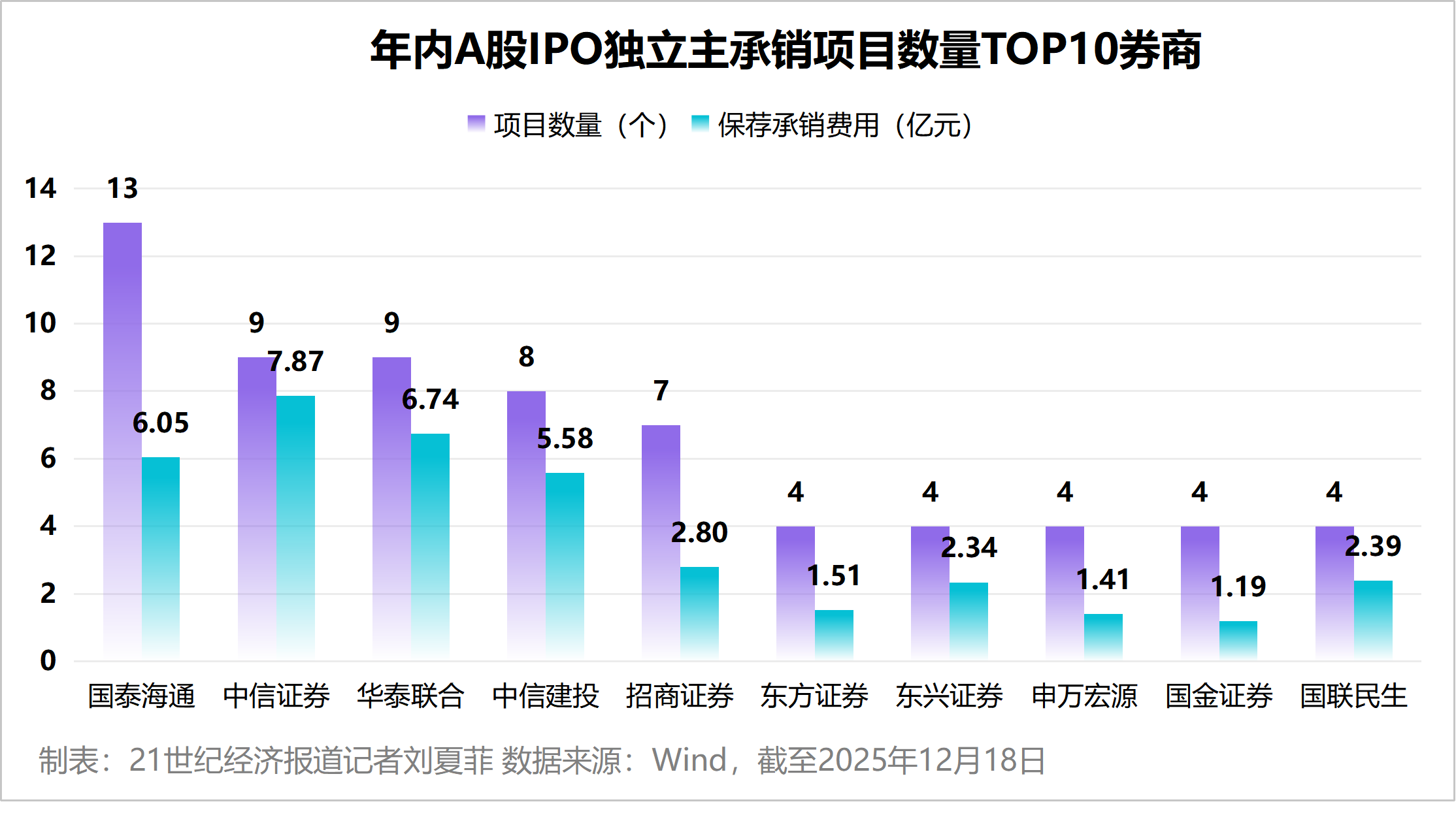
Core Insights - The recent IPOs of Muxi Co. and Moer Thread have set new records for the highest floating profits in the A-share market, with Muxi Co. achieving a maximum floating profit of approximately 395,200 yuan per share on its first trading day [1][6][7]. Group 1: IPO Performance - Muxi Co. and Moer Thread have been the most discussed companies in December, with their IPOs creating significant wealth for investors [5]. - Muxi Co. generated a floating profit of 395,200 yuan per share, while Moer Thread achieved a floating profit of 286,900 yuan per share on their respective first trading days [6][7]. Group 2: Underwriter Earnings - Huatai United Securities, the underwriter for Muxi Co., is expected to earn 268 million yuan in underwriting fees and over 652 million yuan in investment floating profits [2][7]. - CITIC Securities, the underwriter for Moer Thread, anticipates earning over 100 million yuan in underwriting fees and more than 828 million yuan in investment floating profits [9]. Group 3: Overall Market Trends - The A-share IPO market has seen a recovery, with 105 companies listed in 2023, raising a total of 120.99 billion yuan, representing an increase of over 80% compared to the previous year [11]. - The total underwriting and advisory fees generated for securities firms from IPOs reached 5.932 billion yuan, marking a growth of over 30% year-on-year [11][13]. Group 4: Competitive Landscape - Leading underwriters such as CITIC Securities, Huatai United Securities, and Guotai Junan have captured a significant share of the underwriting fees, with the top four firms accounting for nearly half of the total industry revenue [14][15]. - The competition among underwriters has shifted from quantity to the ability to price and sell high-value projects, reflecting a trend towards concentration in the industry [15]. Group 5: Strategic Placement and Risks - The strategic placement system in the Sci-Tech Innovation Board requires underwriters to participate in IPOs, with a lock-up period of 24 months, which adds uncertainty to the potential profits [20][24]. - As of December 18, 2023, 16 new stocks on the Sci-Tech Innovation Board have generated over 3 billion yuan in floating profits for underwriters, with CITIC Securities leading with 1.406 billion yuan in floating profits [21][24].

港股市场速览:科技巨头带动整体市场持续回撤
Guoxin Securities· 2025-12-20 13:45
Investment Rating - The report maintains an "Outperform" rating for the Hong Kong stock market [4] Core Insights - The overall market is experiencing a pullback driven by technology giants, with the Hang Seng Index down by 1.1% and the Hang Seng Composite Index down by 1.2% [1] - Valuation levels for most industries are declining, with the Hang Seng Index's forward P/E ratio decreasing by 1.7% to 11.6x [2] - Earnings expectations have been adjusted upwards overall, with the Hang Seng Index's EPS increasing by 0.3% compared to the previous week [3] Summary by Sections Market Performance - The Hang Seng Index decreased by 1.1%, while the Hang Seng Composite Index fell by 1.2%. Mid-cap stocks outperformed small-cap and large-cap stocks [1] - Among major concept indices, the Hang Seng Consumer Index rose by 0.3%, while the Hang Seng Internet Index dropped by 2.9% [1] Valuation Levels - The valuation of the Hang Seng Index decreased by 1.7% to 11.6x, and the Hang Seng Composite Index's valuation fell by 2.4% to 11.4x [2] - The most significant valuation increase was in the basic chemicals sector (+11.6%), while the real estate sector saw the largest decline (-19.0%) [2] Earnings Expectations - The EPS for the Hang Seng Index increased by 0.3%, and the Hang Seng Composite Index's EPS rose by 1.2% compared to the previous week [3] - The real estate sector saw a substantial EPS upward revision of 20.5%, while the basic chemicals sector experienced a downward revision of 10.2% [3]
谁在分羹“最赚钱新股”盛宴?IPO热潮下券商的造富“生意经”
2 1 Shi Ji Jing Ji Bao Dao· 2025-12-20 09:57
21世纪经济报道记者易妍君见习记者刘夏菲 两家公司分别在上市首日创造了一签28.69万元和39.52万元的最高浮盈,一再刷新A股"最赚钱新股"的纪录。 低至万分之三的中签率,上市首日一签近40万元的最高浮盈......近日,随着沐曦股份的上市,A股"最赚钱新股"的纪录再度被刷新。 "国产GPU双子星"摩尔线程、沐曦股份接连登陆科创板,一场属于投资者的"打新狂欢"也在年末达到顶点。 不过,在投资者们计算着"中一签能赚多少"的同时,陪伴公司"闯关"上市的承销保荐券商,究竟能赚多少钱? 拆解承销保荐券商的收益账单,两条线索清晰浮现。一是服务性收入,主要包括IPO发生时即确认、在招股书中已披露的保荐承销费;二是投资性收入,包 括余额包销股份和战略配售跟投股份,随股价波动而形成的浮动盈亏,属风险性筹码。 据此计算,沐曦股份的保荐人华泰联合证券,将从这个IPO项目中获得一笔2.68亿元的保荐承销费,以及超6.52亿元的投资浮盈。而摩尔线程的保荐人中信 证券,预计将获得一笔或超1亿元的保荐承销费,以及超8.28亿元的投资浮盈(以12月18日收盘价计算)。 在这个盛大的财富故事背后,券商作为"隐形赢家"的"生意经"正徐徐摊开 ...

市北高新间接参股天兵科技,后者冲刺商业航天第一股
Zhong Guo Jing Ying Bao· 2025-12-20 08:02
Core Viewpoint - Shibei Gaoxin indirectly holds a stake in Jiangsu Tianbing Aerospace Technology Co., Ltd., which is aiming to become the first publicly listed company in the commercial aerospace sector in China [1] Group 1: Company Investment - Shibei Gaoxin holds a 2.69% share in the Central China Media Industry Investment Fund, which invested 100 million yuan in Tianbing Technology, acquiring a 0.55% stake [1] - Tianbing Technology focuses on the development of next-generation liquid rocket engines and medium to large liquid launch vehicles, establishing a comprehensive industrial chain from rocket research and development to large-scale manufacturing and dedicated launch facilities [1] Group 2: Production Capacity - Tianbing Technology has the capability to produce 30 units of the "Tianlong-3" large-capacity liquid rocket and 500 units of the Tianhu series engines annually, ensuring large-scale commercial delivery [1] Group 3: Market Positioning - Tianbing Technology has submitted its listing guidance for approval to the China Securities Regulatory Commission, officially pursuing the title of "first stock in commercial aerospace" with CITIC Securities as its advisory institution [1]


新奥天然气股份有限公司 关于控股子公司开展资产支持专项计划 并获得深圳证券交易所无异议函的自愿性公告
Zhong Guo Zheng Quan Bao - Zhong Zheng Wang· 2025-12-20 06:37
Group 1 - The company plans to issue an asset-backed special plan using distributed photovoltaic power generation projects and energy storage projects as underlying assets, managed by CITIC Securities and Huatai Asset Management, with a total fundraising scale not exceeding 4 billion yuan [1][6] - The first phase of the issuance is expected to be 608 million yuan, with the specific issuance details to be confirmed in the final materials [1][6] - The asset-backed special plan aims to optimize the asset and financing structure, promote overall business development, and enhance the company's sustainability [2] Group 2 - The underlying assets consist of various distributed photovoltaic power generation projects and energy storage projects held by the company's subsidiary [6] - The repayment source for the asset-backed special plan will be the cash flow generated from the underlying assets [6] - The plan has received a no-objection letter from the Shenzhen Stock Exchange, confirming its compliance with listing requirements [1]

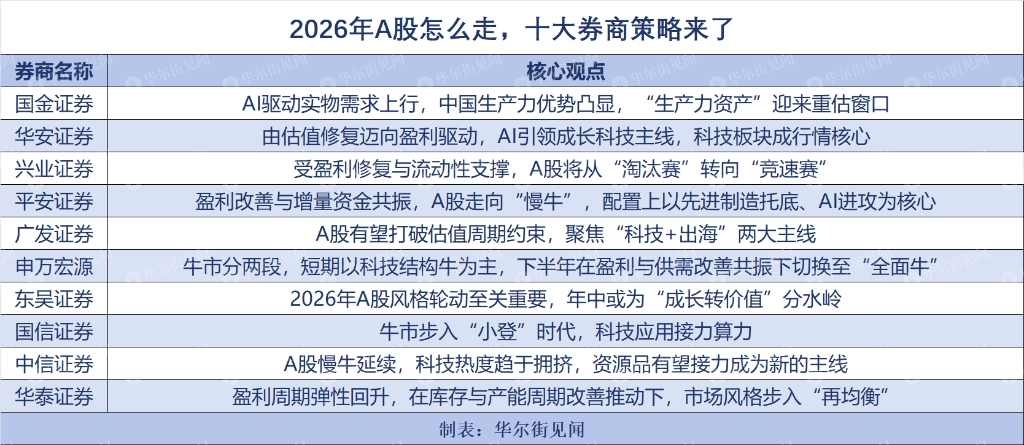
科技领跑、周期接力、慢牛到全面牛……2026年A股怎么走,十大券商策略来了
Hua Er Jie Jian Wen· 2025-12-20 04:57
Core Viewpoint - The A-share market is transitioning from a liquidity and valuation-driven phase to a new stage that emphasizes fundamentals and profit recovery, with a projected double-digit profit growth for the entire A-share market in 2026 [1][2][4]. Group 1: Market Outlook - Most major domestic securities firms believe that the A-share market will remain in a bull market in 2026, with profit recovery being a key variable for market sustainability [1][2]. - The overall profit growth for the A-share market is expected to rise from 8.2% in 2025 to 10.3% in 2026, with the growth rate for non-financial sectors projected at 7.7% [12][64]. - The first half of 2026 is anticipated to maintain market momentum, but a significant transition may occur mid-year, particularly for sectors that have seen substantial gains [1][2][27]. Group 2: Sector Focus - The technology sector remains a consensus direction for 2026, with a shift from infrastructure investment to application and performance realization in AI, focusing on areas like robotics and smart driving [2][21]. - The "anti-involution" policy is expected to drive profit recovery in sectors such as steel, chemicals, and new energy, while resource products may present opportunities as they follow the technology sector [2][27]. - The report highlights four main areas for investment opportunities: AI, new energy, military industry, and innovative pharmaceuticals, with a focus on sectors that are expected to benefit from the "15th Five-Year Plan" [34][40][79]. Group 3: Investment Strategies - The investment strategy should prioritize "manufacturing as a shield and technology as a sword," emphasizing advanced manufacturing and AI as core components [40][44]. - The report suggests a rotation in market style from growth to value, particularly around mid-2026, as the market may shift focus based on liquidity and industry trends [68][69]. - The report emphasizes the importance of identifying high-performance sectors within the "future industries" and suggests a focus on resource security and energy [79][91]. Group 4: Financial Metrics and Predictions - The overall A-share market is expected to see a significant recovery in profitability, with non-financial net profit growth projected to rebound from 6.5% in 2025 to 16.5% in 2026 [33][64]. - The report predicts that the supply-side reforms will lead to a more balanced market, with a focus on sectors that have undergone significant price recovery and demand stimulation [27][92]. - The report indicates that the current market valuation structure remains healthy, with no signs of overheating, suggesting further upward potential [80][89].




独家|水贝市场不再显示投资金价格 商家操作不一
Zhong Guo Jing Ying Bao· 2025-12-19 15:02
Group 1 - The Shenzhen Shui Bei gold market has adjusted its pricing method, now only displaying prices for gold, platinum, and silver, with gold priced uniformly at 1125 yuan per gram, regardless of investment or jewelry classification [1] - Previously, the market differentiated between investment gold and jewelry gold, with investment gold priced at 953 yuan per gram and jewelry gold at 1053 yuan per gram, a difference of 100 yuan per gram [1] - Different merchants in the Shui Bei market have varied responses regarding the pricing adjustment, with one confirming the inability to purchase gold bars at investment prices, while another claims they can still sell gold bars at investment prices with an online exclusive price of 994 yuan per gram [1] Group 2 - The Ministry of Finance and the State Taxation Administration announced new tax policies regarding gold, effective from November 1, 2025, to December 31, 2027, which clarify VAT details for standard gold transactions through the Shanghai Gold Exchange and Shanghai Futures Exchange [2] - For non-investment gold enterprises, such as those dealing in jewelry and industrial uses, the reduction of input tax deduction from 13% to 6% may increase their gold costs [2] - Although the tax policy for personal purchases of gold jewelry remains unchanged, the new regulations may indirectly affect retail prices by influencing raw material costs [2]
金融科技拐点:从“硬投入”到“软实力”,关注五大关键词
2 1 Shi Ji Jing Ji Bao Dao· 2025-12-19 13:27
Core Insights - The financial technology industry is expected to undergo significant changes in 2026, coinciding with the update of the "Financial Technology Development Plan" [1] - The digital economy has rapidly developed from 2019 to 2025, transitioning financial technology from foundational support to a more substantial role [1] - Financial institutions are shifting their focus from "hard investment" to "soft power" in technology, emphasizing efficiency over scale [3][4] Financial Technology Development - The previous development plan emphasized principles such as digital-driven, intelligent for the public, green and low-carbon, and equitable finance, with eight key tasks outlined [1] - Financial institutions have established top-level designs for digital transformation, with flexible organizational structures and improved cloud infrastructure [1] - The integration of AI, blockchain, and privacy computing technologies is accelerating, enhancing the accessibility of financial services [1] Investment Trends - There is a noticeable slowdown in the growth rate of technology investments by financial institutions, particularly among major banks [2] - From 2020 to 2024, technology investment by 16 state-owned and joint-stock banks increased from 140.4 billion to 187.4 billion yuan, but the growth rate has significantly decreased [2] - Some banks have begun to reduce their technology investment amounts starting in 2023, with only one bank achieving double-digit growth in 2024 [2] Organizational Changes - Financial institutions are adjusting their organizational structures to optimize technology governance and deepen reform [6] - Initiatives include the establishment of digital financial committees and AI action groups to enhance decision-making and risk management [6][7] - The focus is on breaking down departmental barriers and fostering collaboration across different levels of governance [7] Technology Application - Financial institutions are pursuing both "frontier exploration" and "practical efficiency" in technology applications, with a shift towards using technology as a production factor [4] - AI applications are increasingly penetrating core business areas, with banks implementing AI in various operational scenarios [9] - The integration of internal and external data is enhancing customer profiling, risk management, and marketing strategies [8] Future Outlook - The "14th Five-Year Plan" emphasizes the importance of building a strong financial nation, with a focus on AI governance, cross-border data flow mechanisms, and sustainable finance [10][11][14] - The development of digital RMB and the establishment of financial technology centers in key cities like Shanghai and Hong Kong are strategic priorities [12][15] - The financial industry is expected to continue innovating in green finance and integrating environmental and social responsibilities into core business processes [14]