
博时基金

Search documents
超175亿,跑了!
Zhong Guo Ji Jin Bao· 2025-11-26 06:06
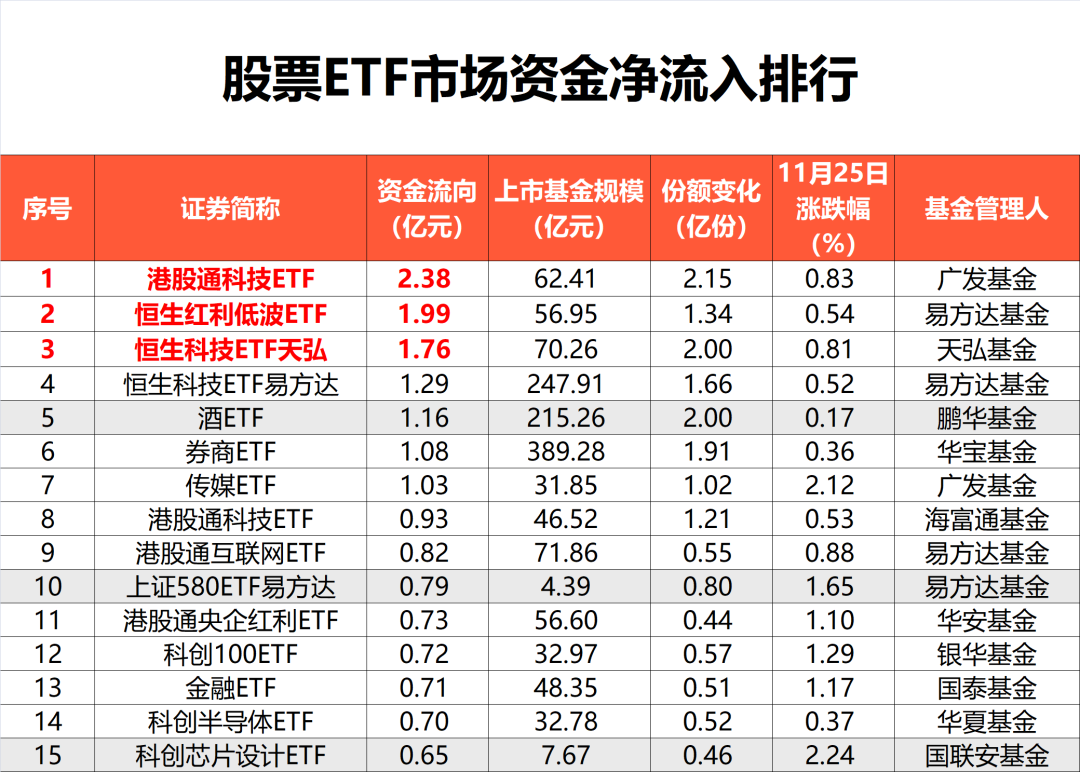
Group 1 - The core point of the article highlights a significant net outflow of over 17.5 billion yuan from the stock ETF market amid a collective rise in A-share indices, indicating a trend of "selling on rallies" by investors [1][2] - The total scale of the stock ETF market reached 4.54 trillion yuan, with a reduction of 8.241 billion units in total shares on the day of the market surge [2] - The Hong Kong stock market ETFs and commodity ETFs saw notable net inflows of 1.214 billion yuan and 415 million yuan, respectively, indicating a shift in investor preference [2][3] Group 2 - On an index level, the Shanghai market government bond index experienced the highest net inflow of 627 million yuan, while the Hang Seng Technology Index saw inflows exceeding 7.6 billion yuan over the recent five days [3] - The top-performing ETFs in terms of net inflow included the Hong Kong Stock Connect Technology ETF with 238 million yuan, and the Hang Seng Dividend Low Volatility ETF with 199 million yuan [5][6] - Conversely, the CSI 500 Index faced the largest net outflow of 3.332 billion yuan, with the corresponding CSI 500 ETF seeing nearly 3 billion yuan in outflows, indicating a lack of investor confidence in this segment [8][9] Group 3 - Despite the outflows from certain ETFs, institutional investors remain optimistic about the A-share market's future performance, with expectations of a potential cross-year and spring market rally [12] - Analysts from Bosera Fund noted that market sentiment indicators are currently low, suggesting limited downside potential for the market, while Guotai Fund highlighted growth opportunities in sectors such as AI, electric vehicles, and industrial metals [12]

超175亿,跑了!
中国基金报· 2025-11-26 06:02
Core Insights - The stock ETF market experienced a net outflow of over 17.5 billion yuan on November 25, despite the overall rise in A-share indices, indicating a "sell on strength" strategy among investors [2][5]. Market Overview - A-share indices collectively rose, with significant gains in computing hardware stocks and active AI application sectors, while the aquaculture sector saw a collective adjustment [2]. - The total scale of the stock ETF market reached 4.54 trillion yuan, with 1,266 stock ETFs (including cross-border ETFs) [4]. Fund Flows - The stock ETF market saw a reduction of 8.241 billion units, translating to a net outflow of over 17.5 billion yuan based on average transaction prices [5]. - The Hong Kong stock market ETFs and commodity ETFs led the net inflows, with 1.214 billion yuan and 415 million yuan respectively [6]. - The net inflow for the Hang Seng Technology Index exceeded 7.6 billion yuan over the past five days, while the CSI 300 Index saw over 5.6 billion yuan in inflows [6]. Top Performing ETFs - The top inflow ETFs included: - Hong Kong Stock Connect Technology ETF: 238 million yuan [8] - Hang Seng Dividend Low Volatility ETF: 199 million yuan [9] - Hang Seng Technology ETF (Tianhong): 176 million yuan [9] - Other notable inflows were observed in the Hong Kong Stock Connect Internet ETF and the Shanghai Stock Exchange 580 ETF, each exceeding 70 million yuan [9]. Outflows from Broad-based ETFs - Broad-based ETFs experienced significant outflows, totaling 13.143 billion yuan, with the CSI 500 Index ETF leading the outflows at 3.332 billion yuan [11]. - Other ETFs with notable outflows included the ChiNext ETF and CSI 1000 ETF, with outflows of 2.39 billion yuan and 1.534 billion yuan respectively [11]. Market Sentiment and Future Outlook - Despite some investors opting to "take profits," institutions remain optimistic about the A-share market's future performance. Analysts from Bosera Fund noted that market sentiment indicators are at low levels, suggesting limited downside potential [14]. - Guotai Fund anticipates a potential cross-year and spring market rally, focusing on growth sectors such as AI, electric vehicles, and industrial metals, while also highlighting opportunities in hospitality, logistics, and aviation sectors as year-end and Spring Festival approaches [14].

沪深300ETF博时(515130)红盘上扬涨近1%,专家称A股有望延续慢牛走势
Xin Lang Cai Jing· 2025-11-26 05:22
展望未来,银河证券表示,"十五五"开局之年改革政策预期强化,人民币汇率向上等价格因素支撑流动 性向好,A股市场信心有望得到提振。在居民存款搬家持续演绎、机构投资者加大入市力度、全球资本 流向重塑叠加政策工具护航下,A股市场仍将受益于流动性向上逻辑。当前A股估值处于相对合理区 间,从全球主要权益市场比较来看仍处于中等偏低水平。2026年,A股市场盈利有望接棒估值,成为市 场聚焦的关键点。 资金流入方面,沪深300ETF博时最新资金流入流出持平。拉长时间看,近10个交易日内,合计"吸 金"1328.33万元。(数据来源:Wind) 沪深300ETF博时紧密跟踪沪深300指数,沪深300指数由沪深市场中规模大、流动性好的最具代表性的 300只证券组成,于2005年4月8日正式发布,以反映沪深市场上市公司证券的整体表现。 截至2025年11月26日 13:05,沪深300指数强势上涨1.00%,成分股中际旭创上涨16.05%,新易盛上涨 11.92%,沪电股份上涨9.86%,天孚通信,工业富联等个股跟涨。沪深300ETF博时(515130)上涨 0.96%,最新价报1.47元。拉长时间看,截至2025年11月25日, ...
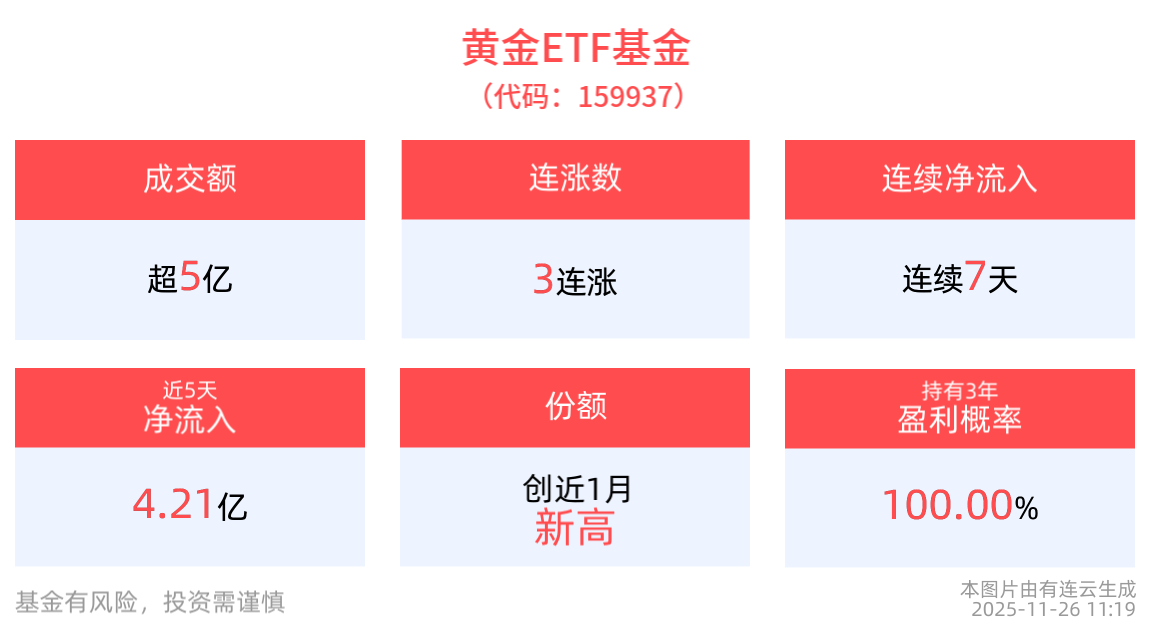
经济数据强化降息预期,金价短线走强,黄金ETF基金(159937)红盘冲击3连涨,连续7日“吸金”合计超11亿元
Sou Hu Cai Jing· 2025-11-26 03:55
Group 1 - The core viewpoint of the news highlights the recent performance of gold ETFs, indicating a 0.37% increase, marking three consecutive days of gains, with the latest price at 9.03 yuan and a 2.64% increase over the past week [3] - The liquidity of the gold ETF is noted, with a turnover of 1.45% and a transaction volume of 5.76 billion yuan, while the average daily transaction volume over the past month is 15.01 billion yuan [3] - Spot gold prices fell by 0.14% to $4130.59 per ounce, with COMEX gold futures rising by 0.81% to $4127.20 per ounce, reflecting market fluctuations [3] Group 2 - CITIC Securities points out a decrease in VIX for gold, silver, and copper, while the VIX for crude oil has increased, suggesting a long-term bullish outlook on gold due to weak economic conditions and rising geopolitical threats [4] - Historical data shows a negative correlation between gold and the US dollar index, as well as between gold and US real interest rates, with recent increases in both the dollar index and real interest rates [4] - The latest share count for the gold ETF reached 4.394 billion, a one-month high, with a net inflow of 1.107 billion yuan over the past week, averaging 158 million yuan per day [4]
CPO概念持续上行,创业板ETF博时(159908)盘中拉升涨近2%
Xin Lang Cai Jing· 2025-11-26 03:01
Group 1 - The ChiNext Index has shown strong performance, rising by 1.33% as of November 26, 2025, with notable gains in constituent stocks such as Maiwei Co., Ltd. (up 10.59%) and Zhongji Xuchuang (up 9.40%) [1] - The ChiNext ETF by Bosera has increased by 7.80% over the past three months, with a latest price of 2.81 yuan and a turnover rate of 1.63% on November 26, 2025 [1][3] - The optical module (CPO) index rose by 3.01% on November 26, 2025, with institutional funds seeing a net inflow of 34.13 billion yuan [1] Group 2 - The communication industry has performed exceptionally well in 2025, with a year-to-date increase of 55.58%, ranking second among all industries, and institutional holdings have significantly increased [2] - The GB300 platform is expected to ramp up production in Q4, leading to large-scale shipments of 1.6T optical modules, with silicon photonics technology projected to capture nearly 60% of the global optical module market by 2030 [2] - Public fund holdings in the communication sector have surpassed 6.5%, a historical high, while valuations remain relatively low, not fully reflecting the sector's high growth potential [2]

两市ETF两融余额减少12.41亿元丨ETF融资融券日报
2 1 Shi Ji Jing Ji Bao Dao· 2025-11-26 02:57
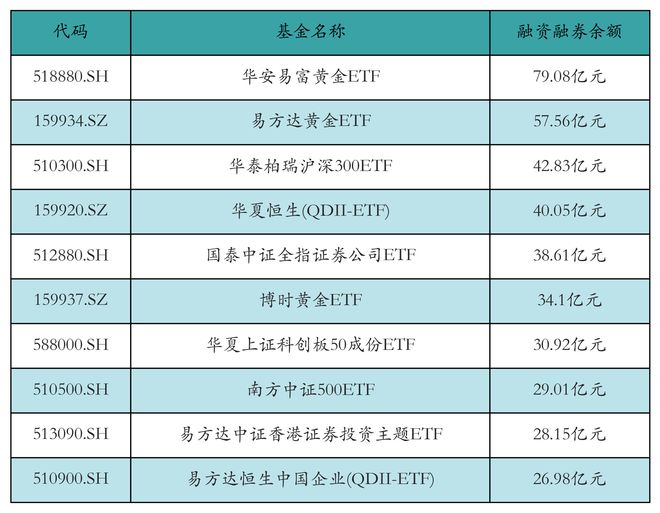
Market Overview - As of November 25, the total ETF margin balance in the two markets is 119.68 billion yuan, a decrease of 1.241 billion yuan from the previous trading day [1] - The financing balance is 112.48 billion yuan, down by 1.436 billion yuan, while the securities lending balance is 7.198 billion yuan, an increase of 196 million yuan [1] - In the Shanghai market, the ETF margin balance is 83.791 billion yuan, a decrease of 641 million yuan, with a financing balance of 77.457 billion yuan, down by 820 million yuan [1] - In the Shenzhen market, the ETF margin balance is 35.889 billion yuan, a decrease of 600 million yuan, with a financing balance of 35.025 billion yuan, down by 616 million yuan [1] ETF Margin Balance - The top three ETFs by margin balance on November 25 are: - Huaan Yifu Gold ETF (7.908 billion yuan) - E Fund Gold ETF (5.756 billion yuan) - Huatai-PB CSI 300 ETF (4.283 billion yuan) [2] - The detailed top 10 ETFs by margin balance are provided in the table [2] ETF Financing Amount - The top three ETFs by financing amount on November 25 are: - Huatai-PB Southern Dongying Hang Seng Technology Index (1.067 billion yuan) - E Fund CSI Hong Kong Investment Theme ETF (1.031 billion yuan) - Huaxia Hang Seng Technology ETF (891 million yuan) [3] - The detailed top 10 ETFs by financing amount are provided in the table [4] ETF Net Financing Amount - The top three ETFs by net financing amount on November 25 are: - Huaxia Hang Seng Technology ETF (122 million yuan) - GF CSI Hong Kong Innovation Drug ETF (105 million yuan) - E Fund CSI Hong Kong Investment Theme ETF (43.632 million yuan) [5] - The detailed top 10 ETFs by net financing amount are provided in the table [6] ETF Securities Lending Amount - The top three ETFs by securities lending amount on November 25 are: - Huatai-PB CSI 300 ETF (54.567 million yuan) - Southern CSI 500 ETF (46.885 million yuan) - Southern CSI 1000 ETF (14.959 million yuan) [7] - The detailed top 10 ETFs by securities lending amount are provided in the table [8]
QDII基金交易热!管理人频繁提示溢价风险 部分产品限购
Bei Jing Shang Bao· 2025-11-26 00:41
Core Viewpoint - Multiple fund managers have issued warnings regarding the premium risk associated with QDII funds, indicating that over 20 funds may be affected by secondary market trading price premiums, despite the majority showing strong performance this year [1][2]. Group 1: Premium Risk Warnings - On November 25, several fund management companies, including Huaxia, GF, and others, released announcements regarding potential premium risks for their QDII funds, affecting more than 20 products [2]. - The premium risk is attributed to factors such as supply-demand imbalance, ineffective arbitrage mechanisms, and speculative trading behavior [3]. - The secondary market trading prices of these funds are influenced not only by net asset value changes but also by market supply and demand, systemic risks, and liquidity risks [3]. Group 2: Performance of QDII Funds - As of November 21, 92.16% of the 689 QDII funds recorded positive returns this year, with some funds achieving over 100% returns [4]. - The top-performing fund, Huaxia Hong Kong Advantage Selected Mixed QDII, had a return rate of 122.7% [4]. - A total of 165 QDII funds have recently suspended subscriptions or large subscriptions to protect existing investors [5]. Group 3: Market Conditions and Future Outlook - The recent performance of U.S. stocks has been volatile, influenced by hawkish signals from the Federal Reserve and concerns over AI bubbles [2]. - The QDII quota has only increased once this year, with a total of $30.8 billion allocated to 82 institutions, reflecting ongoing investor interest in overseas assets [5]. - Analysts suggest that investors should wait for market adjustments before purchasing QDII funds and remain cautious of potential valuation bubbles in U.S. stocks [6].
限购债基新发权益基金 公募逆势布局热情高
Zhong Guo Zheng Quan Bao· 2025-11-25 20:27
Core Viewpoint - The recent adjustment in A-share market has led to increased discussions on risk aversion, with public fund companies showing a tendency to limit large subscriptions for defensive funds while actively launching equity index products [1][2]. Group 1: Fund Subscription Trends - Many public fund institutions have chosen to limit large subscriptions for defensive products such as bond funds, money market funds, and dividend-themed funds, reflecting a cautious approach towards potential inflows of risk-averse capital [2][3]. - Since November 14, over a hundred products, primarily bond funds, have suspended large subscriptions, indicating a trend towards restraint in accepting new capital [2][3]. - Fund managers emphasize the importance of maintaining a balanced approach to fund inflows, as excessive short-term capital can hinder effective investment management and potentially harm investor interests [1][2]. Group 2: Active Equity Fund Launches - Despite the cautious stance on defensive funds, there is a notable enthusiasm for launching equity index products, with several new funds being introduced under major indices like the Shanghai Composite Index and the ChiNext Index [2][3]. - For instance, the Guotou Ruijin Shanghai Composite Index Enhanced Fund raised 971 million yuan during its subscription period from October 22 to November 11, attracting 3,453 investors [2]. - The number of newly established products linked to the Shanghai Index and the North Star 50 Index has reached historical highs this year, with 8 and 23 products respectively, while the ChiNext Index has seen 17 new products, matching last year's total [3]. Group 3: Market Outlook and Sector Focus - Various institutions believe that the recent market fluctuations do not alter the long-term positive trend, suggesting a focus on structural opportunities, particularly in sectors with favorable industry trends such as technology, consumption, high-end manufacturing, and pharmaceuticals [3][4]. - The market is expected to experience a mid-term upward trend, supported by ample liquidity and improving industry conditions, despite potential short-term volatility [3][4]. - Companies are advised to balance their portfolios by increasing allocations to stable dividend assets while also investing in sectors with strong industrial trends, such as AI computing power and new energy [4].
QDII基金交易火热 部分产品限购
Bei Jing Shang Bao· 2025-11-25 16:40
Core Viewpoint - Multiple fund managers have issued warnings regarding the premium risk of QDII funds, indicating that over 20 funds may be trading at a premium in the secondary market, despite strong performance in the year, with over 90% of these funds achieving positive returns [1][2]. Group 1: Premium Risk Warnings - On November 25, several fund management companies, including Huaxia, GF, and others, released announcements about the potential premium risk associated with their QDII funds, affecting more than 20 products [2]. - The premium risk is attributed to factors such as supply-demand imbalance, failure of arbitrage mechanisms, and short-term speculation driven by the "T+0" trading system [3]. Group 2: Performance of QDII Funds - As of November 21, 92.16% of the 689 QDII funds recorded positive returns for the year, with the highest performing fund, Huaxia Hong Kong Advantage Selected Mixed QDII, achieving a return of 122.7% [4]. - A total of 52 QDII funds have reported returns exceeding 50% for the year, indicating strong overall performance in the sector [4]. Group 3: Fund Subscription Restrictions - As of November 25, 165 QDII funds have suspended subscriptions or limited large subscriptions to protect the interests of existing fund holders, with some funds imposing strict limits on subscription amounts [5][6]. - The tightening of QDII quotas has contributed to these restrictions, with only one increase in quotas occurring in June, resulting in a total QDII investment quota of $1708.69 billion as of the end of October [6].
QDII基金交易热!管理人频繁提示溢价风险,部分产品限购
Bei Jing Shang Bao· 2025-11-25 13:18
Core Viewpoint - Multiple fund managers have issued warnings regarding the premium risk of their QDII funds, indicating that over 20 funds may be affected by secondary market trading price premiums, despite the majority showing strong performance this year [1][3]. Group 1: Premium Risk Warnings - On November 25, several fund management companies, including Huaxia, GF, and Huitianfu, announced premium risk warnings for their QDII funds, affecting more than 20 products [3]. - The funds involved track indices such as the Nasdaq 100, S&P 500, and MSCI US 50, with these indices showing significant gains of 18.38%, 18.07%, and 14% year-to-date, respectively [3]. - The warnings are not new; for instance, Huaxia Nomura Nikkei 225 ETF has issued premium risk alerts up to 30 times since November [3]. Group 2: Market Performance and Fund Management Actions - As of November 21, 92.16% of the 689 QDII funds reported positive returns this year, with some funds, like Huitianfu Hong Kong Advantage Mixed QDII, achieving returns exceeding 122% [6]. - In response to the premium risks, 165 QDII funds have suspended subscriptions or limited large subscriptions, with some funds imposing strict limits on subscription amounts [7][8]. - The tightening of QDII quotas has led to a supply-demand imbalance, contributing to the premium phenomenon as investors rush to buy into these funds [5][8]. Group 3: Market Dynamics and Investor Behavior - The premium risk is exacerbated by a failure in the arbitrage mechanism due to the suspension of the primary market for subscriptions and redemptions, making it difficult to correct the premiums quickly [5]. - High-frequency trading and speculative activities have further amplified price volatility in the QDII funds, particularly those allowing T+0 trading [5]. - Analysts suggest that investors should wait for market adjustments before purchasing QDII funds to avoid chasing high prices, while also being mindful of the overall market conditions and potential risks [8].
