中国东航

Search documents
机器人助检测、AI解析手册……东航技术亮相第三届CATA航空大会
Zhong Guo Min Hang Wang· 2025-10-25 07:19
Core Insights - Eastern Airlines Technology showcased two innovative achievements in the aviation maintenance sector at the third CATA Aviation Conference, namely the "QEC Fault Detection Robot" and the "Ruiyan Maintenance Manual Platform" [1][4] Group 1: QEC Fault Detection Robot - The QEC Fault Detection Robot is the first domestic AI-assisted detection system based on "5G+AI" technology, addressing the issue of assembly accuracy in complex aircraft engine installations [5] - The robot integrates a high-precision vision system and intelligent algorithms, enabling real-time data transmission and processing via a 5G private network [5] - It can autonomously navigate and complete comprehensive image collection, intelligent analysis, and automatic report generation within 30 minutes, achieving a detection rate of over 90% for assembly errors larger than 10mm and a false positive rate below 15% [5] Group 2: Ruiyan Maintenance Manual Platform - The Ruiyan Maintenance Manual Platform focuses on efficiently managing and applying maintenance manuals amidst increasingly complex aircraft systems and vast technical documentation [6] - It features digital and structured deep management of manuals, supporting seamless access on both PC and mobile platforms, and enhances production preparation and maintenance implementation efficiency [6] - The platform includes an AI-driven translation engine trained on over 500,000 high-quality translation sentences, achieving over 90% accuracy in translating maintenance manual content, thus breaking language barriers in technical documentation [7]




中国东航携手瑞金医院赴云南沧源开展医疗义诊
Zhong Guo Min Hang Wang· 2025-10-25 02:57
Core Points - China Eastern Airlines, in collaboration with Ruijin Hospital, is conducting a three-day free medical consultation event in Cangyuan, Yunnan Province, from October 22 to 24, 2025, to provide quality medical services to local residents [1][2] - A team of 21 expert doctors from 18 departments of Ruijin Hospital arrived in Cangyuan to offer medical consultations, focusing on common diseases and preventive care for respiratory infections, foodborne diseases, and skin conditions [2][3] - China Eastern Airlines has integrated social responsibility into its corporate strategy, actively engaging in healthcare support initiatives, including organizing expert consultations and establishing a "cloud hospital" to enhance local medical services [3]

航空机场板块10月24日跌1.41%,中国国航领跌,主力资金净流出1.97亿元
Zheng Xing Xing Ye Ri Bao· 2025-10-24 08:27
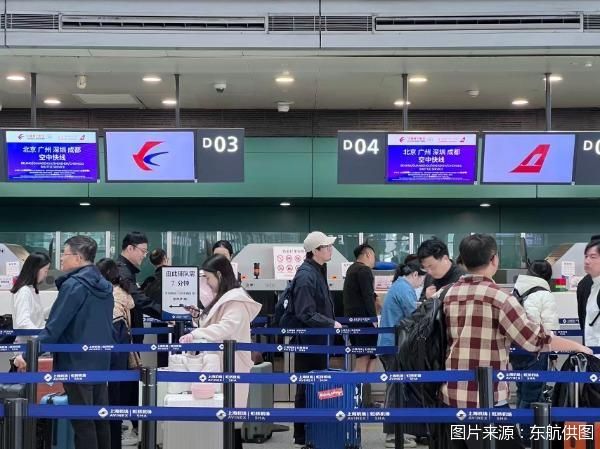
Group 1 - The aviation and airport sector experienced a decline of 1.41% on October 24, with China National Aviation leading the drop [1] - The Shanghai Composite Index closed at 3950.31, up 0.71%, while the Shenzhen Component Index closed at 13289.18, up 2.02% [1] - Xiamen Airport saw a closing price of 15.70, with an increase of 2.28%, while China Eastern Airlines closed at 4.85, down 1.82% [1] Group 2 - The aviation and airport sector had a net outflow of 197 million yuan from institutional investors, while retail investors saw a net inflow of 100 million yuan [2] - Shenzhen Airport had a net inflow of 14.99 million yuan from institutional investors, while China National Aviation experienced a net outflow of 10.24 million yuan [2] - The overall capital flow showed that retail investors contributed positively to some stocks, despite the overall sector decline [2]



东航江西分公司联合江西机场商贸推出融合会员服务
Zhong Guo Min Hang Wang· 2025-10-24 05:04
Core Insights - Eastern Airlines Jiangxi Branch collaborates with Jiangxi Airport Group to explore a "flight + commerce" integrated service model, launching a special benefit for travelers that allows direct use of Eastern Airlines points for consumption [1][2] - The initiative enhances the travel experience by enabling seamless point redemption at 54 retail, dining, and service merchants in the core commercial area of Nanchang Changbei Airport [1][2] Summary by Sections - **Partnership and Service Launch** - Eastern Airlines Jiangxi Branch and Jiangxi Airport Group have partnered to create a new service model that integrates air travel with commercial services [1] - The launch includes the "Eastern Airlines Wallet" and a program allowing members to directly use their points for purchases [1] - **Operational Advantages** - The collaboration leverages Eastern Airlines' operational strengths at Changbei Airport, ensuring precise alignment of marketing resources with passenger flow [1] - This results in a seamless transition for travelers to enjoy point redemption immediately after security checks [1] - **Merchant Participation and Consumer Engagement** - All participating merchants in the airport's isolation area prominently display "Eastern Airlines Wallet" promotional signage to enhance visibility and recognition of the benefits [2] - Since the program's recent initiation, travelers have used a total of 3.636 million Eastern Airlines points for purchases at the airport [2] - **Impact on Brand and Customer Loyalty** - The partnership taps into Eastern Airlines' stable and high-quality member customer base, driving targeted consumer traffic to the Jiangxi airport commercial area [2] - This initiative not only boosts brand recognition for Eastern Airlines but also enhances member loyalty, contributing to a closed-loop ecosystem of "air service + commercial experience" [2]

新型航空燃料热浪来袭!碳减排最多达九成
Zheng Quan Shi Bao Wang· 2025-10-24 03:40
Core Insights - The global aviation industry is entering the "SAF era," driven by policy changes and increasing demand for sustainable aviation fuel (SAF) [1][2][5] - The SAF market is expected to grow significantly, with a projected supply-demand gap exceeding 26 million tons from 2030 to 2035, leading to a market size in the thousands of billions of yuan [1][2] - SAF can reduce carbon dioxide emissions by 69% to 90% compared to traditional fuels, making it a viable path for the aviation industry's decarbonization efforts [2][5] Industry Developments - The European Union has mandated that by 2030, 6% of fuel used in flights from its airports must be SAF, with a target of 70% by 2050 [2][3] - China's SAF consumption is projected to exceed 20,000 tons this year, with various initiatives and policies being implemented to support the industry [3][6] - Major Chinese airlines are beginning to incorporate SAF into their operations, with commitments to increase SAF usage significantly by 2030 [3][6] Market Dynamics - The price of SAF has surged, with recent figures exceeding $2,700 per ton, driven by regulatory requirements and rising raw material costs [4][10] - The competition for SAF production capacity is intensifying, with numerous companies launching projects to meet the growing demand [6][7] - The current collection of waste cooking oil in China is limited to about 5 million tons annually, which is insufficient to meet future SAF demand [8][9] Challenges and Opportunities - The high cost of SAF production remains a significant barrier to widespread adoption, with estimates suggesting that SAF could be 4.2 times more expensive than conventional jet fuel [9][10] - Companies are exploring diverse raw materials for SAF production to enhance supply and reduce costs, including non-food biomass and green hydrogen [8][9] - The industry is witnessing a shift in production locations, with potential growth in regions rich in agricultural waste and renewable resources [9]

暗中较劲的中美航权
Hu Xiu· 2025-10-24 01:51
美国交通部则在其拟议的命令中表示:"(中国航班使用俄罗斯领空)已成为一个重要的竞争因素,对美国航空公司造成严重不 利影响,需尽可能消除美国和中国航空公司之间的竞争差距。" 早在2023年5月,俄罗斯领空问题就成为中美复航谈判的焦点,美方同意中国航空公司增加两国间航班数量,但前提是新航班不 得飞越俄罗斯。 2024年,中美达成协议,双方航空公司原则上共可运营每周100班定期客运航班,中方50班,美方50班。 截至目前,中方的六家航司早已把每周50个航班飞满,而美国航司尚未用满额度,采取了一种"软对抗"的方式。 飞过美国的朋友一般都清楚,北京、上海到美国西海岸城市(西雅图、旧金山、洛杉矶)的航线通常是走北太平洋,即日本→ 阿留申群岛,不太受俄罗斯关闭领空限制。 但飞美国东海岸城市(纽约、华盛顿、波士顿)则是向北经西伯利亚、北极和加拿大,这样的航线最短、最经济。 近日,美媒报道称特朗普政府拟提议禁止中国航空公司在往返美国的航班上飞越俄罗斯领空,认为这种做法使美国航空公司处 于不利地位。 众所周知,自2022年3月以来西方与俄罗斯便互关了领空,而中国航班仍可以使用俄罗斯领空,于是欧美航空公司就感到心理不 平衡,认为中 ...
碳减排最多达九成 新型航空燃料直面高成本与低产能考验
Zheng Quan Shi Bao· 2025-10-23 17:15
Core Insights - The global aviation industry is entering the "SAF era," driven by policy initiatives and a significant expected increase in demand for Sustainable Aviation Fuel (SAF) [1][3][4] - The aviation sector is one of the hardest to decarbonize, with SAF being a viable alternative to traditional fuels, potentially reducing CO2 emissions by 69%-90% [2][3] - The European Union has set ambitious SAF blending targets, aiming for 2% by 2025, 6% by 2030, and 70% by 2050, which will significantly increase SAF demand [2][4] Industry Developments - China's SAF consumption is projected to exceed 20,000 tons this year, with various initiatives and policies being implemented to support the industry [3][5] - The establishment of the China Sustainable Aviation Fuel Industry Alliance and local government policies indicate a strong push towards SAF development [3][5] - Major airlines, including Cathay Pacific and China Eastern Airlines, are committing to increasing their SAF consumption as part of their ESG strategies [3][5] Market Dynamics - The price of SAF has surged, with European prices exceeding $2,700 per ton, driven by mandatory blending policies and rising raw material costs [4][9] - The competition for SAF production capacity is intensifying, with companies like Junheng Bio and Weili investing in large-scale SAF projects [5][6] - Current SAF production capacity in China is around 1 million tons, with expectations to double by 2026, although it remains insufficient to meet global demand [5][6] Raw Material and Cost Considerations - The primary feedstock for SAF production is waste cooking oil, with China's collection capacity limited to about 500,000 tons annually, which is insufficient for large-scale SAF production [6][8] - The average global cost of SAF is projected to be 4.2 times that of conventional jet fuel, raising concerns about its economic viability [8][9] - The high cost of SAF is a significant barrier to its adoption, with airlines facing pressure to balance sustainability goals with competitive pricing [9] Future Outlook - The diversification of raw materials for SAF production, including non-food biomass and green hydrogen, is expected to reshape the industry landscape [7][8] - The successful scaling of SAF production will depend on technological advancements and supportive government policies to lower costs and increase supply [9]
东航冬航季上新冰雪航线、空中快线,日均执行航班约3130班
Bei Jing Shang Bao· 2025-10-23 14:12
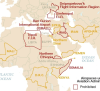
Core Points - Eastern Airlines will start its 2025 winter flight schedule on October 26, with a total of 820 aircraft and 253 domestic and international destinations across 39 countries [1][3] - The airline plans to operate 953 passenger routes, including 756 domestic and 197 international routes, with a focus on popular winter travel destinations [3] - New domestic routes include 38 additions, particularly to regions known for winter tourism, and increased frequency to cities like Harbin and Changchun [3] - The "Air Express" service will expand to 49 routes with an average of 899 daily flights, including high-frequency routes between major cities [3] - Eastern Airlines has fully deployed its 11 C919 aircraft, serving 12 routes to 10 cities in the new season [3]
航空机场板块10月23日涨0.38%,深圳机场领涨,主力资金净流入3222.04万元
Zheng Xing Xing Ye Ri Bao· 2025-10-23 08:20
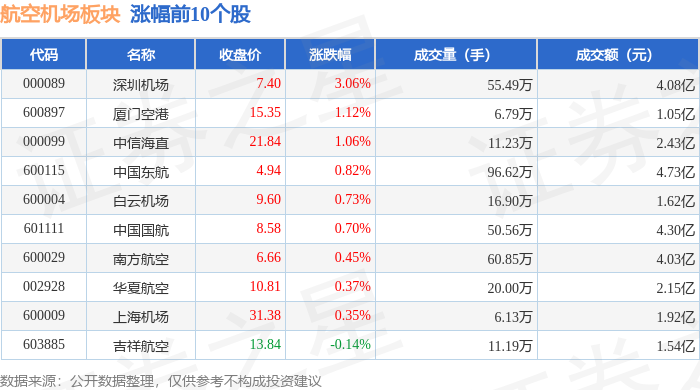
Market Overview - On October 23, the aviation and airport sector rose by 0.38% compared to the previous trading day, with Shenzhen Airport leading the gains [1] - The Shanghai Composite Index closed at 3922.41, up 0.22%, while the Shenzhen Component Index closed at 13025.45, also up 0.22% [1] Stock Performance - Shenzhen Airport (000089) closed at 7.40, up 3.06% with a trading volume of 554,900 shares and a turnover of 408 million yuan [1] - Xiamen Airport (600897) closed at 15.35, up 1.12% with a trading volume of 67,900 shares and a turnover of 105 million yuan [1] - China Eastern Airlines (600115) closed at 4.94, up 0.82% with a trading volume of 966,200 shares and a turnover of 473 million yuan [1] - China Southern Airlines (600029) closed at 6.66, up 0.45% with a trading volume of 608,500 shares and a turnover of 403 million yuan [1] Capital Flow - The aviation and airport sector saw a net inflow of 32.22 million yuan from institutional investors, while retail investors experienced a net inflow of 35.07 million yuan [2] - However, speculative funds recorded a net outflow of 67.29 million yuan [2] Individual Stock Capital Flow - China Southern Airlines (600029) had a net inflow of 69.47 million yuan from institutional investors, while it faced a net outflow of 34.49 million yuan from speculative funds [3] - China Eastern Airlines (600115) saw a net inflow of 39.42 million yuan from institutional investors, with a net outflow of 3.79 million yuan from speculative funds [3] - Shenzhen Airport (000089) experienced a net outflow of 11.13 million yuan from institutional investors, but had a net inflow of 5.62 million yuan from retail investors [3]


防御投资首选,交通运输ETF(159666)下跌0.19%
Sou Hu Cai Jing· 2025-10-23 06:30
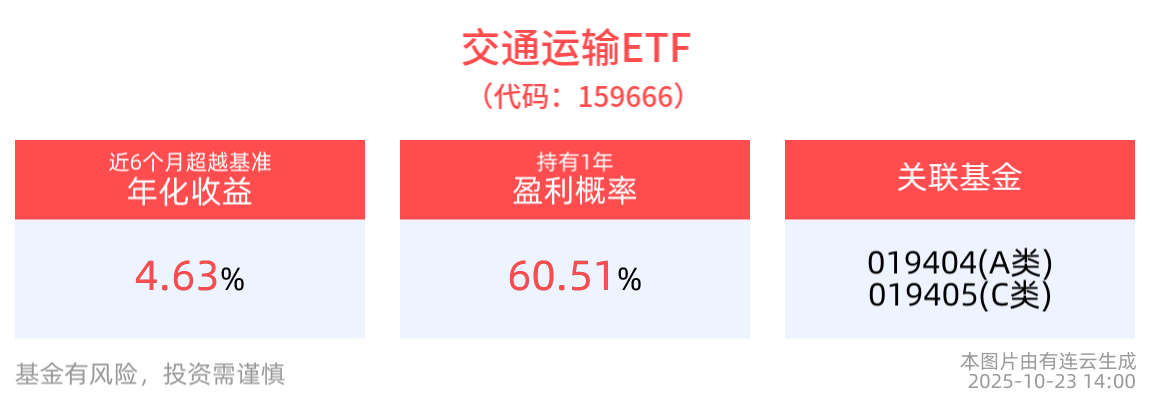
Core Insights - The Transportation ETF (159666) has experienced a slight decline of 0.29% as of October 23, 2025, with a latest price of 1.02 yuan, while it has seen a cumulative increase of 0.79% over the past week as of October 22, 2025 [2] Performance Summary - The Transportation ETF has achieved a net value increase of 20.35% over the past two years [2] - The highest single-month return since inception was 15.82%, with the longest consecutive months of increase being 4 months and the maximum increase during that period being 11.93% [2] - The average monthly return during the rising months is 3.16%, with a total annual profit percentage of 100.00% and a historical one-year profit probability of 60.51% [2] - Over the last six months, the ETF has outperformed its benchmark with an annualized excess return of 4.63% [2] Risk and Drawdown - The maximum drawdown over the past six months was 4.93%, with a relative benchmark drawdown of 0.04% [2] Fee Structure - The management fee for the Transportation ETF is 0.50%, and the custody fee is 0.10% [2] Tracking Accuracy - The tracking error for the Transportation ETF over the past month was 0.015% [2] Index Composition - The Transportation ETF closely tracks the CSI All Share Transportation Index, which reflects the overall performance of various industry companies within the index [3] - The index is categorized into 11 primary industries, 35 secondary industries, over 90 tertiary industries, and more than 200 quaternary industries [3] Top Holdings - The top holdings in the Transportation ETF include SF Holding (10.25% weight, -0.90% change), Beijing-Shanghai High-Speed Railway (9.99% weight, 0.00% change), and COSCO Shipping Holdings (8.27% weight, -0.13% change) [5]