宝洁公司

Search documents
财经观察:多重压力下,美国信用卡消费增速放缓
Huan Qiu Shi Bao· 2025-08-18 22:56
Core Insights - The growth rate of credit card spending in the U.S. has slowed down, with debit card spending outpacing credit card spending for the first time in four years [1][12] - American consumers are increasingly managing their credit card debt, with a notable rise in personal loans as a strategy to pay off credit card balances [2][12] - Young Americans, particularly those aged 18 to 29, are facing significant credit card debt and overdue payments, indicating a troubling trend in financial health among this demographic [5][12] Group 1: Credit Card Spending Trends - Credit card debt in the U.S. has surpassed $1 trillion, but the growth rate of credit card spending has decreased to 5.65% year-on-year, compared to a 6.57% increase in debit card spending [1][12] - Since the end of last year, credit card spending growth has lagged behind that of debit cards, contrasting with the previous 14 quarters where credit card spending consistently outperformed debit card spending [1][12] - The average annual interest rate for credit cards is approximately 22%, significantly higher than that of personal loans, which has led consumers to seek personal loans to manage credit card debt [2][12] Group 2: Consumer Debt Management - A report from credit agency Equifax indicates that while credit card loan balances are growing at a slower pace, the delinquency rate has decreased, suggesting consumers are actively managing their debts [2] - Many consumers are opting for personal loans to pay off credit card debt, with personal loan issuance increasing by 18% year-on-year in the first quarter, reaching a record total of $257 billion [2] - Despite initial success in reducing credit card balances by an average of 57% through personal loans, many consumers find themselves accumulating credit card debt again within 18 months [2] Group 3: Demographic Insights - Young adults (ages 18-29) represent the largest group of credit card delinquents, with nearly 10% of their overdue amounts being 90 days or more past due [5] - The overall credit card delinquency rate has remained high, with 6.93% of debt overdue over the past year, indicating a concerning trend in financial stability among younger consumers [5][12] - A survey revealed that 42% of Americans are worried about their ability to repay credit card debt, with this anxiety affecting their mental health and overall well-being [5][12] Group 4: Economic Context - The slowdown in credit card spending is attributed to rising costs from tariffs and the resumption of student loan repayments, which have added financial pressure on households [10][11] - The job market is showing signs of cooling, with non-farm payrolls adding only 73,000 jobs in July, below market expectations, contributing to consumer uncertainty [11] - Consumers are prioritizing essential spending and reducing discretionary expenses, reflecting a shift in financial behavior in response to economic pressures [11][12]

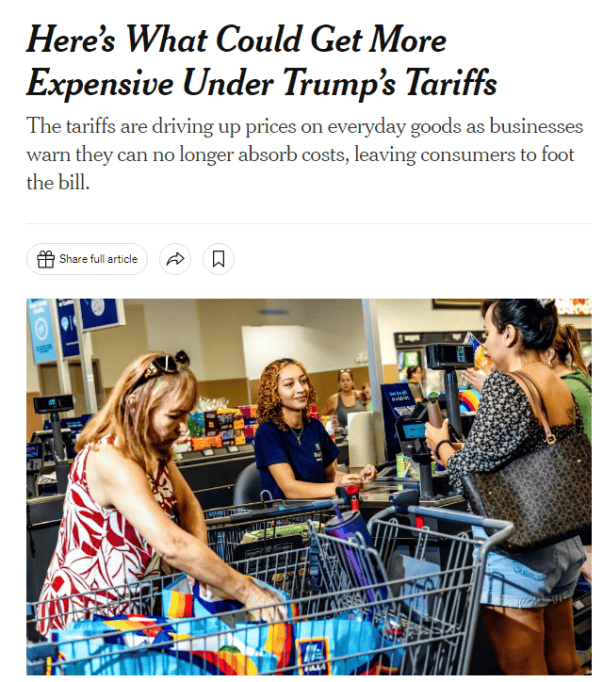
关税的不确定性正变为涨价的确定性——美国企业应对关税一线观察
Xin Hua She· 2025-08-18 11:28
Group 1: Economic Impact of Tariffs - The implementation of new tariffs by the U.S. government has led to increased uncertainty in the economy and a clear trend of rising costs for consumers across various products, from coffee to household items [1][2] - As of June, U.S. consumers had already absorbed 22% of the tariff costs, with expectations that this will rise to 67% by October due to the ongoing transfer of costs from businesses to consumers [2] - The trade-weighted average tariff rate for all products in the U.S. has surged to 20.11%, significantly higher than the 2.44% at the beginning of the year [2] Group 2: Price Increases by Companies - Procter & Gamble announced plans to raise prices on approximately 25% of its personal care and household products by an average of 2.5% to offset an additional $1 billion in costs due to tariffs [4] - Retail prices for imported goods have increased by about 4%, while domestic goods have seen a 2% rise from March to July [3] - Companies like Mohawk Industries and Gear Drive are also planning to pass on tariff costs to consumers, indicating a broader trend of price increases across various sectors [4][5] Group 3: Consumer Behavior and Market Dynamics - Concerns about rising prices and potential inflation are leading to changes in consumer purchasing behavior, with some customers reducing their buying volumes [5] - The uncertainty surrounding tariffs is complicating operations for companies, with reports of a 50% decrease in inquiries from international buyers [5] - Companies are restructuring their operations to manage increased costs, including layoffs and discontinuing certain products to maintain profitability [5]
【世界说】美媒:企业无力承担关税成本只能美国消费者买单 几乎所有商品都更贵
Sou Hu Cai Jing· 2025-08-18 11:20
Group 1 - The newly implemented "reciprocal tariffs" by the U.S. government will impose tariffs ranging from 10% to 41% on numerous trade partners, leading to increased prices for a wide array of consumer goods, from cars to shoes and bananas [1][4] - According to data from Yale University's Budget Lab, the average tariff rate on U.S. imports has risen to over 18%, the highest level since 1934, significantly up from 2.4% in January 2025 [4] - Economists warn that most of the tariff costs will ultimately be passed on to U.S. consumers, with significant price increases expected in essential categories such as clothing, food, and automobiles [4][5] Group 2 - Major companies like Adidas, Stanley Black & Decker, and Procter & Gamble have indicated plans to pass some of the tariff costs onto consumers, while others have begun to raise product prices or restructure supply chains [5] - Fast-food chains such as Chipotle and McDonald's have noted that low-income families are already showing signs of financial strain, with reduced spending on dining and travel [5] - Economic experts highlight that the burden of tariffs disproportionately affects low-income and working-class families, exacerbating the current economic situation compared to January 2025 [5]
抵制美国货!“印度制造”能突围吗?
Guo Ji Jin Rong Bao· 2025-08-18 11:01
Group 1: Trade Tensions and Economic Impact - Trade tensions have cast a shadow over the Indian industry, with the U.S. imposing a total of 50% tariffs on Indian goods, marking the highest tariff rate on a trading partner [1][4] - The latest data shows India's trade deficit widened to $27.35 billion in July, the highest in eight months, with imports growing faster than exports [4] - The potential impact of U.S. tariffs could lead to a 60% drop in India's exports to the U.S., dragging down GDP by approximately 1 percentage point [4] Group 2: Modi's Vision for "New India" - Prime Minister Modi, in his 103-minute Independence Day speech, emphasized the vision of a "self-reliant India," aiming to reduce dependence on imports and promote local manufacturing [1][5] - The "Make in India" initiative, launched in 2014, aims to increase the manufacturing sector's contribution to GDP to 25% by 2025, positioning India as a global manufacturing hub [6] - Modi's government is committed to not sacrificing farmers' interests for trade agreements, highlighting agriculture and industry as core national strategies [5][6] Group 3: Negotiation Stalemate - The core issues in U.S.-India negotiations revolve around U.S. demands for India to open its agricultural and dairy markets, which the Indian government has deemed a "red line" [2] - India relies on energy imports for 9% of its GDP, with over 30% of its energy supply coming from Russian oil, complicating U.S. demands to sever ties with Russia [2] - Indian officials argue that it is unfair for the U.S. and EU to continue purchasing Russian goods while penalizing India [2] Group 4: Domestic Response and Resistance - There is a growing wave of resistance against U.S. products in India, with brands like Apple and Starbucks becoming targets of boycotts [1][6] - The "local awakening forum," linked to the ruling party, is promoting the use of domestic brands over American ones, reflecting a significant grassroots movement [6] - Social media campaigns are amplifying the message of self-reliance, with calls to replace foreign products with local alternatives [6]
人事频繁变动 宝洁站在转型十字路口
Bei Jing Shang Bao· 2025-08-17 15:40
Core Viewpoint - Procter & Gamble (P&G) is undergoing significant leadership changes in its beauty division, reflecting concerns about the division's performance and the company's broader restructuring efforts [1][4]. Leadership Changes - Freddy Bharucha, the current President of Global Personal Care, will replace Alex Keith as CEO of the beauty division, effective December 1, 2025, as Keith plans to retire on February 20, 2026 [3][4]. - The beauty division, which includes brands like SK-II, Olay, and Pantene, has seen declining performance, with net sales of 107.398 billion yuan in FY2025, down 2% year-over-year, and net income of 19.486 billion yuan, down 8% [3][4]. Company Performance - P&G's overall growth has been slowing in recent years, prompting the company to push for transformation and strategic adjustments [5]. - The company has also announced a change in its CEO, with Jon Moeller stepping down and Shailesh Jejurikar taking over on January 1, 2026 [5]. Industry Context - The beauty industry is experiencing a significant turnover in leadership, with over 100 executives replaced across major companies like L'Oréal, Estée Lauder, and Shiseido in 2025 [5]. - P&G's leadership changes are part of a broader trend of frequent executive turnover, which is believed to enhance organizational flexibility and strategic agility [6]. Market Dynamics - The Chinese cosmetics market is projected to reach a retail total of 600 billion yuan in 2024, growing by 8.7% year-over-year, making it the second-largest market globally after the U.S. [7]. - Local brands are gaining market share, increasing from 35% in 2019 to 48% in 2024, posing challenges for international brands like P&G [7]. Pricing Strategy - To address cost pressures, P&G has informed major retailers of price increases on some products starting in August, with about 25% of products in the U.S. seeing a price hike of approximately 5% [7][8]. - The company has noted that organic sales growth was 2% in the April to June period, driven by price increases and product mix optimization [8].


年内3起人事变动,宝洁站在转型十字路口
Bei Jing Shang Bao· 2025-08-17 13:00
Core Insights - Procter & Gamble (P&G) is undergoing significant leadership changes in its beauty division, with Freddy Bharucha set to replace Alex Keith as CEO, effective December 1, 2025, as Keith plans to retire on February 20, 2026 [1][4] - The beauty division, which includes brands like SK-II and Olay, has faced declining performance, with net sales of 107.398 billion yuan in fiscal year 2025, down 2% year-over-year, and net income of 19.486 billion yuan, down 8% [3][4] - The leadership transition reflects P&G's concerns about the beauty division's growth amid increasing competition and a shift in market dynamics from growth to a more competitive landscape [4][5] Company Overview - P&G's beauty division is part of a larger structure that includes five main segments: beauty, grooming, health care, fabric and home care, and baby, feminine, and family care [3] - Freddy Bharucha has been with P&G since 1995 and has held various leadership roles, contributing to the growth of the personal care and beauty business over the years [3][4] - The company is also experiencing broader organizational changes, including the upcoming transition of CEO Jon Moeller to COO Shailesh Jejurikar, effective January 1, 2026 [4][6] Industry Context - The beauty market has shifted from an incremental growth phase to a more competitive environment, requiring brands to focus on customer acquisition and product innovation to drive sales [5] - P&G is at a critical juncture, navigating global business restructuring and brand strategy adjustments to maintain its leadership position in the beauty industry [6]

UTG: An Excellent Utility Fund For The Long Term, But Too Expensive
Seeking Alpha· 2025-08-17 12:10
Group 1 - The primary goal of the "High Income DIY Portfolios" Marketplace service is to provide high income with low risk and capital preservation for DIY investors [1] - The service offers vital information and portfolio/asset allocation strategies aimed at creating stable, long-term passive income with sustainable yields [1] - The portfolios are specifically designed for income investors, including retirees or near-retirees, and include seven different portfolios: 3 buy-and-hold, 3 rotational portfolios, and a 3-bucket NPP model portfolio [1] Group 2 - The portfolio offerings include two high-income portfolios, two dividend growth investing (DGI) portfolios, and a conservative NPP strategy portfolio characterized by low drawdowns and high growth potential [1]

美股市场速览:市场再创新高,中小盘表现强势
Guoxin Securities· 2025-08-17 04:46
Investment Rating - The report maintains a "Underperform" rating for the U.S. stock market [1] Core Insights - The U.S. stock market continues to reach new highs, with small-cap stocks showing strong performance [3] - The S&P 500 index increased by 0.9%, while the Nasdaq rose by 0.8% [3] - 18 out of 24 sectors experienced gains, with notable increases in pharmaceuticals, biotechnology, and life sciences (+5.5%) and healthcare equipment and services (+4.2%) [3] Price Trends - The report highlights that small-cap value stocks (Russell 2000 Value) outperformed small-cap growth stocks, with a rise of 3.4% compared to 2.8% [3] - The sectors with the largest gains include pharmaceuticals and biotechnology (+5.5%), healthcare equipment and services (+4.2%), and durable goods and apparel (+3.6%) [3] - Conversely, sectors that declined include food and staples retailing (-2.4%) and commercial and professional services (-1.4%) [3] Fund Flows - Estimated fund flows for S&P 500 constituents showed a significant increase to +$7.58 billion this week, up from +$1.70 billion last week [4] - The healthcare equipment and services sector saw the highest inflow at +$2.76 billion, followed by media and entertainment (+$1.31 billion) and pharmaceuticals (+$1.09 billion) [4] - Notably, the software and services sector experienced an outflow of -$476 million [4] Earnings Forecast - The report indicates a 0.2% upward adjustment in the 12-month forward EPS expectations for S&P 500 constituents [5] - 22 sectors saw an increase in earnings expectations, with semiconductor products and equipment leading at +0.6% [5] - The energy sector was the only one to experience a downward revision, with a decrease of -0.3% [5] Global Asset Overview - The S&P 500 index closed at 6,450, reflecting a 0.9% increase for the week and a 16.1% increase year-to-date [11] - The Russell 2000 index, representing small-cap stocks, rose by 3.1% this week, indicating strong performance in this segment [11] Sector Observations - The healthcare sector recorded a price return of 5.0% this week, outperforming other sectors [16] - The materials sector also performed well, with a 1.8% increase, while the energy sector lagged with only a 0.5% increase [16] - The report notes that the pharmaceutical and biotechnology sector had the highest price return at 5.5% [16]




美联储上演鹰鸽大战!帮主郑重:9月降息别指望“大礼包”
Sou Hu Cai Jing· 2025-08-16 17:47
Core Viewpoint - The internal debate within the Federal Reserve regarding the extent of interest rate cuts is intensifying, with contrasting views from officials on the necessity and magnitude of potential cuts [1][4]. Group 1: Interest Rate Cut Perspectives - San Francisco Fed President Daly opposes a drastic 50 basis point cut in September, advocating for a gradual approach to avoid market misinterpretation of economic distress [3]. - Daly highlights the labor market's weakening, noting a significant drop in July's non-farm payrolls, which has shifted her view from "stable" to "weakening" [3]. - Concerns about inflation persist, as July's CPI was moderate, but the PPI saw its largest increase in three years, indicating potential inflationary pressures that could complicate aggressive rate cuts [3]. Group 2: Political and Market Dynamics - The Trump administration is pressuring for substantial rate cuts, with Treasury Secretary Mnuchin suggesting a reduction of 150-175 basis points, while Fed officials maintain their policy independence [4]. - Market expectations are heavily leaning towards a 98% probability of a 50 basis point cut in September, which could lead to volatility if the Fed does not meet these expectations [5]. - A potential reluctance from the Fed to cut rates could lead to a decline in the dollar index and a rebound in currencies like the euro and pound, as well as increased capital flows into emerging markets [6]. Group 3: Investment Implications - Investors are advised against betting on a significant rate cut, as the likelihood of a 50 basis point reduction is low, which could result in market turbulence if expectations are unmet [7]. - Focus should be on "policy divergence stocks," with bank stocks benefiting from a neutral rate environment and defensive sectors like gold and utilities gaining traction if the economy weakens [7]. - Long-term investment strategies should be data-driven, with upcoming non-farm payroll and CPI data serving as critical indicators before any rate decisions [7].

Our Top 10 High Growth Dividend Stocks - August 2025
Seeking Alpha· 2025-08-16 12:15
Group 1 - The primary goal of the "High Income DIY Portfolios" Marketplace service is to provide high income with low risk and capital preservation for DIY investors [1] - The service offers vital information and portfolio/asset allocation strategies aimed at creating stable, long-term passive income with sustainable yields [1] - The portfolios are specifically designed for income investors, including retirees or near-retirees, and include seven different portfolios: 3 buy-and-hold, 3 rotational portfolios, and a 3-bucket NPP model portfolio [1] Group 2 - The portfolios consist of two high-income portfolios, two dividend growth investing (DGI) portfolios, and a conservative NPP strategy portfolio characterized by low drawdowns and high growth potential [1]