CPI

Search documents
招商期货-期货研究报告:商品期货早班车-20260213
Zhao Shang Qi Huo· 2026-02-13 03:24
Report Industry Investment Rating - Not provided in the report Core Viewpoints of the Report - The precious metals market is highly volatile. Gold is recommended to hold long - term positions, while silver requires cautious participation [1]. - For base metals, copper and tin suggest waiting for stable buying opportunities. Aluminum is expected to be range - bound, and alumina has upward potential [2][4]. - In the industrial silicon market, the fundamentals show a situation of both weak supply and demand, and the price is expected to fluctuate within a certain range [4]. - In the black industry, it is recommended to close positions in rebar, iron ore, and coking coal [6]. - In the agricultural products market, soybeans and corn futures are expected to show different trends, and corresponding trading strategies are provided for each [7]. - In the energy and chemical market, different products have different supply - demand situations and trading suggestions, such as short - term weak fluctuations and medium - term improvement opportunities [9][10] Summary by Relevant Catalogs Precious Metals - **Market Performance**: Last night, precious metals fell rapidly. The Shanghai Gold 2604 contract barely held the 1100 - yuan mark, and the Shanghai Silver 2604 contract fell below the 20000 - yuan mark [1]. - **Fundamentals**: The U.S. Treasury Secretary's decision and concerns about AI investment led to drops in U.S. technology stocks and precious metals. There were changes in gold and silver inventories in various places [1]. - **Trading Strategy**: Hold long positions in gold and be cautious with silver [1] Base Metals Copper - **Market Performance**: Copper prices weakened significantly yesterday [2]. - **Fundamentals**: U.S. stock market decline, concerns about AI, dollar strengthening, tight copper ore supply, and the Spring Festival off - peak season affecting demand [2]. - **Trading Strategy**: Wait for stable buying opportunities [2] Aluminum - **Market Performance**: The closing price of the electrolytic aluminum main contract decreased by 0.21% compared with the previous trading day, and the 0 - 3 month spread was - 400 yuan/ton [2]. - **Fundamentals**: High - load production in electrolytic aluminum plants and a slight increase in the weekly aluminum product start - up rate [2]. - **Trading Strategy**: The price is expected to be range - bound in the short term [2] Alumina - **Market Performance**: The closing price of the alumina main contract decreased by 1.20% compared with the previous trading day, and the 0 - 3 month spread was - 206 yuan/ton [2]. - **Fundamentals**: Some alumina plants entered the production - reduction and rotation maintenance stage, while electrolytic aluminum plants maintained high - load production [2]. - **Trading Strategy**: Pay attention to subsequent maintenance and shutdown situations as the price has upward potential [2] Industrial Silicon - **Market Performance**: The main 05 contract closed at 8335 yuan/ton, a decrease of 35 yuan/ton from the previous trading day, with a closing price decrease of 0.42% [4]. - **Fundamentals**: Stable furnace - opening quantity and an overall start - up rate of 22.36%. Both the polysilicon and organic silicon industries are promoting anti - involution, with expected production declines [4]. - **Trading Strategy**: The price is expected to fluctuate between 8200 - 8800 yuan. Consider short - selling at high prices if the large - scale production reduction is short - term [4] Carbonate Lithium - **Market Performance**: LC2605 was 149,420 yuan/ton (- 840), a closing price decrease of 0.56% [4]. - **Fundamentals**: Changes in the prices of lithium - related products, production and inventory changes in the lithium salt industry, and expected production declines in downstream materials [4]. - **Trading Strategy**: The price is expected to fluctuate [4] Polysilicon - **Market Performance**: The main 05 contract closed at 49015 yuan/ton, a decrease of 165 yuan/ton from the previous trading day, with a closing price decrease of 0.43% [4]. - **Fundamentals**: Stable weekly production and inventory, changes in the production schedules of downstream products, and positive factors in the demand side [4]. - **Trading Strategy**: The main contract is expected to weakly fluctuate between 45000 - 53000 yuan [4] Tin - **Market Performance**: Tin prices weakened significantly yesterday [4]. - **Fundamentals**: Similar to copper, including U.S. stock market decline, dollar strengthening, and tight tin ore supply, along with a significant increase in domestic warehouse receipts [4]. - **Trading Strategy**: Wait for stable buying opportunities [4] Black Industry Rebar - **Market Performance**: The rebar main 2605 contract closed at 3056 yuan/ton, an increase of 11 yuan/ton from the previous night - session closing price [6]. - **Fundamentals**: Decrease in building material apparent demand and production, weak demand expectations but limited supply, and certain technical support for prices [6]. - **Trading Strategy**: Close positions. The reference range for RB05 is 3040 - 3100 yuan [6] Iron Ore - **Market Performance**: The iron ore main 2605 contract closed at 759.5 yuan/ton, a decrease of 2.5 yuan/ton from the previous night - session closing price [6]. - **Fundamentals**: Changes in iron ore inventory and molten iron production, neutral supply - demand situation, and certain technical support for prices [6]. - **Trading Strategy**: Close positions. The reference range for I05 is 750 - 780 yuan [6] Coking Coal - **Market Performance**: The coking coal main 2605 contract closed at 1121 yuan/ton, an increase of 1 yuan/ton from the previous night - session closing price [6]. - **Fundamentals**: Changes in molten iron production, weak supply - demand situation, and certain technical support for prices [6]. - **Trading Strategy**: Close positions. The reference range for JM05 is 1090 - 1140 yuan [6] Agricultural Products Soybean Meal - **Market Performance**: CBOT soybeans are short - term strong, reflecting the expectation of good U.S. soybean exports [7]. - **Fundamentals**: South American bumper harvest expectation, strong U.S. soybean crushing and increasing export expectations, and an overall improving U.S. soybean supply - demand but a globally loosening supply - demand [7]. - **Trading Strategy**: Pay attention to China's purchase of U.S. soybeans and South American production realization; the domestic market is weaker and range - bound [7] Corn - **Market Performance**: Corn futures prices are strong, and spot prices are stable [7]. - **Fundamentals**: More than 60% of grain sales are completed, with limited sales pressure. However, the selling mentality in the Northeast has changed, and downstream enterprises are replenishing inventory at low prices [7]. - **Trading Strategy**: The futures price is expected to be range - bound and slightly strong due to policy disturbances [7] Oils and Fats - **Market Performance**: The Malaysian market is short - term weak [8]. - **Fundamentals**: A 14% month - on - month decrease in Malaysian palm oil production in January, a 11% month - on - month increase in exports, and a 7.7% month - on - month decrease in inventory at the end of January [8]. - **Trading Strategy**: Oils and fats are weak. Consider an anti - spread strategy and pay attention to future production and biodiesel policies [8] Cotton - **Market Performance**: ICE U.S. cotton futures prices continued to rebound, while international crude oil futures prices fell sharply [8]. - **Fundamentals**: A 3.2% year - on - year decrease in the expected U.S. cotton planting area in the 26/27 season, and changes in U.S. cotton export sales and domestic cotton supply - demand [8]. - **Trading Strategy**: Buy at low prices. The price range is 14600 - 15000 yuan/ton [8] Eggs - **Market Performance**: Egg futures prices rebounded, and spot prices stopped quoting [8]. - **Fundamentals**: A decrease in the number of laying hens in production, active chick replenishment, and expected seasonal decline in egg prices due to weakening demand [8]. - **Trading Strategy**: The futures price is expected to be range - bound and weak [8] Pigs - **Market Performance**: Pig futures prices are weak, and spot prices have a slight increase [8]. - **Fundamentals**: Expected rapid decline in slaughter volume after the minor New Year, large daily slaughter pressure this month, and a situation of strong supply and weak demand [8]. - **Trading Strategy**: The futures price is expected to be range - bound and weak [8] Energy and Chemicals LLDPE - **Market Performance**: The LLDPE main contract continued to fluctuate slightly. The low - price spot in North China was 6530 yuan/ton, and the 05 - contract basis was 200 points lower than the futures price [9]. - **Fundamentals**: Easing domestic supply pressure and weakening downstream demand [9]. - **Trading Strategy**: Short - term weak fluctuations, and consider long - positions at low prices in the medium - term [9] PTA - **Market Performance**: PX CFR China price was 917 dollars/ton, and PTA East China spot price was 5180 yuan/ton, with a spot basis of - 73 yuan/ton [10]. - **Fundamentals**: High - level supply of PX and PTA, and a situation of inventory accumulation [10]. - **Trading Strategy**: Maintain a long - position view on PX in the medium - term, and consider taking profits on PTA [10] PP - **Market Performance**: The PP main contract continued to fluctuate slightly. The PP spot price in East China was 6550 yuan/ton, and the 01 - contract basis was 130 points lower than the futures price [10]. - **Fundamentals**: Increasing supply pressure and weakening downstream demand [10]. - **Trading Strategy**: Short - term weak fluctuations, and consider short - positions at high prices in the medium - term [10] MEG - **Market Performance**: The East China spot price was 3675 yuan/ton, with a spot basis of - 105 yuan/ton [10]. - **Fundamentals**: Increasing supply, inventory accumulation, and weakening downstream demand [10]. - **Trading Strategy**: Consider long - positions at appropriate times as the market may start to destock in March [10] Styrene - **Market Performance**: The styrene main contract fluctuated slightly. The East China spot market price was 7570 yuan/ton [10]. - **Fundamentals**: High - level pure benzene inventory, low - level styrene inventory, and weak supply - demand on both sides [10]. - **Trading Strategy**: Short - term wide - range fluctuations, and consider long - positions on styrene or related spread strategies in the medium - to - long - term [10]
中信建投期货:2月13日黑色系早报
Xin Lang Cai Jing· 2026-02-13 01:19
Group 1 - The core viewpoint indicates that the steel market is experiencing weak stability before the holiday, with low fluctuations in futures steel prices [4][12] - In January, China's CPI rose by 0.2% month-on-month and year-on-year, while PPI increased by 0.4% month-on-month, marking the fourth consecutive month of increase [4][12] - The sales of excavators in January 2026 reached 18,708 units, a year-on-year increase of 49.5%, with domestic sales up by 61.4% [4][12] Group 2 - The production of rebar decreased by 225,200 tons to 1,691,600 tons, with inventory increasing by 672,500 tons to 5,848,200 tons [5][14] - Hot-rolled coil production slightly decreased by 14,000 tons to 3,077,600 tons, while total inventory rose by 115,700 tons to 3,707,700 tons [5][14] - The average cost for independent electric arc furnace steel mills was 3,296 yuan per ton, with an average loss of 520 yuan per ton [4][12] Group 3 - The total supply of five major steel products was 7,940,600 tons, a week-on-week decrease of 258,400 tons, while total inventory increased by 1,449,300 tons, a rise of 7.8% [4][12] - The steel market is currently in a weak supply-demand situation, with steel mills implementing production cuts as the holiday approaches [5][14] - The strategy for rebar is to observe support around 3,050, while for hot-rolled coil, support is around 3,200 [6][15]



格林期货早盘提示:焦煤、焦炭-20260213
Ge Lin Qi Huo· 2026-02-13 01:16
1. Report's Industry Investment Rating - The investment rating for the black sector (coking coal and coke) is "interval oscillation" [1] 2. Report's Core View - Before the Spring Festival, the coking coal spot market was sluggish with a double - weak supply - demand situation. After the Spring Festival, the resumption of work at coal mines may be faster than that of downstream steel mills, so the supply side may be stronger than the demand side. Investors are advised to pay attention to post - Spring Festival macro policies and coal import changes and control risks by holding light or no positions during the festival [1] 3. Summary by Relevant Catalogs 3.1 Market Quotes - Yesterday, the main coking coal contract Jm2605 closed at 1,120.0 yuan/ton, down 0.31% from the daytime session opening; the main coke contract J2605 closed at 1,664.0 yuan/ton, down 0.18% from the daytime session opening. In last night's session, the coking coal main contract closed at 1,121.0 yuan/ton, up 0.09% from the daytime session closing, and the coke main contract closed at 1,665.0 yuan/ton, up 0.06% from the daytime session closing [1] 3.2 Important Information - In January, China's CPI rose 0.2% month - on - month and 0.2% year - on - year, with core CPI rising 0.8% year - on - year; PPI rose 0.4% month - on - month for four consecutive months, with the increase expanding by 0.2 percentage points from the previous month, and fell 1.4% year - on - year, with the decline narrowing by 0.5 percentage points from the previous month [1] - This week, the supply of five major steel products was 794.06 million tons, a weekly decrease of 25.84 million tons or 3.2%; the total inventory was 1,442.73 million tons, a weekly increase of 104.98 million tons or 7.8%; the weekly apparent consumption was 689.08 million tons, a 9.4% decrease from the previous week [1] - As of February 11, the cumulative coal storage at the Ganqimaodu Port reached 6.0448 billion tons, a year - on - year increase of 52.39%, and the coal import volume exceeded 6 billion tons 23 days earlier than in 2025 [1] 3.3 Market Logic - Before the Spring Festival, the domestic coking coal supply and demand were in a double - weak pattern. After the Spring Festival, coal mines may resume work faster than downstream steel mills, and the supply side may be stronger than the demand side. Attention should be paid to post - Spring Festival macro policies and coal import changes [1] 3.4 Trading Strategy - On the last trading day before the Spring Festival, it is recommended to hold light or no positions during the festival. After the festival, pay attention to the resumption of work rhythm of steel mills [1]
2026年1月通胀数据点评:涨价在外不在内
Orient Securities· 2026-02-12 13:45
Group 1: CPI Analysis - In January 2026, the CPI year-on-year increased by 0.2%, down 0.6 percentage points from the previous value of 0.8%[6] - The CPI month-on-month remained flat at 0.2%, consistent with the previous month[6] - The decline in CPI is attributed to both base effects and weak month-on-month momentum[6] - Core inflation remains the main contributor, with clothing, services, and medical care showing positive growth, while food, housing, and transportation experienced negative growth[6][17] Group 2: PPI Analysis - In January 2026, the PPI year-on-year decreased by 1.4%, an improvement of 0.5 percentage points from the previous value of -1.9%[23] - The month-on-month PPI increased by 0.4%, up 0.2 percentage points from the previous month[23] - The rise in PPI is driven by base effects and stronger month-on-month momentum, particularly in the non-ferrous metals sector[23][32] - Non-ferrous metals continue to provide the main upward pressure on PPI, while other sectors like equipment and durable goods show slight improvements[32] Group 3: Price Transmission Issues - The report indicates that price increases are primarily driven by external factors, with limited transmission to downstream prices[35] - The upcoming Chinese New Year is expected to lead to a significant rebound in CPI for February 2026, as historical trends suggest a month-on-month increase[35] - External geopolitical factors are expected to support PPI in the short term, but internal price transmission requires more demand-side policies and capacity clearing measures[35]
瑞达期货股指期货全景日报-20260212
Rui Da Qi Huo· 2026-02-12 09:24
| 数据指标 | 项目类别 | 最新 | 环比 数据指标 | 最新 | 环比 | | --- | --- | --- | --- | --- | --- | | IF主力合约(2603) | | 4716.8 IH主力合约(2603) 3083.0 | +4.2↑ IF次主力合约(2602) -9.4↓ IH次主力合约(2602) | 4719.4 3082.8 | +3.2↑ -9.0↓ | | IC主力合约(2603) | | 8448.8 | +112.2↑ IC次主力合约(2602) | 8448.2 | +103.2↑ | | IM主力合约(2603) | | 8338.0 | +93.6↑ IM次主力合约(2602) | 8345.4 | +83.0↑ | | IF-IH当月合约价差 | 期货盘面 | 1636.6 | +12.0↑ IC-IF当月合约价差 | 3728.8 | +102.6↑ | | IM-IC当月合约价差 | | -102.8 | -20.6↓ IC-IH当月合约价差 | 5365.4 | +114.6↑ | | IM-IF当月合约价差 | | 3626.0 | +82.0↑ ...
国新证券每日晨报-20260212
Guoxin Securities Co., Ltd· 2026-02-12 06:35
周三(2 月 11 日)大盘缩量震荡,走势分化。截至收 盘,上证综指收于 4131.99 点,上涨 0.09%;深成指 收于 14160.93 点,下跌 0.35%;科创 50 下跌 1.11%; 创业板指下跌 1.08%,万得全 A 成交额共 20010 亿元, 较前一日有所下降。 1. 国务院办公厅印发《关于完善全国统一电力市场体 系的实施意见》 国内市场综述 缩量震荡 走势分化 行业方面,30 个中信一级行业有 13 个上涨,其中建 材、有色金属及石油石化涨幅居前,而通信、传媒及 国防军工则跌幅较大,概念方面,玻璃纤维、稀有金 属精选及钴矿等指数表现活跃。 海外市场综述 美国三大股指小幅收跌,IBM 跌超 6% 周三(2 月 11 日),美国三大股指小幅收跌,道指跌 0.13%,标普 500 指数基本持平,纳指跌 0.16%。IBM 跌超 6%,赛富时跌逾 4%,领跌道指。万得美国科技七 巨头指数跌 0.57%。纳斯达克中国金龙指数跌 0.65%。 新闻精要 2. 长征十号与梦舟飞船首次飞行试验任务成功 3. 20.5 亿元"新春礼包"将在春节期间惠及消费者 4. 国家统计局:1 月份 CPI 环比上涨 ...
今年1月北京CPI环比上涨 同比涨幅回落
Zhong Guo Xin Wen Wang· 2026-02-12 05:53
Group 1 - In January, Beijing's Consumer Price Index (CPI) increased by 0.3% month-on-month, while the year-on-year growth rate decreased [1] - Food prices saw a rise in fresh fruit by 2.6%, eggs by 2.4%, and seafood by 2.2%, while fresh vegetable prices shifted from a 4.7% increase to a 4.3% decrease, and pork prices fell by 0.3% [1] - Non-food industrial consumer goods prices rose by 0.6%, with gold jewelry prices increasing by 8.2% and gasoline prices decreasing by 1.3% [1] Group 2 - Year-on-year, Beijing's CPI rose by 0.1%, with a decrease in the growth rate by 0.9 percentage points [2] - In the food category, fresh vegetables and fruits increased by 10.4% and 1.2% respectively, while pork and eggs saw declines of 15.2% and 10.9% [2] - The industrial producer price index decreased by 1.9% year-on-year, while it increased by 0.1% month-on-month [2]
CPI与PPI走势趋于收敛——2026年1月通胀数据解读【陈兴团队·华福宏观】
陈兴宏观研究· 2026-02-12 04:51
Group 1 - Energy and raw material prices are experiencing a phase of decline, with January PPI decreasing by 1.4% month-on-month, a reduction of 5 percentage points compared to the previous month. The prices in the oil and gas extraction industry fell by 16.7%, while the prices in the oil, coal, and other fuel processing industries dropped by 11.5% [2][11] - The overall energy-related industries are in a deep negative growth zone, significantly dragging down the PPI. Although some non-energy sectors, such as non-ferrous metals and electronics manufacturing, are seeing price recoveries, the high weight and large declines in the energy sector continue to be a major factor in the year-on-year negative PPI for January [2][11] - The January CPI year-on-year growth rate decreased to 0.2%, down by 0.6 percentage points from the previous month, influenced by a high base from last year's Spring Festival and current weak food prices. The core CPI year-on-year growth rate recorded 0.8%, a decrease of 0.4 percentage points from the previous month [3][4] Group 2 - The CPI year-on-year growth rate fell to 0.2%, with food prices turning from growth to a decline of -0.7%, impacting the CPI by approximately 0.11 percentage points. The prices of fresh vegetables and fruits increased by 6.9% and 3.2%, respectively, while pork and egg prices decreased by 13.7% and 10.6% [4][7] - Non-food prices saw a year-on-year growth rate decrease of 0.4 percentage points to 0.4%. Energy prices fell by 5% year-on-year, contributing approximately 0.34 percentage points to the CPI decline, with gasoline prices down by 11.4% [4][7] - The January PPI year-on-year decline narrowed to 1.4%, a reduction of 0.5 percentage points from the previous month, marking the second consecutive month of narrowing. The prices of production materials recorded a year-on-year growth rate of -1.3%, while living materials saw a decline of -1.7% [11][14]

基期轮换:确保CPI数据更准确反映消费新变化
Sou Hu Cai Jing· 2026-02-12 04:29
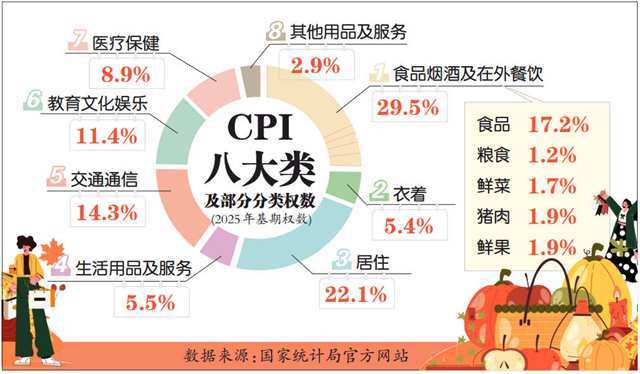
Group 1 - The core idea of the news is the upcoming price index base period rotation in China, which is a fundamental statistical practice to ensure that the Consumer Price Index (CPI) accurately reflects current consumer behavior and economic conditions [2][3]. - The base period rotation will update the reference point for price comparisons from 2020 to 2025, allowing for a more accurate representation of the changes in consumer spending patterns [2][3]. - The CPI is designed to reflect the price level changes of a representative basket of goods and services consumed by residents over a certain period [2]. Group 2 - The rotation will involve adjustments to the CPI survey classification directory, survey points, representative specifications, classification weights, and price comparison base periods [4]. - New categories reflecting current consumption trends will be added, such as housing security equipment, elderly products, dishwashers, electric vehicle charging, photography services, internet medical services, and medical beauty services [4]. - The name of the "Food, Tobacco, and Alcohol" category will be changed to "Food, Tobacco, Alcohol, and Dining Out," and "Tourism" will be renamed to "Travel Agency and Other Tourism Services" to better reflect consumer spending [4]. Group 3 - The national CPI survey will cover approximately 120,000 points and about 620,000 specifications, expanding the coverage compared to the previous base period [6]. - New retail formats, such as membership-based supermarkets and flash sales platforms, will be included in the survey points, along with new representative specifications like smart drones [6]. - The data collection methods for CPI will be optimized, with an increased use of big data applications, including online transaction prices and administrative records [6]. Group 4 - The CPI weights, which represent the expenditure share of each category in the fixed basket, will see minor overall changes compared to the 2020 base period, with service weights increasing and consumer goods weights decreasing [7]. - Specific categories such as Food, Tobacco, and Alcohol; Transportation and Communication; Education, Culture, and Entertainment; Medical Care; and Other Goods and Services will see an increase in their weights [7]. Group 5 - The base period rotation will impact various policies linked to the CPI, such as price subsidy mechanisms for low-income groups when CPI growth exceeds certain thresholds [8]. - A more accurate CPI will also provide a reference for adjustments in interest rates, minimum pensions, and other livelihood policies [8].
招商宏观:春节错月导致CPI显著回落
Sou Hu Cai Jing· 2026-02-12 03:50
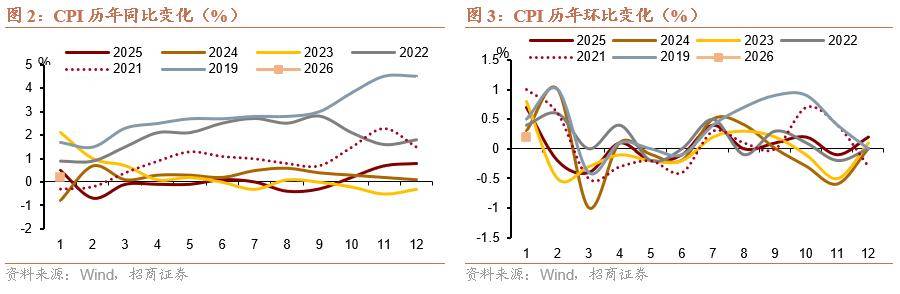
Group 1: CPI Analysis - In January, the CPI increased by 0.2% month-on-month and 0.2% year-on-year, with a significant drop in year-on-year growth due to the timing of the Spring Festival [1] - The food item saw a year-on-year decline of 0.7%, down 1.8 percentage points, while pork prices continued to be under pressure with a year-on-year drop of 13.7% [1] - Core CPI, excluding food and energy, recorded a year-on-year increase of 0.8%, down 0.4 percentage points from the previous month, but month-on-month, it reached a six-month high of 0.3% [1] Group 2: PPI Analysis - In January, the PPI decreased by 1.4% year-on-year, but the decline narrowed by 0.5 percentage points from the previous month, with a month-on-month increase of 0.4%, marking four consecutive months of growth [2] - Key industries such as cement and photovoltaic equipment saw price increases, with cement rising by 0.1% and photovoltaic equipment by 1.9% month-on-month [2] - The prices in the non-ferrous metal industry surged, with mining and processing prices increasing by 5.7% and 5.2% respectively [2] Group 3: Future Expectations - The CPI for February is expected to rise by 1.3% year-on-year, potentially reaching a new high since February 2023, driven by the Spring Festival demand [3] - The PPI is anticipated to turn positive in the second quarter of this year, reflecting improvements in industrial price environments and the gradual recovery of economic momentum [3] - Current policies are focused on expanding domestic demand and promoting reasonable price recovery, which is expected to support the overall economic environment [3]