
Music Streaming

Search documents
Spotify to raise US prices in first quarter of next year, FT reports
Reuters· 2025-11-24 23:26
Core Insights - Spotify plans to increase its U.S. subscription prices in the first quarter of next year, as reported by the Financial Times, citing three sources familiar with the matter [1] Company Summary - The price hike is expected to impact Spotify's subscription model, potentially affecting user retention and revenue growth [1] - The decision to raise prices may reflect broader trends in the streaming industry, where companies are adjusting pricing strategies to enhance profitability [1] Industry Summary - The streaming industry is experiencing shifts in pricing strategies as companies seek to balance user growth with financial sustainability [1] - This move by Spotify may signal a trend among competitors to follow suit in raising subscription prices [1]



Chartmetric Integrates NetEase Cloud Music Charts, Offering Global Industry Deeper Insight into China's Streaming Landscape
Prnewswire· 2025-11-24 15:00
Core Insights - Chartmetric has integrated chart data from NetEase Cloud Music, enhancing access to regional listening trends for global music professionals [1][2] - The integration aims to bridge the data gap between China's music ecosystem and the global market, facilitating artist development and marketing strategies [2][3] Company Overview - NetEase Cloud Music is a leading music streaming platform in China, primarily catering to a youth demographic, with 90% of its users under the age of 35 [2][5] - The platform is pivotal for music discovery, especially for international and independent artists, and generates significant streaming volumes for global acts [3][5] Chartmetric Integration - Chartmetric now tracks three key rankings from NetEase: China Hot 100 Songs Chart (weekly), International Hot 100 Songs Chart (weekly), and International New 100 Songs Chart (daily) [7] - This integration allows users to monitor performance across China's streaming ecosystem and compare regional trends with global benchmarks [7] Recent Developments - Mariah Carey launched her album "Here For It All" in China via NetEase Cloud Music, achieving quadrupled first-week streams compared to her previous album "Caution" [4] - This launch is noted as Carey's strongest studio album debut in the Chinese market to date [4] Industry Impact - The collaboration between NetEase Cloud Music and Chartmetric is expected to expand visibility for artists and foster new opportunities for discovery and collaboration within the music industry [3][6] - Over 5,000 organizations in the music industry utilize Chartmetric's tools for market intelligence and to identify emerging talent [7]


付费模式触顶、免费势力上行,音乐平台竞争逻辑的再分层
3 6 Ke· 2025-11-21 01:09
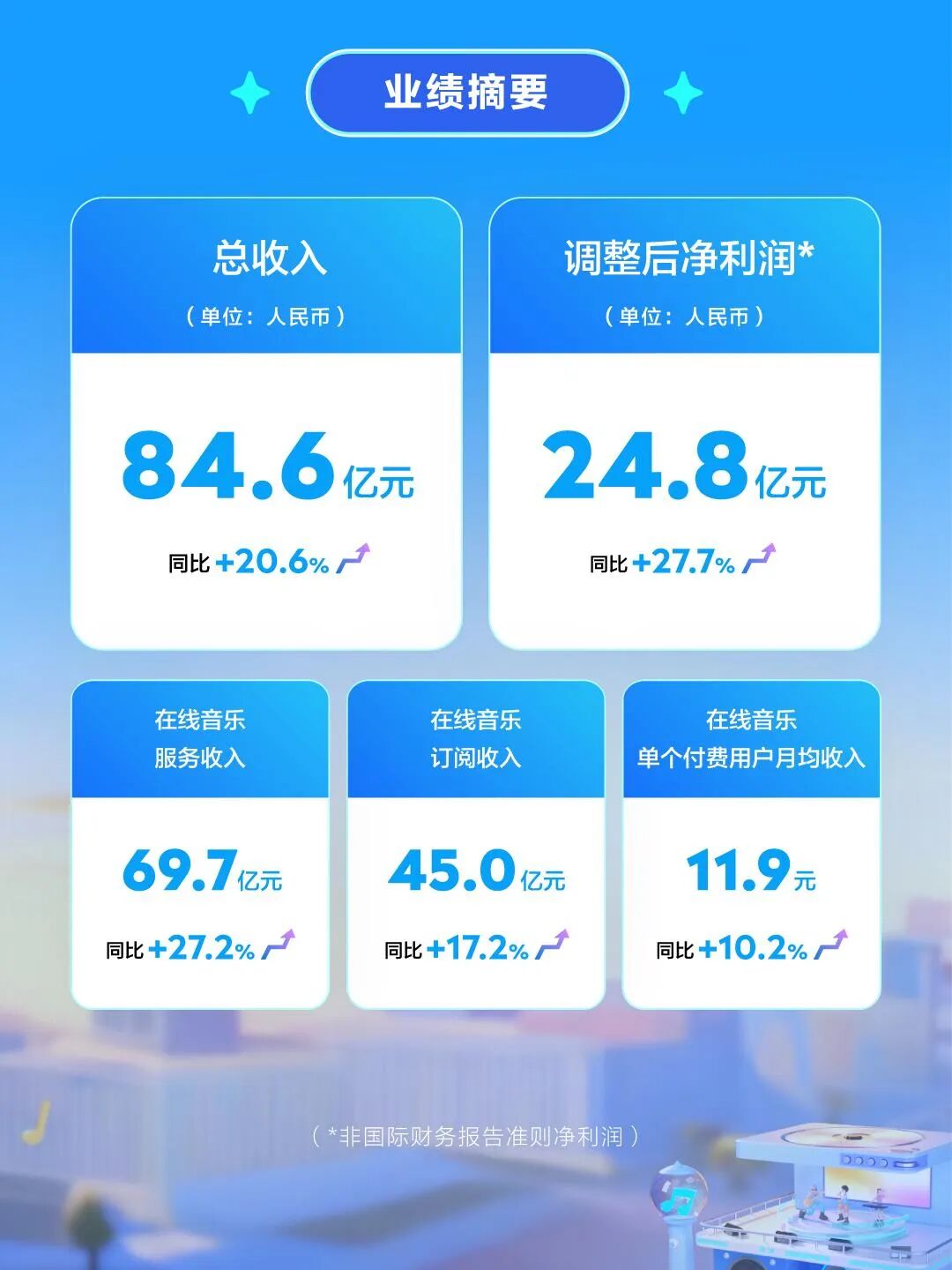
Core Insights - The traditional growth logic of online music platforms, centered around "paid" and "copyright," is showing signs of instability as Tencent Music's growth stabilizes and NetEase Cloud Music experiences stagnation in revenue growth [1][2] - The industry appears to be entering a "next problem cycle," with ByteDance's free music platforms rapidly gaining user engagement, leading to a clear "cross curve" where mainstream paid platforms are slowing down while free platforms are surging [1][8] Tencent Music Performance - Tencent Music reported a total revenue of 84.6 billion yuan in Q3, a year-on-year increase of 20.6%, marking a new high since last year [2] - The adjusted net profit reached 24.1 billion yuan, with online music service revenue growing by 27.2% to 69.7 billion yuan [2][4] - Online music paying users increased by 5.6% year-on-year to 125.7 million, with ARPPU rising from 10.8 yuan to 11.9 yuan, a growth of 10.2% [4] User Engagement Trends - Despite strong revenue figures, Tencent Music's online music mobile MAU declined by 4.3% year-on-year to 551 million, marking the 16th consecutive quarter of decline [5] - The growth of paying users is slowing, with a noticeable decrease in the net increase of paying users since Q2 2024, leading to a negative market reaction with a nearly 13% drop in stock price post-earnings report [5][7] NetEase Cloud Music Performance - NetEase Cloud Music reported a net revenue of 2.0 billion yuan (approximately 275.9 million USD) in Q3 2025, a decline of 1.8% compared to the same period last year [5] - The gross profit for Q3 was 655.2 million yuan, remaining relatively stable year-on-year [5] Industry Challenges - A common issue for both platforms is the slowing subscription growth, indicating that the traditional "copyright barrier + library scale" logic is no longer sufficient for high growth [7] - High copyright costs and a slowdown in the addition of premium content, combined with fragmented listening habits among younger users, are diminishing the persuasive power of library differentiation [7] Rise of Free Music Platforms - ByteDance's free music platforms, such as Soda Music and Tomato Listening, are rapidly gaining traction, with Soda Music's MAU growing from 6 million to 120 million in just three years, achieving a year-on-year growth rate of 90.7% [10][12] - The user base of Tencent's KuGou and QQ Music has seen a decline, with significant user migration to Soda Music, which has captured over 17 million users from Tencent Music [12] Strategic Shifts - The competition is shifting from a focus on paid platforms to a battle for user attention, with free platforms leveraging algorithm-driven recommendations to attract users who are less sensitive to copyright and payment [14][15] - Tencent Music is exploring global partnerships and expanding its content supply system while launching a simplified music service targeting students and light users to counter the impact of ByteDance's free offerings [15][19] Conclusion - The music industry is transitioning from a "paid model competition" to a "attention model competition," indicating a significant structural change driven by the rise of free music platforms [20][21]

After Plunging 17.5% in 4 Weeks, Here's Why the Trend Might Reverse for Tencent Music Entertainment Group (TME)
ZACKS· 2025-11-20 15:35
Core Viewpoint - Tencent Music Entertainment Group (TME) has experienced a significant decline of 17.5% over the past four weeks, but it is now in oversold territory, indicating a potential trend reversal supported by analyst consensus for better earnings than previously predicted [1] Group 1: Technical Analysis - The Relative Strength Index (RSI) is a momentum oscillator that helps identify whether a stock is oversold, with readings below 30 indicating oversold conditions [2] - TME's current RSI reading is 26.72, suggesting that the heavy selling pressure may be exhausting, and a trend reversal could occur soon [5] Group 2: Fundamental Analysis - Analysts have raised earnings estimates for TME, with a 1.2% increase in the consensus EPS estimate over the last 30 days, indicating potential price appreciation in the near term [6] - TME holds a Zacks Rank 2 (Buy), placing it in the top 20% of over 4,000 ranked stocks based on earnings estimate revisions and EPS surprises, further supporting the stock's potential turnaround [7]

Spotify acquires music database WhoSampled
TechCrunch· 2025-11-19 19:59
Core Insights - Spotify has acquired WhoSampled, a community-run database that tracks sampled music, enhancing its music discovery features [1][2] - The acquisition includes both the WhoSampled team and its database, which contains over 1.2 million songs and nearly 622,000 samples [1] - WhoSampled will maintain its standalone platform and brand post-acquisition, with plans for user-facing improvements [3][4] Company Overview - WhoSampled, launched in 2008 and based in London, provides an extensive database of songs, samples, covers, and remixes [1] - The company had a small team of around 10 employees prior to the acquisition [1] Strategic Implications - The acquisition aligns with Spotify's vision of enhancing musical context and improving user engagement with music [4] - WhoSampled's data will support Spotify's new features, including the upcoming music discovery tool SongDNA [1]

后版权时代,汽水音乐掀桌?
3 6 Ke· 2025-11-18 01:09
Core Insights - The emergence of Qishui Music as a significant player in the music streaming industry is reshaping the competitive landscape, prompting established giants like Tencent Music and NetEase Cloud Music to reassess their market positions [1][2][9] User Growth and Market Dynamics - Qishui Music has rapidly grown to 120 million active users by September 2025, positioning itself as the fourth largest player in the industry, following Tencent Music, QQ Music, and NetEase Cloud Music [1][4] - Tencent Music's stock fell by 11% following its Q3 2025 earnings report, despite reporting a total revenue of 8.46 billion yuan, a year-on-year increase of 20.6% [1][8] - The user overlap between Qishui Music and traditional platforms like QQ Music and NetEase Cloud Music is only 2%-3%, indicating that Qishui Music is attracting new users rather than merely redistributing existing ones [9][10] Business Model and Revenue Streams - Qishui Music employs a "free + subscription" model, significantly lowering the barriers to entry for users, which contrasts with the traditional subscription-based revenue model of Tencent Music and NetEase Cloud Music [11][13] - Tencent Music's subscription revenue accounted for 53.2% of its total revenue in Q3 2025, while Qishui Music's approach focuses on user engagement through low-cost membership options and promotional offers [11][13] Competitive Strategies - Qishui Music leverages its integration with Douyin (TikTok) to enhance user engagement and retention, with 38% of its users also active on Douyin [4][6] - The platform's algorithm-driven recommendations and short video experiences have proven effective in attracting users, leading to a 90.7% year-on-year increase in active users as of September [6][8] Industry Implications - The loosening of exclusive music copyright agreements has allowed Qishui Music to enter the market more effectively, capitalizing on the shift towards shared rights among platforms [2][3] - The competitive pressure from Qishui Music is forcing Tencent Music and NetEase Cloud Music to innovate and adapt their business models to retain users and market share [17]

When Rule Breakers Find Religion (or, at Least Profits)
Yahoo Finance· 2025-11-17 18:55
分组1: Shopify - Shopify's third-quarter earnings showed a 32% increase in both revenue and gross merchandise volume, indicating strong growth despite rising costs [2][6] - The company is focusing on expanding its subscription-style solutions, which has helped attract new merchants and increase transaction volumes [2][6] - However, costs associated with merchant solutions are rising faster than revenue, impacting gross margins and earnings growth [2][6] - Management anticipates slower revenue growth in the upcoming quarter, leading to a decline in share prices despite a strong performance over the past year [2][6] - Shopify's gross merchandise volume reached $350 billion, suggesting significant growth in e-commerce, although it is still behind Amazon's total e-commerce revenue [2][6] 分组2: Spotify - Spotify reported a 30% year-over-year increase in operating profits, with gross margins improving to 31.6% from 31.1% a year ago [6][8] - The company is diversifying revenue streams and cutting expenses, which is helping to improve profitability and cash flow [6][8] - Despite the positive trends, revenue growth and average revenue per user are slowing, raising concerns about future growth potential [6][8] - Spotify has over 700 million monthly active users, with premium subscribers making up 39% of users but generating 90% of revenue [6][8] - The global podcast market is expected to grow significantly, providing further opportunities for Spotify to expand its user base and revenue [8][9] 分组3: Uber - Uber has made significant strides toward profitability by managing operating costs and implementing more profitable pricing algorithms [12][14] - The company is leveraging generative AI to improve productivity and is shifting towards a hybrid model for driver supply, which includes partnerships with fleet operators [12][14] - Uber is projected to support 14 billion trips by the end of the year, showcasing its growth and scale in the market [12][14] - The company faces criticism for its dynamic pricing strategies, which have led to increased trip costs, potentially affecting consumer sentiment and regulatory scrutiny [14][16] - Despite concerns, Uber's pricing models are currently benefiting the company, and it is likely to continue utilizing these strategies in the near term [14][16]
Spotify Stock Has Soared by 40% in 2025, but Here's 1 Big Reason to Be Cautious Heading Into 2026
The Motley Fool· 2025-11-15 09:12
Core Insights - Spotify has outperformed the S&P 500 in 2025 with a 40% return compared to the index's 16% increase, but caution is advised for 2026 [1][2] Company Overview - Spotify is the largest music streaming platform globally, holding a 31.7% market share, significantly ahead of Tencent Music at 14.4% [3] - The company competes by enhancing user experience through advanced technology and diverse content formats, including podcasts and audiobooks [3] Technological Advancements - Artificial intelligence is central to Spotify's strategy, improving its recommendation engine and enabling features like AI Playlist [4] - An integration with OpenAI's ChatGPT allows users to interact with the platform for music recommendations [5] Content Strategy - Spotify is focusing on expanding its video podcast library, which has seen user engagement more than double year-over-year in Q3 2025 [6] - The platform has 281 million Premium subscribers and 446 million ad-supported users, with Premium subscribers contributing approximately 90% of total revenue [7] Financial Performance - In Q3 2025, Spotify generated $4.9 billion in revenue, a 7% increase year-over-year, with a projected total revenue of $19.9 billion for the year, reflecting a 9.5% growth from 2024 [8] - The company is expected to see accelerated growth of 14.5% in 2026, with a significant increase in net income by 200% to $1.04 billion [9] Valuation Concerns - Spotify's current price-to-sales (P/S) ratio is 7.1, which is 69% higher than its average since going public [11] - The price-to-earnings (P/E) ratio stands at 99.2, significantly above the S&P 500's 25.7, indicating a higher valuation compared to the broader market [13] - Even with projected earnings for 2026, Spotify's forward P/E ratio of 45.3 suggests limited upside potential for short-term investors [14] Long-term Outlook - Despite current valuation concerns, long-term prospects remain positive, with forecasts suggesting revenue could reach $100 billion by 2032, indicating substantial growth potential [16]

腾讯音乐-SW(01698.HK):非订阅音乐业务加大投入 深入挖掘产业链价值
Ge Long Hui· 2025-11-14 21:31
Core Viewpoint - The company reported a slight beat in Q3 2025 earnings, driven by strong performance in non-subscription music business [1][2] Performance Review - Q3 2025 revenue reached 8.46 billion yuan, a year-on-year increase of 20.6% - Non-IFRS net profit attributable to the parent company was 2.41 billion yuan, up 32.6%, slightly above the expected 2.30 billion yuan, mainly due to better-than-expected performance in non-subscription music [1] Development Trends - Subscription business shows profitability resilience, while non-subscription business has significant growth potential - Subscription Revenue: Q3 2025 revenue increased by 17.2% to 4.49 billion yuan, with paid users increasing by 1.3 million to 126 million, and ARPPU rising by 10.2% to 11.9 yuan/month. Expected growth in Q4 2025 includes an additional 1.3 million paid users and ARPPU rising to 12.1 yuan/month [1] - Non-Subscription Revenue: Q3 2025 revenue surged by 50.3% to 2.48 billion yuan, with concert and artist economy revenues growing rapidly. The company anticipates a 35.7% year-on-year revenue growth for the full year [1] Profitability and Valuation - Q3 2025 gross margin decreased by 0.9 percentage points to 43.5%, with stable sales expenses and a 5.3% year-on-year increase in management expenses. The company indicated that investments in offline performances and IP economy are crucial for long-term growth [2] - The company maintains a "one body, two wings" strategy to explore the full value of the industry chain, enhancing collaboration with global record companies and innovating product functions and services [2] - Adjustments to profit forecasts for 2025 and 2026 reflect new business growth and potential investments, with Non-IFRS net profit estimates revised to 9.63 billion yuan and 10.75 billion yuan respectively. Current P/E ratios for US and Hong Kong stocks are 24/21 times and 25/22 times for 2025/2026 [2]
Tencent (TME) Loses 8% on Lower PT
Yahoo Finance· 2025-11-13 17:46
Core Viewpoint - Tencent Music Entertainment Group (NYSE:TME) experienced significant selling pressure, with its stock price dropping by 8.39% to close at $19.01 due to a lowered price target from an investment firm [1]. Financial Performance - In the third quarter, Tencent Music reported a net income attributable to shareholders of 2.4 billion yuan, a 32% increase from 1.814 billion yuan in the same period last year [3]. - Revenues for the same quarter rose by 20.6% to 8.463 billion yuan, up from 7.015 billion yuan year-on-year, driven primarily by a 27% growth in revenues from online music services [3]. Analyst Ratings - Macquarie reduced its price target for Tencent Music to $28.30 from $29.80, while maintaining an "outperform" rating, indicating a potential upside of 49% from the latest closing price [2]. Company Strategy - The company highlighted its solid results, attributing them to the strong performance of its online music business, innovations in content, and expansion of services, which have contributed to consistent subscription revenue growth [4]. - Tencent Music's Executive Chairman emphasized the company's strong financial position and operational excellence, indicating plans to broaden music services and create greater value for the music industry [5].
