政府债券

Search documents
财政部拟发行2026年记账式贴现(七期)国债,招标面值总额450亿元
Sou Hu Cai Jing· 2026-01-29 11:20
Group 1 - The Ministry of Finance plans to issue a 2026 book-entry discount treasury bond, specifically the seventh phase [1] - This treasury bond has a term of 182 days and a total competitive bidding face value of 45 billion yuan [1] - The issuance price of this treasury bond will be determined through competitive bidding at a discount to the face value [1] Group 2 - The bond will start accruing interest on February 4, 2026, and will be repaid at face value on August 5, 2026, with adjustments for holidays [1] - The bidding time for this treasury bond is set for February 3, 2026, from 10:35 AM to 11:35 AM [1]
宏观经济专题:从专项债投向拆解衡量财政实际力度
KAIYUAN SECURITIES· 2026-01-20 08:12
Fiscal Support and Debt Structure - In 2025, the total issuance of special bonds reached 4.59 trillion yuan, an increase of approximately 590 billion yuan compared to 2024, marking the highest level in five years[3] - The proportion of special bonds used for debt repayment increased significantly, with 21 provinces raising their share, particularly in "self-audit and self-initiated" provinces[4] - Special bonds for land reserve accounted for about 17% of the total new special bonds issued in 2025, totaling approximately 545.1 billion yuan[6] Investment Trends and Structural Changes - The support for infrastructure investment weakened, with the proportion of general budget expenditure on infrastructure dropping to 18.6% in 2025, down from a stable range of 24%-25% in previous years[15] - Traditional infrastructure and social projects saw a notable decline in funding, particularly in key provinces focused on debt resolution, where funding for infrastructure projects decreased significantly[5] - The shift from traditional infrastructure to land reserve projects indicates a changing focus in investment strategies, with "investment in people" still in its early stages[4] Economic Outlook and Fiscal Balance - The fiscal surplus for 2025 is projected to be around 700 billion yuan, with a potential surplus of 400 billion yuan available for the first quarter of 2026, depending on the spending and revenue performance in December[7] - The issuance of local special bonds in the first quarter of 2026 is expected to maintain the same level as in 2025, with limited incremental increases[7] Risks and Challenges - There are risks associated with policy execution not meeting expectations and potential economic downturns exceeding forecasts[8]
助力经济平稳开局 地方债“早发早用早见效”
Zhong Guo Zheng Quan Bao· 2026-01-08 22:12
Core Viewpoint - The issuance of local government bonds is expected to accelerate in 2026, with a focus on effective investment and economic stabilization, particularly in new infrastructure and urban renewal projects [1][3][4]. Group 1: Local Government Bond Issuance - Ningbo issued 25.372 billion yuan in local bonds on January 8, while Shandong was the first province to issue bonds this year with 72.381 billion yuan on January 5 [1]. - The Ministry of Finance plans to expedite the allocation of the 2026 local government debt limit, facilitating early issuance and usage of bonds to support key projects [2]. - As of January 8, 27 regions, including Beijing and Hebei, have disclosed bond issuance plans for the first quarter, totaling approximately 2 trillion yuan [2]. Group 2: Investment Focus and Economic Impact - The newly disclosed special bonds are primarily directed towards new infrastructure and urban renewal, which are expected to enhance effective investment and stimulate domestic demand [1][3]. - The first quarter of 2026 is projected to see a significant issuance of special bonds, with an estimated scale of around 670 billion yuan [3]. - The focus on major projects in transportation, energy, and urban renewal is seen as essential for both expanding domestic demand and ensuring high-quality development during the 14th Five-Year Plan period [3][4]. Group 3: Trends in Special Bond Issuance - The issuance and utilization of special bonds in 2026 are anticipated to follow three main trends: steady expansion of issuance scale, continued front-loading of issuance rhythm, and an expanded range of funding applications [4]. - The expansion of the funding scope for special bonds will include quasi-public sectors such as the acquisition of existing residential properties [4]. - There is a need for enhanced evaluation mechanisms for special bond projects to ensure quality and prevent misuse of funds [5].
宏观纵览 | 明年一季度地方计划发债超万亿,积极财政政策靠前发力
Sou Hu Cai Jing· 2025-12-23 10:57
Core Viewpoint - Local governments are preparing to issue government bonds early next year to support major project construction, which will lay a solid foundation for economic growth in 2026 and ensure a good start for the "14th Five-Year Plan" [1][5] Group 1: Bond Issuance Plans - At least 14 provinces and cities have publicly disclosed plans to issue government bonds in the first quarter of next year, with a cumulative issuance scale nearing 1.2 trillion yuan [1][3] - Jiangsu plans to issue a total of 105.6 billion yuan in government bonds in the first quarter, including 70 billion yuan in new bonds and 35.6 billion yuan in refinancing bonds [3] - Ningbo is set to issue 32.6 billion yuan in new special bonds and 1 billion yuan in new general bonds in early January [6] Group 2: Fiscal Policy and Debt Management - The central government has authorized the early issuance of next year's local government debt limits to facilitate timely bond issuance and support major projects [3][4] - The new local government debt limit for 2025 is set at 5.2 trillion yuan, with the early issuance for 2026 not exceeding 3.12 trillion yuan, adhering to a 60% cap [4] - The Ministry of Finance plans to issue 2 trillion yuan in refinancing bonds in 2026 to replace existing hidden debts, aiming to alleviate local government debt risks [8] Group 3: Investment and Economic Impact - The central economic work conference emphasized the need for a more proactive fiscal policy in 2026 to stabilize investment and promote economic recovery [5] - The early issuance of bonds is expected to effectively drive social investment and amplify investment effects, significantly contributing to economic growth [8] Group 4: Optimization of Bond Management - The National Development and Reform Commission plans to optimize the management of local government special bonds, allowing for more flexibility and autonomy in project approval [9] - Pilot programs for "self-examination and self-issuance" of special bond projects have been implemented in several provinces to enhance issuance efficiency [9]
深交所:2025年新疆维吾尔自治区政府专项债券(五十四期)12月23日上市交易
Sou Hu Cai Jing· 2025-12-19 08:24
Group 1 - The core announcement is regarding the listing of the 2025 Xinjiang Uygur Autonomous Region Government Special Bonds (54th issue) on the Shenzhen Stock Exchange, effective December 23, 2025 [1] - The total issuance amount of this bond is 2.595 billion yuan, with a fixed interest rate of 2.5% and a maturity period of 20 years [1]
前三季度政府债供给创高峰,化债加快推进
Lian He Zi Xin· 2025-12-03 11:00
1. Report Industry Investment Rating No relevant information provided. 2. Core Viewpoints of the Report - In the first three quarters of 2025, the issuance scale and net financing of local government bonds reached a record high for the same period, with the 2 - trillion - yuan implicit debt replacement nearing completion. The fourth - quarter government bond supply pressure is expected to decline, and the incremental fiscal policy will maintain its previous positive tone, with ample room for future action. The bond market interest rate is expected to fluctuate downward within a certain range, and efforts will continue to be made to resolve debts while promoting development and build a long - term government debt management mechanism [2][32][34]. 3. Summary According to the Directory 3.1 Local Government Bond - Related Policy Review - Fiscal policy: A more active fiscal policy is implemented, with a larger - scale government bond issuance plan. The fiscal deficit rate is increased to about 4%, and the deficit scale is 5.66 trillion yuan. The planned issuance of ultra - long - term special treasury bonds is 1.3 trillion yuan, and special treasury bonds of 500 billion yuan are to support state - owned banks in replenishing core tier - one capital. The new local government special bond quota is 4.4 trillion yuan. The government also promotes the early issuance and use of bonds and guides and drives social capital [4][5][6]. - Debt replacement: The implicit debt replacement policy is accelerated, with a 6 - trillion - yuan local government debt quota approved to replace the stock implicit debt from 2024 - 2026, 2 trillion yuan per year. Additionally, 80 billion yuan is allocated from new local government special bonds annually for five consecutive years for debt resolution. The debt - risk - high area list is dynamically adjusted [7][8]. - Debt management: The local debt monitoring system and government debt risk indicator system are improved, and the special bond management mechanism is optimized. Penalties for illegal debt - raising and false debt - resolution are strengthened, and the reform and transformation of local government financing platforms are promoted [9]. 3.2 Review of the Local Government Bond Market in the First Three Quarters of 2025 - **Issuance overview**: In the first three quarters of 2025, 1,816 local government bonds were issued, totaling 8.53 trillion yuan, a 27.60% increase year - on - year. Special bonds accounted for 75.96% of new issuances. New bonds were issued at 4.35 trillion yuan, and refinancing bonds at 4.18 trillion yuan, with 1.99 trillion yuan of special refinancing special bonds for implicit debt replacement. The net financing was 6.15 trillion yuan, a 54.24% increase. The issuance of land reserve special bonds accelerated in Q3. The issuance of bonds with a term of 10 years or more increased, and the weighted average issuance term was 15.63 years. Economically active regions and "self - review and self - issuance" pilot areas were the main issuers of new special bonds, while key provinces mainly issued refinancing bonds [13][19][20]. - **Interest rate and spread analysis**: In Q3 2025, the average issuance interest rate of local government bonds rebounded due to multiple factors. The average issuance interest rates in Q1, Q2, and Q3 were 1.94%, 1.85%, and 2.01% respectively. The spread widened in the first three quarters of 2025, and there were significant differences in the spread trends among provinces [22][23]. - **Investment areas of local government special bonds**: In the first three quarters of 2025, infrastructure was the main focus of special bond funds. The top three investment areas were urban infrastructure, transportation infrastructure construction, and urban - rural development, accounting for 51.95% of the total. Land reserve special bonds for idle land recovery projects restarted, with an issuance amount accounting for 7.01% [29]. 3.3 Future Outlook for Local Government Bonds - **Issuance outlook**: In the fourth quarter, the government bond issuance will enter the final stage, with reduced supply pressure. The new local government debt quota for 2026 is expected to be issued more quickly. The planned issuance of local government bonds in Q4 is 1.26 trillion yuan, including 730 billion yuan of new special bonds [32]. - **Fiscal policy outlook**: The fiscal policy will maintain its previous positive tone in Q4, with funds tilted towards large economic provinces. The government will strengthen the supervision of relevant funds and project lifecycle management [34]. - **Interest rate outlook**: The bond market interest rate is expected to fluctuate downward within a certain range, affected by multiple factors such as monetary policy, market sentiment, and policy changes [35]. - **Debt management outlook**: The principle of resolving debts while promoting development will be adhered to, and efforts will be made to build a long - term government debt management mechanism. The government will continue to implement a package of debt - resolution measures, strengthen debt management, and improve the performance of bond fund use [36][37].
日本增发巨额国债刺激经济,债汇遭抛售或触发全球债市风暴
2 1 Shi Ji Jing Ji Bao Dao· 2025-11-29 08:00
Core Viewpoint - The Japanese government is planning to finance a new round of economic stimulus through a significant increase in government bond issuance, amounting to approximately 11.7 trillion yen (about 529.9 billion RMB) to cover the spending gap from the recently announced economic measures [1][2]. Group 1: Economic Stimulus Plan - The 2025 supplementary budget is expected to have general account expenditures of about 18.3 trillion yen, with 17.7 trillion yen allocated for the implementation of the economic measures, marking a substantial 27% increase from the previous year's 13.9 trillion yen [2]. - The total scale of the comprehensive economic measures is approximately 21.3 trillion yen, indicating a significant commitment to economic stimulus despite the associated debt concerns [1][2]. Group 2: Debt Issuance and Market Reaction - The planned bond issuance significantly exceeds the 6.7 trillion yen in bonds issued by the previous administration, reflecting Japan's heavy reliance on debt financing [2]. - The Japanese yen and long-term government bonds have been under pressure, with the yen trading around 156 against the dollar and long-term bond yields rising, indicating market concerns over Japan's fiscal health [3][4]. Group 3: Fiscal Concerns and Future Outlook - Japan's debt-to-GDP ratio has surpassed 260%, raising questions about the government's ability to balance economic stimulus with fiscal responsibility [5]. - Analysts express concerns that continued reliance on debt issuance could exacerbate fiscal deterioration, especially given the pressures from an aging population and the sustainability of tax revenue growth [5][6]. - The potential for rising interest rates, coupled with high leverage, could increase interest expenditure as a proportion of fiscal spending, further straining the budget [5][6]. Group 4: Global Implications - The ongoing sell-off of Japanese assets may have broader implications for global markets, particularly if investors liquidate overseas assets to cover yen-denominated loans, potentially impacting U.S. Treasuries and equities [7]. - The risk of a liquidity crunch in global markets could arise if yen carry trades are unwound, leading to capital outflows from emerging markets [7].
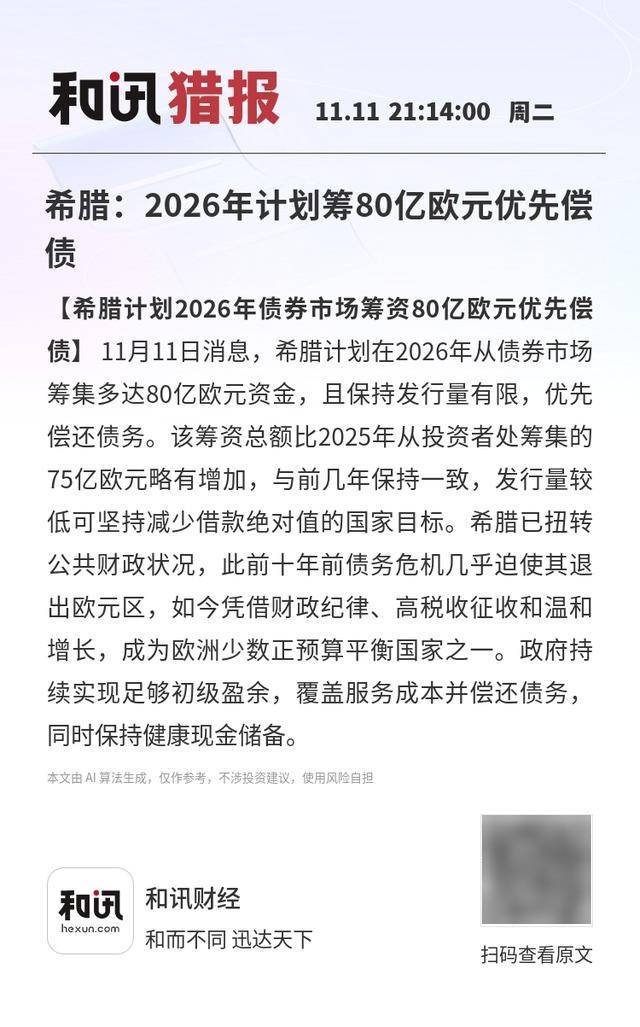
希腊:2026年计划筹80亿欧元优先偿债
Sou Hu Cai Jing· 2025-11-11 14:20
Core Points - Greece plans to raise up to €8 billion from the bond market in 2026, prioritizing debt repayment while maintaining limited issuance [1][2] - The planned fundraising amount is slightly higher than the €7.5 billion raised in 2025, consistent with previous years, and aims to reduce the absolute value of borrowing [1][2] - Greece has successfully reversed its public finance situation, recovering from a debt crisis that nearly forced it out of the Eurozone a decade ago [1][2] - The country is now one of the few in Europe with a balanced budget, supported by fiscal discipline, high tax collection, and moderate growth [1][2] - The government continues to achieve sufficient primary surpluses to cover service costs and repay debt while maintaining healthy cash reserves [1][2]

【专项债】最新中央审计报告发现的问题汇总
Sou Hu Cai Jing· 2025-10-28 11:22
Core Insights - The report highlights significant issues in the management and usage of local special bonds across nine provinces, with identified problems involving a total amount of 132.597 billion yuan [2] Group 1: Violations and Mismanagement - Issue 1: Nine regions illegally borrowed 2.029 billion yuan, primarily for prohibited projects such as lighting projects and government buildings, violating the negative list management outlined in the State Council's document [3] - Issue 2: Seven provinces falsely reported expenditure completion totaling 46.435 billion yuan, exploiting loopholes in the monitoring system that lacks proper separation of duties, allowing individuals to self-fill, self-review, and self-report [4] - Issue 3: 92 regions misappropriated 65.18 billion yuan, mainly for "three guarantees" and repaying state-owned enterprise debts, which is against the regulations prohibiting the use of special bonds for regular expenditures [5] Group 2: Idle and Wasted Funds - Issue 4: 70 regions had idle or wasted funds amounting to 18.953 billion yuan, caused by over-issuance of bonds, insufficient preparation, and policy changes leading to project termination, with 2.157 billion yuan already incurring interest of 129 million yuan [6]

今年以来广义财政收入增速首次转正,增量政策陆续出台实施
第一财经· 2025-10-23 15:10
Core Viewpoint - The article discusses the recovery of China's fiscal revenue in 2023, driven primarily by tax revenue growth, alongside the implementation of proactive fiscal policies to stabilize the economy and support key sectors [3][4]. Fiscal Revenue and Tax Recovery - In the first three quarters of 2023, the broad fiscal revenue reached 194,593 billion yuan, marking a year-on-year growth of approximately 0.4%, the first positive growth this year [3][4]. - The general public budget revenue was 163,876 billion yuan, with tax revenue at 132,664 billion yuan, showing a year-on-year increase of 0.5% and 0.7% respectively [6][4]. - Tax revenue growth turned positive in 2023, with September seeing an 8.7% year-on-year increase, the highest monthly growth this year [6][4]. - The recovery in tax revenue is attributed to improved corporate performance and active capital market transactions, with capital market-related tax revenue increasing by 56.8% year-on-year [6][4]. - Non-tax revenue, however, declined by 0.4% to 31,212 billion yuan, primarily due to a high base from the previous year and stricter regulation on administrative penalties [8][7]. Government Fund Revenue - Government fund revenue, mainly from land sales, decreased by 0.5% to 30,717 billion yuan, with land use rights revenue dropping by 4.2% to 22,302 billion yuan [12][4]. - The decline in land sale revenue is attributed to ongoing policies aimed at stabilizing the real estate market [12][4]. Fiscal Expenditure Trends - Fiscal expenditure in the first three quarters reached 208,064 billion yuan, a year-on-year increase of 3.1%, with significant allocations to social security, education, and healthcare [15][4]. - The government has accelerated the issuance of special bonds to support major projects, with net financing from government bonds reaching 1.146 trillion yuan, an increase of 428 billion yuan year-on-year [13][4]. - Government fund expenditure grew significantly by 23.9% to 74,924 billion yuan, reflecting a strong focus on public welfare and infrastructure [16][4]. Economic Stabilization Measures - The government has introduced new policy financial tools worth 500 billion yuan to enhance project capital and stimulate investment, with over 3.3 trillion yuan in total project investment expected [19][4]. - Recent fiscal policies aim to support local governments in managing existing debts and facilitating economic recovery, particularly in major economic provinces [19][4].