贵金属市场

Search documents
双属性加持白银领跑 超买压力拖累黄金 —— Wmax 贵金属市场研判
Sou Hu Cai Jing· 2026-02-26 09:18
Core Viewpoint - The global precious metals market is currently experiencing extreme differentiation, with gold showing signs of structural pullback risk due to historical overbought conditions, while silver is leading the market due to its dual role as a safe-haven and industrial asset, potentially achieving the longest consecutive monthly gains on record [2][6][10]. Group 1: Gold Market Analysis - Gold has stabilized above the critical support level of $5,100 per ounce, driven by increased safe-haven demand amid trade policy uncertainties, but faces significant structural pullback risks due to historical overbought momentum readings [3][10]. - The major resistance zone for gold is identified between $5,200 and $5,300 per ounce, with current momentum showing signs of exhaustion, resembling patterns seen before previous sharp declines [5]. - A critical support level is set at $5,100 per ounce; if gold falls below this level, it may face further consolidation risks, with potential declines to $4,800, $4,630, and $4,380 [5][10]. Group 2: Silver Market Analysis - Silver has outperformed gold year-to-date, with a current price around $88.90 per ounce and a monthly increase of approximately 4.3%, positioning it as the preferred hedging asset in the market [7][10]. - The dual attributes of silver as both an investment safe-haven and an industrial metal, combined with a projected supply deficit of 67 million ounces by 2026, underpin its strong medium to long-term upward trajectory [6][9]. - Short-term fluctuations in silver prices are expected due to profit-taking and sensitivity to economic cycles, but the overall upward trend remains intact unless there is a fundamental shift in global monetary policy or a sudden collapse in industrial demand [9][10].

贵金属:喧嚣后的中场休息: 黄金步入节前“冷静期”
Sou Hu Cai Jing· 2026-02-10 10:51
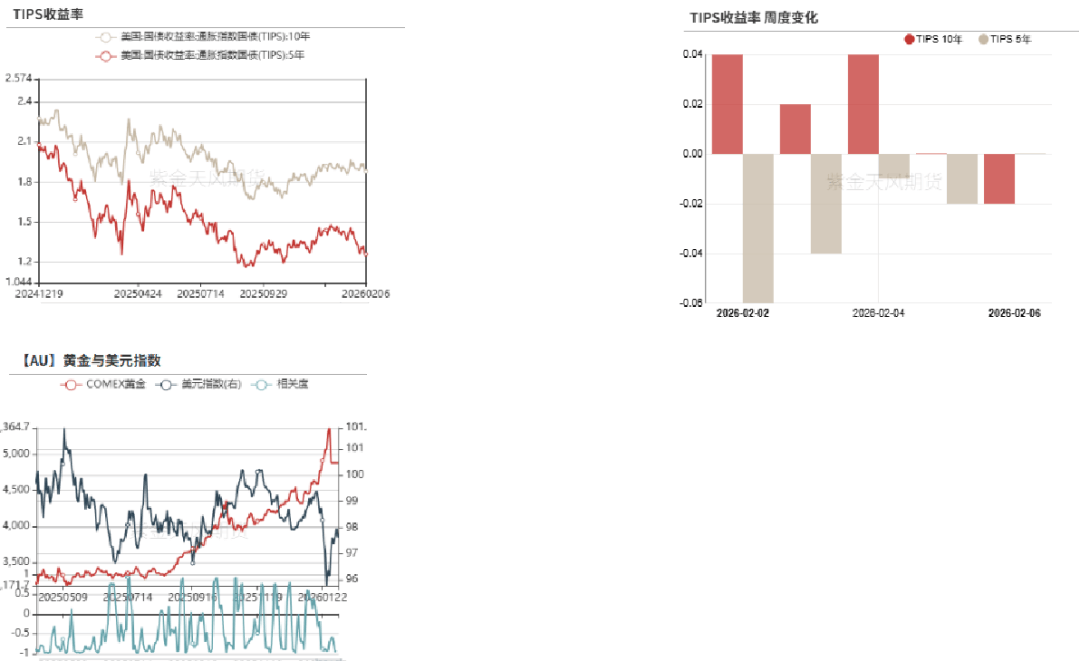
Group 1 - The core viewpoint of the articles indicates a shift in market expectations towards potential interest rate cuts by the Federal Reserve, driven by weak labor market data and changes in monetary policy outlook [1][3] - The labor market data showed a significant drop in job openings, with December's JOLTS vacancies falling to 6.54 million from 6.93 million in November, marking the lowest level since 2020 [1] - The yield curve has steepened following the nomination of a new Federal Reserve chair, with expectations of a dovish monetary policy stance influencing short-term rates while long-term rates are affected by liquidity concerns [3] Group 2 - Gold prices increased by 1.6% over the week, recovering from previous declines, but the market is expected to take time to rebuild confidence and structure [2] - The upcoming Federal Reserve chair's proposal to shorten the average maturity of the Fed's balance sheet may delay the issuance of long-term bonds, providing limited support for gold prices [2] - Chinese demand for precious metals is a key driver, but may weaken temporarily due to the upcoming Lunar New Year, potentially reducing volatility in the global precious metals market [2] Group 3 - The U.S. Treasury yields across various maturities declined, with the 30-year UST down 2 basis points to 4.85%, and the 10-year UST down 3 basis points to 4.2% [3] - The usage of overnight reverse repurchase agreements (ONRRP) fell to $3.11 billion, a decrease of $7.31 billion from the previous week [3] - The net short positions in 2-year and 10-year UST futures increased, indicating a bearish sentiment among non-commercial investors [3] Group 4 - The U.S. dollar index rose by 0.5% to 97.6, moving in tandem with gold prices, which suggests an increasing correlation between the two [7] - The total holdings of the dollar index decreased, with non-commercial long positions down by 1,335 contracts to 17,000 contracts, while short positions decreased by 4,888 contracts to 17,000 contracts [10] - Offshore dollar liquidity costs have risen, as indicated by the decline in the 3-month Basis Swaps for both the yen and euro [13] Group 5 - The copper-to-gold ratio fell to 2.63, indicating a marginal decline in global demand momentum as copper prices dropped while gold prices rose [16] - The gold-silver ratio increased due to the rise in gold prices and the decline in silver prices, reflecting market dynamics [19] - Gold premiums increased after a price correction, indicating strong domestic buying support [28] Group 6 - COMEX gold inventory decreased by 331,000 ounces to 35.294 million ounces, while silver inventory fell by 1.523 million ounces to 39.0466 million ounces [34] - SPDR gold ETF holdings decreased by 7.44 tons to 1,079.7 tons, remaining near the lower median of the past decade [39] - COMEX gold total positions fell by 78,769 contracts to 489,000 contracts, with a notable increase in short positions, indicating a growing bearish sentiment [39]
避险狂潮下的华尔街 “大撤退”:市场重启背后的三重逻辑
Sou Hu Cai Jing· 2026-02-06 05:45
Group 1 - The current mainstream sentiment on Wall Street is characterized by a "run for cover" mentality due to a combination of valuation bubbles, intensified AI competition, and policy uncertainties, leading to a broad retreat from previously favored assets like tech stocks and precious metals [1] - The core trigger for the recent risk-off retreat is the disconnection of popular asset valuations from fundamental support, with tech stocks experiencing inflated valuations driven by the AI boom, while their earnings growth has not kept pace [2] - Precious metals, particularly silver, have seen a significant decline of 17%, attributed to speculative trading that pushed prices to unreasonable highs without underlying economic demand [2] Group 2 - The market sentiment shift from "optimistic expectations" to "cautious defense" is driven by the accumulation of multiple risk factors, including heightened competition in the AI sector and uncertainties surrounding Federal Reserve policy changes [3][4] - Investors are increasingly moving funds from high-risk, overvalued assets into traditional safe-haven investments like U.S. Treasuries, indicating a notable decrease in risk appetite [3] - The essence of the recent risk-off wave is a recalibration of the asset pricing system, as previous bullish assumptions about the stock market are losing their validity due to emerging challenges in AI, economic stability, and unclear monetary policy directions [4] Group 3 - The market is expected to maintain a volatile adjustment phase in the short term, as the digestion of valuation bubbles will take time and key variables remain uncertain [5] - Despite the current risks, the retreat presents opportunities for long-term investors as some quality assets return to reasonable price levels, and ongoing AI advancements may drive industry upgrades and economic growth in the long run [5] - Investors are advised to avoid high-valuation, speculative assets and focus on stable, reasonably valued opportunities while maintaining a cautious defensive posture by allocating to safe-haven assets [5]

黄金、白银,暴跌!
中国能源报· 2026-02-06 04:05
Key Points - The core viewpoint of the articles highlights a significant decline in precious metal prices, particularly gold and silver, alongside a downturn in major U.S. stock indices, indicating a broader market reaction to economic conditions [1][4]. Precious Metals Market - As of February 6, 2023, the London gold spot price dropped over 4% to $4,760.25 per ounce, while COMEX gold futures fell more than 2% to $4,825.5 per ounce [1][4]. - The London silver spot price experienced a dramatic decline of 19%, closing at $71.841 per ounce, with COMEX silver futures down over 14% at $72.565 per ounce [1][4]. - The Shanghai Futures Exchange announced adjustments to margin requirements and price limits for various metals, including gold and silver, effective February 9, 2023 [5][7]. U.S. Stock Market - On February 5, 2023, all three major U.S. stock indices closed lower, with the Dow Jones down 1.2%, the S&P 500 down 1.23%, and the Nasdaq down 1.59% [1]. - Amazon's stock fell over 10% in after-hours trading due to significantly higher capital expenditure expectations than the market anticipated [1]. Chinese Stocks - In the Chinese stock market, NIO saw an increase of over 6%, while other companies like Atour and Huazhu Group rose over 5% [4]. - Conversely, Tencent Holdings fell over 1%, and Dingdong Maicai's stock dropped 14.53% after initially rising nearly 10% in pre-market trading [4].

运河财富|金价暴跌后反弹 行情逻辑变了吗
Sou Hu Cai Jing· 2026-02-05 10:21
Core Viewpoint - The precious metals market experienced significant volatility in January 2026, with gold prices reaching a historical high of $5598.75 per ounce and then experiencing a 9% drop in a single day, marking the largest single-day decline in nearly 40 years. However, the market has since stabilized, with gold prices rebounding to around $4900 per ounce and silver prices recovering approximately 10% [1][2]. Group 1: Market Volatility and Recovery - The precious metals market saw a remarkable rise and fall, with gold prices nearly hitting $5600 per ounce and silver exceeding $120 per ounce, resulting in cumulative increases of 24% and 62% respectively for January [2]. - Following a sharp decline at the end of January, the market began to stabilize, with gold prices recovering about 6% and silver prices rebounding around 10% as of February 3 [2]. - Analysts attribute the recent volatility to a combination of profit-taking, increased margin requirements by the Chicago Mercantile Exchange, and market sentiment influenced by the nomination of a new Federal Reserve chairman [2][3]. Group 2: Underlying Market Dynamics - Despite the recent fluctuations, analysts believe that the core drivers supporting precious metal prices remain intact, primarily due to the weakening of the US dollar and ongoing central bank gold purchases [4]. - The current gold price may have deviated from traditional valuation frameworks, with factors such as global central bank buying, a weakening dollar, and economic policy uncertainties driving structural demand [6]. - Analysts emphasize the importance of understanding gold pricing through three layers: monetary attributes, financial attributes, and safe-haven attributes, which influence long-term valuation and short-term volatility [7][8]. Group 3: Future Outlook - The future trajectory of gold prices is contingent upon the US addressing issues related to low inflation, low interest rates, and the dominance of the dollar, which requires restoring investor confidence in US debt [9]. - Analysts predict that geopolitical tensions and economic data could trigger further buying in precious metals, with key support levels identified for gold around $5000 per ounce and silver between $75 and $80 per ounce [11]. - UBS forecasts a potential upward scenario for gold prices reaching $7200 per ounce, while a downward scenario could see prices drop to $4600 per ounce, depending on Federal Reserve policy shifts and geopolitical developments [11].

金价暴跌后反弹,行情逻辑变了吗
Sou Hu Cai Jing· 2026-02-03 23:51
Core Viewpoint - The precious metals market experienced significant volatility in early 2026, with gold prices reaching a historical high of $5,598.75 per ounce and then experiencing a 9% drop, marking the largest single-day decline in nearly 40 years. However, the market has since stabilized, with gold rebounding to around $4,900 per ounce and silver to approximately $87 per ounce, indicating a recovery from extreme panic [1][2]. Group 1: Market Dynamics - The precious metals market saw a remarkable rise in January, with gold prices nearing $5,600 per ounce and silver exceeding $120 per ounce, resulting in cumulative increases of 24% and 62% respectively by January 29 [2]. - The recent sharp declines in gold and silver prices were attributed to three main factors: profit-taking, increased margin requirements by the Chicago Mercantile Exchange (CME), and market sentiment affected by the nomination of a new Federal Reserve chairman [2][3]. - Analysts believe that the recent market fluctuations are more a result of profit-taking after a heated market rather than panic selling, with the long-term price support for precious metals remaining intact until the U.S. dollar's credit issues are resolved [1][4]. Group 2: Valuation and Future Outlook - Current gold prices may have deviated from traditional valuation frameworks, with analysts suggesting that the ongoing market dynamics are fundamentally different from past trends, driven by factors such as global central bank gold purchases and a weakening dollar [5][6]. - The pricing of gold is influenced by three layers: its monetary attribute, financial attribute, and safe-haven attribute, with current prices being significantly above what is considered reasonable based on historical valuations [6]. - Future trends in gold prices will depend on the U.S. addressing issues related to low inflation, low interest rates, and the dollar's dominance, with specific conditions needed to restore investor confidence in U.S. debt [7]. Group 3: Investment Sentiment - Analysts remain optimistic about the future of gold, with expectations that geopolitical tensions and economic data could trigger renewed buying interest in precious metals [8]. - Key support levels for gold are identified around $5,000 per ounce, with predictions for potential price targets ranging from $4,600 to $7,200 per ounce depending on market conditions [8]. - Despite the long-term bullish outlook for gold, short-term investors are advised to be cautious of downward risks, as current prices may have already priced in nearly a decade of potential gains [9].
金价暴跌后反弹 行情逻辑变了吗
Zhong Guo Zheng Quan Bao· 2026-02-03 20:27
Core Viewpoint - The precious metals market experienced significant volatility, with gold reaching a historical high of $5598.75 per ounce and then experiencing a 9% drop, marking the largest single-day decline in nearly 40 years. However, the market has since stabilized, with gold prices rebounding to around $4900 per ounce and silver prices increasing by approximately 10% [1][2]. Group 1: Market Dynamics - The recent fluctuations in the precious metals market are attributed to a combination of factors, including profit-taking, increased margin requirements by the Chicago Mercantile Exchange, and market sentiment influenced by the nomination of a new Federal Reserve chairman [2][3]. - Analysts believe that the recent market turbulence is more a result of a cooling off after an overheated market rather than panic selling, with the long-term fundamentals supporting price increases remaining intact [1][3]. Group 2: Price Drivers - The core drivers of the recent gold price surge include a weakening dollar, ongoing central bank purchases of gold, and structural shifts in the global monetary system, which have not fundamentally changed [3][5]. - The pricing of gold is influenced by three layers: its monetary attribute, financial attribute, and safe-haven attribute, with current prices being significantly above traditional valuation frameworks [4][5]. Group 3: Future Outlook - Analysts predict that gold and silver prices may recover to previous highs, with key support levels identified at around $5000 per ounce for gold and between $75 to $80 per ounce for silver. The market's future trajectory will depend on reactions to the Federal Reserve's policies and any emerging geopolitical risks [6][5]. - UBS forecasts a bullish outlook for gold, with potential price targets of $7200 per ounce in an optimistic scenario and $4600 per ounce in a pessimistic scenario, while cautioning investors about short-term downward risks [6].
FPG财盛国际:黄金破5200美元创纪录
Xin Lang Cai Jing· 2026-01-28 12:47
Core Viewpoint - The precious metals market is experiencing a significant surge, with spot gold prices crossing the historic threshold of $5200, driven by a decline in the US dollar index and rising market risk aversion [1][3]. Group 1: Market Dynamics - Spot gold reached a new high of $5224.95, with a cumulative increase of over 20% since the beginning of the year [1][3]. - The strong negative correlation between gold prices and the US dollar is identified as the main driver of the current market trend [1][3]. - The US consumer confidence index fell to its lowest level in over 11 years, further weakening the support for the dollar [1][3]. Group 2: Policy and Economic Factors - Expectations of a shift in policy, particularly with the appointment of a new Federal Reserve chairman, are anticipated to lead to a downward trend in interest rates [2][4]. - Deutsche Bank and other major institutions have raised their target price for gold in 2026 to $6000, influenced by the intertwining of interest rate cuts and geopolitical risks [2][4]. - Silver prices have shown remarkable resilience, with a nearly 60% increase since the start of the year, closing at $113.63 [2][4]. Group 3: Investment Strategy - The current precious metals rally is attributed to multiple macroeconomic pressures [2][4]. - Investors are advised to closely monitor upcoming policy signals from the Federal Reserve as gold prices approach the resistance level of $5240 [2][4]. - The role of gold as the "ultimate safe haven" in asset allocation is expected to strengthen as central banks and institutional investors increase their holdings in non-dollar and tangible assets [2][4].

未来几周看涨到150美元!花旗高喊白银是“打了兴奋剂的黄金”,中国主导、印度跟买
Hua Er Jie Jian Wen· 2026-01-28 02:08
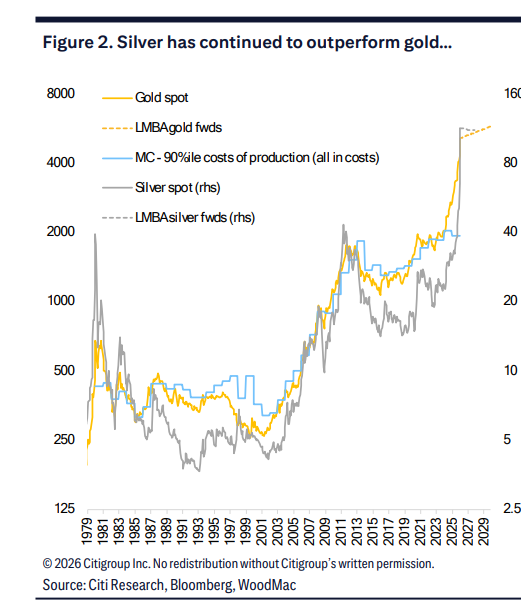
Core Viewpoint - Citi has significantly raised its short-term silver price target from $100 to $150 per ounce, indicating a strong bullish sentiment in the silver market, which is now seen as outperforming gold [1][13]. Group 1: Market Dynamics - The current silver market rally is driven by capital allocation logic rather than traditional industrial demand or supply constraints, positioning silver as a hedge against macroeconomic uncertainties and geopolitical risks [2]. - Silver has shown greater price elasticity and acceleration compared to gold, with silver prices increasing over 30% in the past two weeks, while gold rose about 10% [3]. Group 2: Regional Demand - The recent surge in silver prices, which has doubled since December, is primarily driven by demand from China, with India and global retail demand following suit [5]. - Notably, both China and India are exhibiting "chasing demand" despite the significant price increases, highlighting a key characteristic of the current silver bull market [5]. Group 3: Regulatory Environment - Recent regulatory measures in China, such as the suspension of new subscriptions for the only silver ETF and increased margin requirements for silver futures, are not expected to alter the overall upward trend in silver prices [6][7]. - The behavior of retail investors in China resembles trend-following strategies rather than value-based investing, which supports continued investment in silver as long as it remains relatively affordable compared to gold [8]. Group 4: Market Signals - Despite traditional bearish indicators such as significant outflows from COMEX silver inventories and global silver ETFs, silver prices have surged, indicating a disconnect between conventional supply-demand models and current market dynamics [9]. - The macro risk premium and strong retail demand from China have overshadowed these negative signals, leading to a situation where traditional supply-demand frameworks appear ineffective [9]. Group 5: Price Projections - Citi suggests using the gold-silver ratio as a key metric for determining silver's price ceiling, with potential prices reaching $160-$170 per ounce if the ratio falls to historical lows [10][11]. - In extreme scenarios, if the gold-silver ratio returns to its historical low of approximately 14 times, silver prices could theoretically exceed $300, although this scenario is deemed highly unlikely [12]. Group 6: Conclusion - Overall, Citi maintains a tactical bullish outlook for silver, with a target price of $150 per ounce over the next 0-3 months, driven by macroeconomic and geopolitical risk premiums, alongside strong retail and physical demand from China [13].
现货黄金突破5100美元!黄金、白银还能狂飙多久?
Sou Hu Cai Jing· 2026-01-27 11:12
Group 1 - The core point of the article highlights the contrasting movements in the dollar and precious metals markets, with the dollar index dropping nearly 2% and gold achieving its best weekly performance in nearly six years, rising by 8.4% [1] - Gold prices have reached a historical high, surpassing $5,100 per ounce, with a daily increase of over 2%, showcasing the classic "see-saw" effect between the dollar and gold [1] - Silver prices also saw significant gains, reaching a peak of $109 per ounce, with both gold and silver experiencing increases of over 18% and 51% respectively within a month [1] Group 2 - The surge in the precious metals market is attributed to multiple factors, including geopolitical instability, shifts in monetary policy, and a decline in the dollar's credibility, signaling a deep transformation in the international monetary system [2] - By 2025, gold is expected to account for a larger share of global central bank foreign exchange reserves than U.S. Treasury bonds for the first time since 1996, with central banks projected to purchase an average of 60 tons of gold monthly this year, compared to about 17 tons before 2022 [2] - The ongoing high-level purchases of gold by central banks provide strong support for gold prices, as countries redefine asset safety boundaries and increase gold holdings to optimize reserve structures and hedge against systemic risks [2] Group 3 - The rising gold prices are quickly transmitting to consumer markets, with gold jewelry prices exceeding 1,575 yuan per gram, indicating a shift from traditional consumption to investment attributes in gold jewelry [3][4] - The high gold prices have suppressed some physical gold consumption demand, leading to increased interest in gold-related financial products such as structured deposits, gold ETFs, and paper gold [4] - There is a growing demand for secure storage of high-value physical gold, highlighting the preference of high-net-worth individuals for physical gold in asset allocation, driven by concerns over asset safety [5] Group 4 - The future of the gold market is uncertain, with long-term price influences stemming from changes in economic growth expectations and monetary policy, where any shifts in macroeconomic conditions or geopolitical factors could lead to significant price volatility [7] - Investors are advised to maintain sensitivity to macroeconomic environments when allocating gold assets and to diversify their portfolios, treating gold as a long-term strategic asset [7] - There is a trend among nations, institutions, and households to invest in gold as a relatively stable asset in an uncertain world, reflecting a collective vote of confidence in gold [8]