Polysilicon

Search documents
协鑫科技- 要点 -2026 年上半年多晶硅价格或走软,关注技术进展
2026-03-07 04:20
Summary of GCL Technology Holdings Conference Call Company Overview - **Company**: GCL Technology Holdings (3800.HK) - **Industry**: Polycrystalline Silicon Production Key Points Industry Focus and Policy - Anti-involution remains a significant focus within the industry, with policy announcements being crucial to monitor [1][2] - The enforcement of the Anti-monopoly Law since January has limited the actions of industry players, indicating that future developments will likely be government-led [2] Poly Pricing Outlook - Poly pricing is expected to soften in the first half of 2026, primarily due to weak downstream demand and higher silver prices [3] - Management anticipates that the pricing floor will be protected by the anti-unfair competition law, which is set above total production costs (RMB 45-50/kg). Without this protection, prices could drop to RMB 35/kg, similar to cash cost levels seen in the first half of 2025 [3] Capacity Exit Predictions - There is potential for outdated equipment-driven capacity exits in 2026, even without policy enforcement. Two types of tail capacity are expected to exit: 1. Capacities shut down for over a year, requiring a cash burn ramp-up period of 2-6 months 2. Capacities operating at very low utilization rates, which pose higher safety risks [4] Investment Thesis - GCL Tech is positioned as a leading poly producer at the lower end of the industry cost curve, attributed to its unique FBR Granular Poly technology [5] - The company is projected to become the number one poly player by cost and market share by 2030, driven by increased downstream adoption of Granular Poly [8] Price Target and Risks - The 12-month target price for GCL Tech is set at HK$1.2, based on a 1X 2027E P/B discounted back to 2026E at a COE of 9.2% [8] - **Key Upside Risks**: 1. Significant Tier 1 poly capacity exits or stronger-than-expected solar demand could improve profitability [9] 2. Enhanced profitability outlook for non-Granular Poly business [9] 3. Better-than-expected progress in group-level SG&A optimization [9] - **Key Downside Risks**: 1. Weaker-than-expected solar demand or slower capacity exits could negatively impact pricing policies and profitability [10] 2. Unfavorable changes in raw material or electricity prices may increase production costs, leading to lower gross margins [10] Conclusion - GCL Technology Holdings is navigating a challenging environment with potential pricing pressures and capacity adjustments. However, its strategic positioning and technological advantages may provide a pathway to future growth and market leadership.

[安泰科]多晶硅周评-市场少量成交 观望情绪仍浓 (2026年2月11日)
中国有色金属工业协会硅业分会· 2026-02-11 03:10
Core Viewpoint - The multi-crystalline silicon market is experiencing a slight recovery in activity, but overall transactions remain cautious and primarily exploratory due to weak downstream demand and production cuts among silicon manufacturers [1][2]. Group 1: Market Prices and Transactions - The transaction price range for n-type re-investment material is between 51,000 - 53,000 yuan/ton, with an average transaction price of 51,700 yuan/ton [1]. - The transaction price range for n-type granular silicon is between 50,000 - 51,000 yuan/ton, with an average transaction price of 50,500 yuan/ton [1]. - The market has seen a slight increase in activity with four companies completing small orders, although the overall transaction volume remains low and primarily consists of tentative trades [1]. Group 2: Market Outlook - In the short term, the multi-crystalline silicon market is expected to remain in a stalemate due to the ongoing struggle between weak pre-holiday demand and supply contraction, limiting price fluctuations [2]. - Post-holiday, as terminal installation projects gradually commence, downstream demand is anticipated to increase, potentially boosting procurement needs [2]. - The recent small transactions in the market may provide some price support, but resolving the core supply-demand conflict will depend heavily on a comprehensive recovery in terminal demand and the effective implementation of relevant energy consumption policies [2].

中国光伏:反内卷-China Solar Anti-Involution
2026-01-23 15:35
Summary of Key Points from the Conference Call on China's Solar Industry Industry Overview - The conference focused on the solar industry in China, particularly the polysilicon sector, which is crucial for solar module production [1][2]. Core Insights 1. **Regulatory Concerns**: The State Administration for Market Regulation (SAMR) initiated a probe due to complaints about potential market manipulation following the establishment of an industry consolidation fund. This led to a significant rise in polysilicon prices, raising suspicions of coordinated price increases among producers [2][11]. 2. **Consolidation Fund**: There is a positive bias among industry experts and polysilicon producers regarding the continuation of the China Photovoltaic Industry Association (CPIA)'s consolidation fund approach. This fund aims to buy out smaller players to reduce excess capacity [11][13]. 3. **Price Projections**: The mid-term price outlook for polysilicon is projected to be between RMB 60 to 80 per kg, with near-term prices expected to range from RMB 45 to 60 per kg [11][13]. 4. **Market Performance**: Major polysilicon producers, GCL Tech and Daqo, have underperformed the MSCI China Index by approximately 20% due to market risks and the ongoing SAMR probe [1][24]. 5. **Potential Scenarios**: Three potential scenarios for the industry were discussed, with GCL Tech and Daqo positioned as winners regardless of the outcome. The scenarios include the continuation of the consolidation fund, government-led capacity shutdowns, and a natural market-led consolidation [35][36]. Regulatory Framework - The Anti-Trust Law in China prohibits price-fixing and market manipulation, but there are exceptions for industries facing severe overcapacity, which may apply to the polysilicon sector [15][18]. - The SAMR has requested a rectification plan from polysilicon producers and the CPIA by January 20, 2026, indicating that the regulatory process may take time [21]. Market Dynamics - **Inventory Levels**: Industry inventory is estimated at approximately 570,000 metric tons, while producers expect it to be around 400,000 metric tons. Demand is projected to increase due to the export tax rebate cut, leading to a more balanced supply-demand situation [40][41]. - **Global Demand Outlook**: Global solar demand is expected to decline in 2026, primarily due to a decrease in demand from China, although emerging markets may offset some of this decline [42]. Investment Recommendations - J.P. Morgan maintains an Overweight (OW) rating on GCL Tech and Daqo, citing their strong balance sheets and cost leadership as key factors for potential investment [24][44]. Additional Considerations - The upcoming National Two Sessions in March 2026 may influence regulatory decisions regarding the consolidation fund, which could significantly impact major polysilicon producers [25][24]. - The industry is facing a potential rush in demand in Q1 2026 due to the export tax rebate cut, which may lead to increased production volumes and lower inventory levels for polysilicon producers [25][24]. This summary encapsulates the critical insights and projections regarding the solar industry in China, particularly focusing on the polysilicon sector and its regulatory environment.

中国光伏反内卷:是迂回,而非转向-China Solar Anti-Involution_ A detour, not a u-turn
2026-01-13 11:56
Summary of Key Points from the Conference Call Industry Overview - The conference call discusses the **China Solar Industry**, specifically focusing on the **polysilicon sector** and the implications of the **anti-involution initiative** led by the **State Administration for Market Regulation (SAMR)** [1][4]. Core Insights and Arguments - The SAMR rejected the **CPIA's proposal** for a consolidation fund and self-imposed production quotas, citing non-compliance with anti-trust laws, which is seen as a setback for the solar anti-involution initiative [1][3]. - Despite this setback, the outlook remains optimistic, viewing the situation as a **detour rather than a u-turn** due to the high political profile of the initiative [1][4]. - Potential outcomes include government intervention to manage production quotas or the issuance of waivers by senior bureaus [1][5]. - In a worst-case scenario where higher-cost producers go bankrupt, **Daqo** and **GCL Tech** are expected to emerge as winners due to their strong financial positions [1][9]. Important Developments - A meeting was scheduled for **January 6, 2026**, where the SAMR expressed concerns about anti-trust issues and required major polysilicon producers to submit rectification plans by **January 20, 2026** [2][5]. - The establishment of a platform for consolidating polysilicon capacity was noted on **December 9, 2025**, but concerns about anti-trust compliance may hinder its effectiveness [3][5]. Pricing and Cost Insights - The estimated cost for marginal polysilicon producers is around **Rmb 50/kg**, which is slightly below current spot prices, indicating a need for prices to remain above production costs [4][8]. - The cash production costs for major polysilicon producers in 2025 are projected, with **GCL Tech** being the lowest at **Rmb 23.9/kg** and **Daqo** at **Rmb 36.2/kg** [11]. Stock Recommendations - The report maintains an **Overweight (OW)** rating on **Daqo New Energy (DQ US)** and **GCL Tech (3800 HK)**, highlighting their strong balance sheets and competitive positions in the market [9][23]. Risks and Future Considerations - There are rising risks associated with the polysilicon consolidation fund plan due to the SAMR's anti-trust concerns, which may prevent producers from coordinating production and pricing [3][5]. - If the consolidation plan fails, polysilicon producers may continue to compete freely, potentially leading to a price floor at **Rmb 50/kg** without restrictions on production or sales volume [8]. Conclusion - The solar industry in China is navigating significant regulatory challenges, but the long-term outlook remains positive, particularly for financially robust companies like Daqo and GCL Tech. The situation is being closely monitored for further developments regarding government interventions and market dynamics [1][4][9].
Global Markets Brace for Fed Turmoil as Powell Faces Criminal Probe; China’s Solar Sector Rattled by Antitrust Action
Stock Market News· 2026-01-12 03:38
Powell Under Criminal Investigation, Threatening Fed IndependenceFederal Reserve Chair Jay Powell is facing an unprecedented criminal investigation by the U.S. Department of Justice concerning his congressional testimony regarding a $2.5 billion renovation project at the Federal Reserve's Washington headquarters. Powell has publicly condemned the probe as a direct assault on the central bank's operational independence, linking it to persistent pressure from the Trump administration for aggressive interest r ...
通威股份:2025 年亚太峰会反馈
2025-11-25 05:06
Summary of Tongwei Co. Ltd. Conference Call Company Overview - **Company**: Tongwei Co. Ltd. (Ticker: 600438.SS) - **Industry**: China Utilities, specifically in the solar energy sector Key Points Industry Consolidation - The industry has reached a consensus on a buyout framework, with plans to phase out approximately **600-700kt** of marginal capacity, resulting in a retained capacity of about **2,700kt** annually [1][2] - Future production will be strictly aligned with actual demand, indicating a shift towards more disciplined capacity management [1] Joint Ventures and Financing - Around **10 producers** are anticipated to become joint venture shareholders, with equity contributions linked to market share of retained capacity [2] - Acquisition pricing will be based on the industry's average capital expenditure per ton, funded by **20-30%** equity and the remainder through acquisition loans [2] Antitrust Considerations - The primary challenge remaining is obtaining antitrust clearance from the government, which management expects to be approved by the end of the year at the earliest [2] Polysilicon Pricing Dynamics - Year-to-date, polysilicon prices have rebounded due to industry discipline, a legal ban on below-cost selling, and capped monthly shipments of approximately **100+kt** [3] - Current manufacturing-side inventories are around **300kt**, with Tongwei holding **200kt** of that total [3] - Management does not foresee inventory levels disrupting prices as long as leading producers avoid aggressive destocking [3] Long-term Pricing Outlook - Management estimates a reasonable long-term polysilicon price range of **Rmb70–80k/ton**, which translates to a unit net profit of approximately **Rmb15–20k/ton** for Tongwei [4] Demand Outlook - Management expresses caution regarding solar demand in China for **2026**, particularly following Document No.136, but anticipates potential policy adjustments if demand significantly slows in the first half of 2026 [5] Financial Metrics - **Market Capitalization**: Rmb103,411 million - **Current Share Price**: Rmb22.97 (as of November 21, 2025) - **Price Target**: Rmb21.85, indicating a downside of **5%** from the current price [7] - **Revenue Forecast**: Expected to be **Rmb92.5 billion** in 2026, with an EBITDA of **Rmb8.3 billion** [7] Valuation Methodology - The price target is derived from a discounted cash flow (DCF) methodology, using a weighted average cost of capital (WACC) of **9.5%** and a terminal growth rate of **2.0%** [9] Risks - **Upside Risks**: Higher-than-expected photovoltaic (PV) installations, less new polysilicon capacity from entrants, and faster development of next-generation solar technologies [11] - **Downside Risks**: Lower-than-expected PV installations, intensified competition, and slower overseas market exploration for its module business [11] Additional Insights - The conference call reflects a strategic shift in the solar industry towards consolidation and disciplined capacity management, which may present both opportunities and risks for investors in the sector [1][2][5]

X @Bloomberg
Bloomberg· 2025-11-18 01:34
Industry Outlook - Tongwei 对太阳能行业缓解持续的供应过剩和扭转亏损的努力充满信心 [1] Company Perspective - Tongwei 的董事长表达了对太阳能行业前景的乐观态度 [1]
中国光伏行业 - 中国政府否决多晶硅行业整合基金设立的首份提案-China Solar Sector-PRC Gov’t Rejected the First Proposal regarding Foundation of Polysilicon Industry Consolidation Fund
2025-11-14 03:48
Summary of the China Solar Sector Conference Call Industry Overview - The conference call focused on the **China Solar Sector**, particularly the polysilicon industry and its consolidation efforts [1][2]. Key Points 1. **Government Rejection of Proposal**: The PRC government rejected the initial proposal for the foundation of an industry consolidation fund aimed at acquiring and shutting down low-efficiency polysilicon production capacity, raising investor concerns about the consolidation of the solar sector [1][2]. 2. **Market Reaction**: Following the news, share prices of 16 Chinese solar companies under coverage dropped by an average of **5%** [1]. 3. **Revised Proposal Expected**: The proposal for the consolidation fund will be revised and resubmitted to the government, with expectations that the capacity to be acquired and shut down may be scaled down [2][3]. 4. **Current Industry Measures**: Other anti-involution measures, such as output caps on high energy consumption production lines and prohibiting sales prices below cost, remain valid [1][5]. 5. **Cyclical Perspective**: The worst phase for the solar sector appears to be over, with industry participants reducing capital expenditures (capex) and improving cash flow amid rising sales prices [5]. Company-Specific Insights 1. **GCL Technology**: - GCL Poly indicated that the consolidation fund aimed to acquire and shut down **2.0 million metric tons (MT)** of low-efficiency capacity, with operational capacity expected to be no more than **1.5 million MT** post-consolidation [3]. - Acquisition costs were guided at **RMB 600-800 million** per **10,000 MT**, with discounts for high energy consumption standards [3]. - Target price set at **HK$1.72**, based on a DCF valuation, reflecting a **20%** premium over its 10-year historical average [7]. 2. **Trina Solar**: - Aiming to reach breakeven in **2Q/3Q 2026** after reporting net losses of **RMB 1,598 million** in **2Q 2025** and **RMB 1,283 million** in **3Q 2025** [6]. - Targeting **8 GWh** of energy storage system (ESS) sales in **2025**, with plans to increase to **15-16 GWh** in **2026** [6][13]. - Target price set at **RMB 25.00** based on DCF valuation [13]. 3. **Ningbo Deye Technology**: - Target price of **RMB 102.0/share**, reflecting sustainable growth in energy storage demand [9]. - Risks include lower-than-expected demand and increased price competition [10]. 4. **Sungrow Power Supply**: - Target price of **RMB 240.00**, based on DCF valuation, with key risks including slower solar installation growth and intensified trade tensions [11][12]. Risks Identified - **GCL Technology**: High risk due to share-price volatility, with potential downsides from slower polysilicon capacity reduction and higher power costs [8]. - **Ningbo Deye Technology**: Risks from lower-than-expected energy storage demand and increased competition [10]. - **Sungrow Power Supply**: Risks from slower solar installation and energy storage demand [12]. - **Trina Solar**: Risks from slower global solar and ESS installation growth [15]. Conclusion The conference highlighted significant challenges in the Chinese solar sector, particularly regarding government policies on consolidation and the financial health of key players. The outlook remains cautious, with potential for recovery as companies adjust their strategies and operations in response to market conditions.

协鑫科技-行业整合基金将削减更多多晶硅产能
2025-11-10 03:34
Summary of GCL Technology Conference Call Company Overview - **Company**: GCL Technology (3800.HK) - **Industry**: Polysilicon production within the China solar sector Key Points and Arguments 1. **Polysilicon Capacity Reduction**: GCL expects that no more than 1.5 million metric tons (MT) of polysilicon capacity will remain operational post-consolidation, significantly lower than the previous estimate of 2.0-2.5 million MT. Approximately 2.0 million MT of excessive capacity will be acquired by the industry consolidation fund [1][2] 2. **Cost Efficiency**: GCL's unit production cost is reported to be lower than most peers by more than RMB 10/kg, with a unit cash production cost of RMB 24.16/kg in 3Q25, reflecting a year-over-year decrease of 27.2% and a quarter-over-quarter decrease of 4.5% [7][1] 3. **Earnings Guidance**: Management has guided for an improvement in earnings, with EBITDA expected to rise quarter-over-quarter in 4Q25E, supported by increased sales prices due to anti-involution measures in the solar sector [8][1] 4. **Industry Consolidation Fund**: The consolidation fund is expected to acquire and shut down approximately 2.0 million MT of low-efficiency capacity, aligning operational capacity with annual demand. The acquisition cost is estimated between RMB 600 million to RMB 800 million per 10,000 MT [2][1] 5. **Cash Reserves**: GCL has sufficient cash reserves, bolstered by a share placement that is expected to yield net proceeds of HK$5.4 billion, allowing the company to participate in the consolidation fund [9][1] 6. **Valuation and Target Price**: The 12-month target price for GCL is set at HK$1.72, based on a discounted cash flow (DCF) valuation, indicating a potential return of 24.6% from the current price of HK$1.38 [3][10] 7. **Earnings Summary**: - 2023A: Net Profit of RMB 2,510 million, EPS of RMB 0.095 - 2024A: Net Loss of RMB 4,750 million, EPS of RMB -0.180 - 2025E: Net Loss of RMB 2,043 million, EPS of RMB -0.076 - 2026E: Net Profit of RMB 282 million, EPS of RMB 0.010 - 2027E: Net Profit of RMB 2,526 million, EPS of RMB 0.089 [5][1] Additional Important Information 1. **Risks**: The stock is assigned a high-risk rating due to potential volatility. Risks include slower-than-expected capacity reductions, lower demand for polysilicon, and higher power costs [11][1] 2. **Management Statements**: The Chairman of GCL Group, Mr. Zhu Gongshan, indicated that 17 leading polysilicon companies have largely agreed to form the consolidation consortium, with completion expected by the end of 2025 [2][1] 3. **Production Cost Reduction Goals**: GCL aims to further reduce its unit cash cost by 5-10% year-over-year in 2026, alongside a target to lower selling, general, and administrative (SG&A) expenses [7][1] This summary encapsulates the critical insights from the conference call regarding GCL Technology's operational strategies, financial outlook, and market positioning within the polysilicon industry.
硅业分会:多晶硅供应预期收缩 市场走势持稳
智通财经网· 2025-11-05 07:52
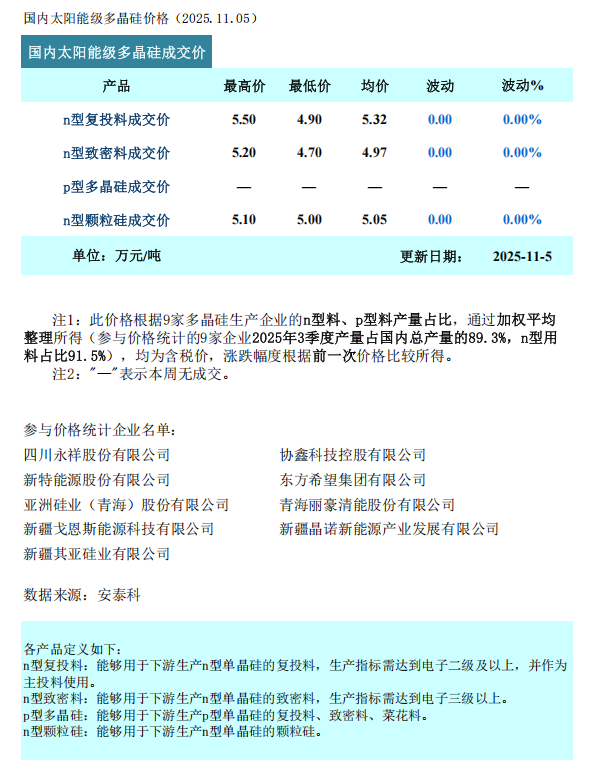
Core Insights - The domestic polysilicon market is experiencing a weak and stable trend, with slight increases in transaction activity and a stable pricing environment due to supply-side production cuts and supportive policies [1][2]. Group 1: Pricing Trends - The transaction price range for n-type reprocessed material is between 49,000 to 55,000 yuan/ton, with an average price of 53,200 yuan/ton, remaining flat week-on-week [1]. - The transaction price range for n-type granular silicon is between 50,000 to 51,000 yuan/ton, with an average price of 50,500 yuan/ton, also remaining flat week-on-week [1]. - The overall polysilicon market is still in a state of oversupply despite the supply contraction, with high industry inventory and weak end-user demand limiting price increases [2]. Group 2: Supply Dynamics - Currently, there are 11 domestic polysilicon producers, with two major companies expected to reduce production and undergo maintenance, leading to a significant estimated decrease in total output by 12.4% month-on-month [2]. - The production plan for domestic polysilicon in November is expected to drop below 120,000 tons, primarily due to rising electricity costs during the dry season in the southwestern region [1]. Group 3: Policy Developments - The new national standard for energy consumption limits for polysilicon and germanium products is in the consultation phase, which is expected to promote capacity clearance and industry upgrades once officially implemented [1].