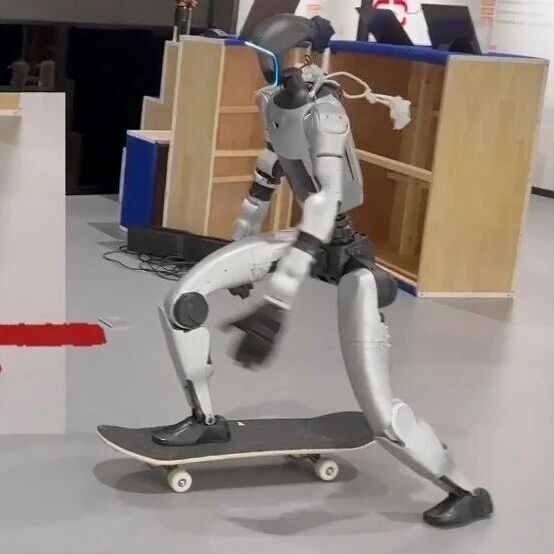
Unitree G1人形机器人

Search documents
中国团队新突破!HUSKY框架让人形机器人成了“滑板高手”!
机器人大讲堂· 2026-03-14 05:48
Core Viewpoint - The article discusses the development of the HUSKY physical perception full-body control framework, which enables humanoid robots to effectively control skateboards, demonstrating advanced dynamic control capabilities in various environments [1][3]. Group 1: Technical Challenges - Controlling a humanoid robot on a skateboard involves complex dynamic control, as the skateboard is an underactuated wheeled platform subject to nonlinear dynamics [3][5]. - Traditional trajectory planning methods are inadequate due to the complex motion characteristics of skateboards, making real-time control challenging [5][8]. Group 2: HUSKY Framework Development - The HUSKY framework begins by analyzing the physical properties of the skateboard, establishing a foundational physical model that informs all subsequent control strategies [7][11]. - The framework incorporates adversarial motion prior (AMP) technology, allowing the robot to learn from human skateboarding data, significantly improving its performance [9][10]. Group 3: Control Strategies - The framework employs a physical-guided steering strategy, where the robot uses body tilt to control the skateboard's direction, enhancing precision and reducing effort [11][13]. - A trajectory-guided transition mechanism is designed to facilitate smooth transitions between pushing and steering phases, addressing a common stability issue in robotic skateboarding [16][19]. Group 4: Real-World Application - The HUSKY framework successfully bridges the gap between simulation and real-world application by accurately identifying skateboard physical parameters and employing domain randomization during training [20][22]. - In real-world tests, the robot demonstrated stable operation at a control frequency of 50Hz, effectively adapting to various surfaces and maintaining balance under external disturbances [23][24]. Group 5: Future Implications - The HUSKY framework not only enhances humanoid robot capabilities in skateboarding but also provides a reusable approach for solving complex control problems in dynamic environments [24]. - Future developments may include integrating visual state estimation for closed-loop control and adapting to more complex terrains, further improving the robot's adaptability [24][25].

创新“新特区”,AWE2026上海新国际博览中心W3馆创新科技展区正式亮相
3 6 Ke· 2026-02-27 03:37
Core Viewpoint - The AWE2026 event is set to showcase a new "Innovation Technology Exhibition Area" in Shanghai, responding to the demand for new growth momentum in the home appliance and consumer electronics industry, which is undergoing structural upgrades and technological transitions [1][3]. Industry Overview - The home appliance and consumer electronics industry in China is solidifying its scale advantages and is at a critical juncture for structural upgrades and technological leaps [1]. - The Innovation Technology Exhibition Area will cover approximately 5,000 square meters, focusing on high-growth potential new technologies, products, and companies [3]. Exhibition Highlights - The Innovation Technology Exhibition Area will feature advancements in embodied intelligence and robotics, AI hardware, new human-computer interaction, and cutting-edge audio-visual and smart entertainment technologies [3][4]. - Key exhibitors include companies like Unitree Technology, MagicLab, and others, showcasing products that are rapidly moving towards application and commercialization [3][4]. Company Profiles - **Unitree Technology**: A leading global company in civil robotics, known for its high-performance quadruped robots and significant R&D capabilities, with over 180 patents [5][7]. - **MagicLab**: A global pioneer in general humanoid robots, focusing on comprehensive R&D with a high percentage of self-developed hardware and software [8][10]. - **LeXiang Technology**: A leader in consumer-grade embodied intelligence, targeting home, elderly care, education, and pet scenarios, achieving significant commercial milestones [11][13]. - **ZhiShen Technology**: An all-industry chain technology service provider in embodied intelligence, with a strong focus on R&D and practical applications in various sectors [14][16]. Product Innovations - The exhibition will showcase various innovative products, including: - Unitree's G1 humanoid robot, capable of complex movements and continuous evolution through deep reinforcement learning [7]. - MagicLab's MagicBot series, featuring high-performance humanoid robots designed for commercial applications [10]. - LeXiang's M1 robot, the first consumer-grade robot utilizing reinforcement learning for control, aimed at various essential scenarios [13]. - ZhiShen's ZSL-1 robot, known for its unique capabilities in challenging environments [16]. AI Hardware and Entertainment - The exhibition will also highlight AI hardware and audio-visual entertainment, exploring how AI can redefine human-technology interactions [17]. - Notable products include the Qwen AI glasses from Alibaba, designed to serve as a personal AI assistant with advanced multi-modal capabilities [18]. - Future Intelligent's AI conference headphones, which have achieved significant sales and feature advanced language translation and transcription capabilities [20][22]. Conclusion - The Innovation Technology Exhibition Area at AWE2026 is expected to be a vibrant hub of technological advancements, potentially leading to the next generation of consumer and lifestyle innovations [27].

人形机器人新突破!敏捷稳定两不误
具身智能之心· 2025-12-05 00:02
Core Idea - The article discusses the AMS (Agility Meets Stability) framework developed by a joint research team from the University of Hong Kong, NVIDIA, and Tsinghua University, which successfully integrates dynamic motion tracking and extreme balance control in humanoid robots using a single strategy [3]. Group 1: Key Innovations of AMS - Heterogeneous Data Sources: AMS generates scalable balance data by directly sampling from the robot's action space, overcoming human data limitations and alleviating long-tail distribution issues [2][17]. - Hybrid Reward Mechanism: AMS employs selective application of balance prior rewards to provide precise balance guidance without sacrificing agility, resolving conflicts in optimization objectives [4][21]. - Adaptive Learning Strategy: The framework dynamically adjusts sampling probabilities and tailors learning for each action, enabling efficient adaptive learning [4][23]. Group 2: Challenges in Humanoid Robotics - Humanoid robots face a dilemma of needing both agile dynamic movement and precise balance control to perform tasks in human environments [5][6]. - Existing research primarily focuses on either dynamic motion tracking or balance control, making it difficult to achieve both capabilities within a unified framework [8][10]. Group 3: Experimental Results - The AMS framework was validated on the Unitree G1 humanoid robot, demonstrating excellent performance in dynamic motion tracking, including activities like shuttle runs and basketball dribbling [24]. - AMS also showcased precise balance control capabilities, effectively managing extreme balance poses [26]. - The framework supports various real-time teleoperation modes, highlighting its practical value as a foundational control model [29]. Group 4: Conclusion - AMS represents a significant advancement in humanoid robot control, combining heterogeneous data sources, a hybrid reward mechanism, and an adaptive learning strategy to achieve both dynamic agility and robust balance, laying a crucial foundation for humanoid robots in human environments [33].

“果链龙头”领益智造转身搞AI,深圳女富豪赴港IPO继续“买买买”
Sou Hu Cai Jing· 2025-12-04 07:12
Core Viewpoint - The company Lingyi Technology is transitioning from a "fruit chain" enterprise to an AI hardware intelligent manufacturing platform, with plans for a secondary listing in Hong Kong to support its expansion and acquisitions [2][10][20]. Group 1: Company Overview - Lingyi Technology, previously known for its precision components in consumer electronics, is now focusing on AI hardware, automotive components, and low-altitude economy products [4][5]. - The company has submitted a prospectus for a secondary listing on the Hong Kong Stock Exchange after previously terminating its listing application in 2022 [2][20]. Group 2: Financial Performance - For the years 2022 to 2025, Lingyi Technology's revenue from AI hardware was 314.79 billion, 307.13 billion, 407.8 billion, and 329.15 billion yuan, accounting for 91.2%, 89.9%, 92.1%, and 87.6% of total revenue respectively [7]. - The company reported total revenues of 345.03 billion, 341.54 billion, 442.6 billion, and 375.9 billion yuan for the same periods, with net profits of 15.6 billion, 20.14 billion, 17.61 billion, and 19.66 billion yuan [9]. Group 3: Business Segments - The AI hardware segment is the primary revenue source, with significant contributions from products like humanoid robot joints, AR glasses, and precision components for smartphones [4][5][7]. - The automotive and low-altitude economy segments are also growing, with revenues of 10.79 billion, 13.85 billion, 21.17 billion, and 19.7 billion yuan from 2022 to 2025, representing 3.1%, 4.1%, 4.8%, and 5.2% of total revenue [9][8]. Group 4: Strategic Acquisitions - Lingyi Technology is actively pursuing acquisitions to enhance its capabilities in the automotive sector, including a recent acquisition of a majority stake in Jiangsu Kedastern Automotive Technology [10][11]. - The company has also announced plans to acquire Zhejiang Xianglong Machinery, further expanding its automotive component business [14]. Group 5: Leadership and Ownership - The founder, Zeng Fangqin, has maintained a significant ownership stake in the company, holding 58.64% of the shares through her investment vehicle [22][25]. - Zeng's commitment to the company is underscored by her decision not to sell shares during the upcoming listing period, reflecting confidence in the company's future [25].

数贸会看见创新未来
Mei Ri Shang Bao· 2025-09-15 00:09
Group 1: Event Overview - The fourth Global Digital Trade Expo will take place from September 25 to 29, 2025, at the Hangzhou International Expo Center, marking its return as China's only national-level global expo in the digital trade sector [1] - The event will feature a larger scale and more diverse content compared to last year, covering approximately 150,000 square meters with eight major exhibition areas [1] Group 2: Exhibition Areas - The eight exhibition areas include: Theme Pavilion, Artificial Intelligence Zone, Digital Entertainment Zone, Smart Mobility Zone, Digital Healthcare Zone, Silk Road E-commerce Zone, Smart Space Zone, and Smart Logistics Zone [1] - The expo aims to cater to various audiences, including tech enthusiasts, families, and consumers interested in global technology [1] Group 3: Interactive Experiences - A unique program called "Star Wish Landing on the Dark Side of the Moon" will allow participants to interact with AI robots and upload their wishes to be sent to the moon by 2029 [2] - The "Dunhuang Experience" will utilize AI technology to recreate the ancient art of the Tang Dynasty, allowing visitors to interact with the art in real-time [3] Group 4: Digital Entertainment and Gaming - The Digital Entertainment Zone will feature immersive experiences, including a pop-up store and interactive gaming areas, appealing to various demographics [4][5] - Attendees can experience cutting-edge VR and AR technologies, including the latest games and interactive robots [6] Group 5: Robotics and AI Innovations - The event will showcase the "Six Little Dragons" of Hangzhou, featuring advanced robotics and AI technologies across multiple fields, including healthcare and gaming [7] - Notable exhibits include humanoid robots and medical-grade robots capable of lifting significant weights [7] Group 6: Future Mobility and Healthcare Technologies - The expo will highlight innovations in future mobility, including Tesla's public test drives and various autonomous vehicles [8] - The Digital Healthcare Zone will present advanced technologies such as smart robots for elderly care and remote monitoring devices [9][10] Group 7: Global Collaboration and Opportunities - The expo will also feature international participation, with representatives from various countries discussing digital investment and smart city collaborations [10] - Activities such as innovation competitions and forums will provide networking opportunities for entrepreneurs [10] Group 8: Engagement and Promotions - Attendees can participate in promotional activities, including receiving digital coupons and collecting cards for prizes [11] - The event emphasizes an engaging experience, encouraging visitors to explore and interact with the latest digital technologies [11]
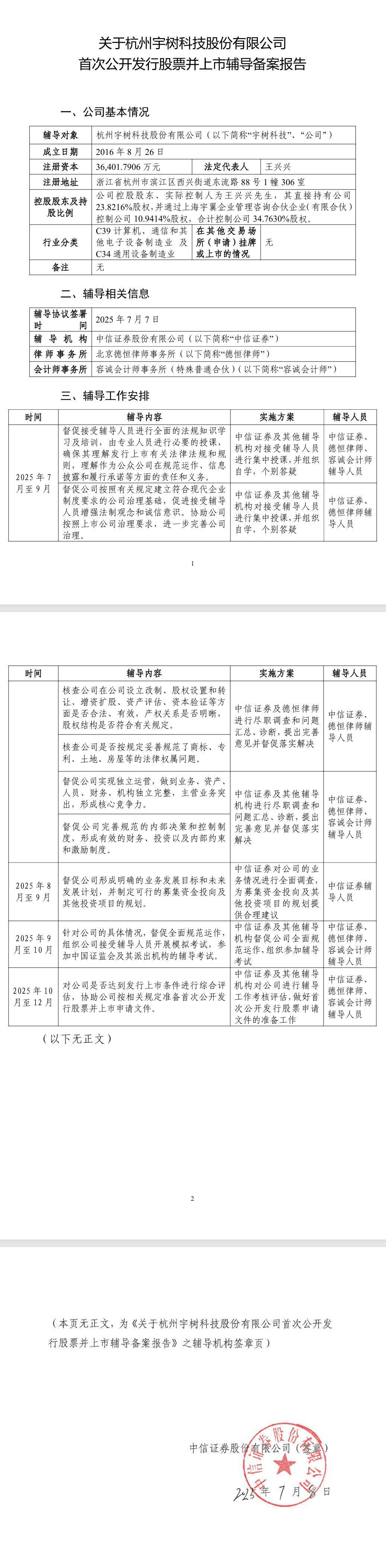
重磅!宇树科技,开启上市辅导!
Sou Hu Cai Jing· 2025-07-22 01:41
Company Overview - Yushu Technology Co., Ltd. officially initiated its A-share IPO process on July 18, 2025, with CITIC Securities as the guiding institution, aiming for completion by October and potential listing within the year [1][3]. - The company was established in August 2016 with a registered capital of 364 million yuan, and the actual controller, Wang Xingxing, holds 23.82% directly and controls a total of 34.76% through partnerships [3][4][6]. Industry Positioning - Yushu Technology operates in the dual sectors of "Computer and Communication Equipment Manufacturing" (C39) and "General Equipment Manufacturing" (C34), focusing on high-performance general-purpose and humanoid robots [3][6]. - The company gained international recognition with its quadruped robot technology and the release of the Unitree G1 humanoid robot in 2024, which attracted significant industry attention [3]. IPO Guidance and Timeline - The IPO guidance includes a structured timeline from July to December 2025, focusing on regulatory compliance, governance optimization, strategic planning, and preparation for the IPO application [3][8][9]. - Key phases include training on regulatory knowledge, establishing modern corporate governance, and conducting due diligence on the company's assets and ownership structure [8][9][10]. Strategic Importance - If successful, Yushu Technology's IPO could position it as the first domestic "general-purpose robot stock," setting a benchmark in the hard technology sector [3]. - The company emphasizes its technological leadership in the quadruped robot market, having submitted over 200 patent applications, with more than 180 granted [14].
宇树科技正式启动A股IPO:年营收超10亿元,已连续多年保持盈利状态
IPO早知道· 2025-07-18 10:34
Core Viewpoint - Company focuses on the research, development, production, and sales of high-performance quadruped/humanoid robots and dexterous robotic arms for both consumer and industrial applications [2][3]. Group 1: Company Overview - Founded in 2016, the company specializes in high-performance quadruped and humanoid robots, as well as dexterous robotic arms [3]. - The company has launched its Unitree H1 and G1 humanoid robots for sale on JD.com, priced at 650,000 yuan and 99,000 yuan respectively [4]. - The company is the first globally to publicly retail high-performance quadruped robots and has achieved early industry application [5]. Group 2: Technological Innovation - The company emphasizes independent research and technological innovation, having developed key components such as motors, reducers, controllers, and laser radars in-house [5][6]. - It has submitted over 200 patent applications domestically and internationally, with more than 180 patents granted [6]. Group 3: Financial Performance - The company's annual revenue exceeds 1 billion yuan, and it has maintained profitability in its financial statements since 2020 [7]. - The company has attracted investments from numerous well-known institutions, including Sequoia China, Tencent, Alibaba, and Ant Group [7].

王兴兴称宇树科技年营收已超10亿
新华网财经· 2025-06-26 07:45
Core Viewpoint - Yuzhu Technology has achieved significant milestones in the robotics industry, including annual revenue exceeding 1 billion RMB and maintaining profitability since 2020, positioning itself as one of the few profitable companies in the sector [2][3]. Company Overview - Founded in 2016, Yuzhu Technology initially focused on quadruped robotic dogs and has since expanded its product line to include the general-purpose humanoid robot G1, which has generated considerable interest since its launch in 2024 [2]. - The company successfully launched its Unitree H1 and G1 humanoid robots on JD.com in early 2025, with prices set at 650,000 RMB and 99,000 RMB respectively, both of which sold out quickly [2]. - Yuzhu Technology has gained substantial brand recognition through appearances at major events such as the CCTV Spring Festival Gala and CES in Las Vegas [2]. Financing and Valuation - Between 2020 and 2022, Yuzhu Technology completed multiple financing rounds (Pre-A, A, A+, B, B+) with notable investors including Sequoia Seed, Chuangxin Capital, and others [2]. - In February 2024, the company raised nearly 1 billion RMB in a B2 round of financing, with participation from various investment firms [2]. - The company completed a C round of financing in early 2025, led by major investors including China Mobile's fund, Tencent, and Alibaba, raising close to 700 million RMB and achieving a post-investment valuation exceeding 12 billion RMB [3]. Industry Context - The robotics industry in China is experiencing rapid growth, with Morgan Stanley projecting the market size to reach 47 billion USD by 2024, accounting for 40% of the global total, and expected to grow to 108 billion USD by 2028, with a compound annual growth rate of 23% [4]. - Yuzhu Technology's founder, Wang Xingxing, highlighted the challenges of household applications for robots, suggesting that industrial and agricultural applications may develop more quickly [4]. Future Prospects - Wang Xingxing expressed interest in potential collaborations with large corporations like Haier, emphasizing the importance of aligning products with market needs and addressing safety and ethical concerns in human-interactive robots [6].

推动我国人工智能健康有序发展(专题深思)
Ren Min Ri Bao· 2025-05-12 22:17
Core Viewpoint - Artificial intelligence (AI) is a strategic technology leading a new round of technological revolution and industrial transformation, significantly changing human production and lifestyle. The emphasis is on leveraging the advantages of a new type of national system to promote the healthy and orderly development of AI in China, focusing on application orientation and self-reliance [1]. Group 1: Achievements in AI Development - The Chinese government has made significant progress in AI, achieving breakthroughs in various fields such as computer vision, natural language processing, and speech recognition, reaching international advanced levels [2]. - Notable achievements include the development of domestically produced AI models that break the U.S. monopoly, the launch of the world's first brain-like complementary vision chip "Tianmou Chip," and the popular Unitree G1 humanoid robot by Yushu Technology, showcasing wide application scenarios [2]. Group 2: Challenges and Gaps - Despite being a leading country in AI, China still faces shortcomings in foundational theories and key core technologies, particularly in areas like high-end chips and core software, where developed countries have long-standing advantages [3]. - There is a need for continuous accumulation of experience in foundational research, including mathematics, computer science, and microelectronics, to address these gaps [3]. Group 3: Advantages of AI Development in China - China has abundant data resources due to its large population, which provides a rich material for training AI models and promotes learning and optimization [4]. - The country has a wide range of application scenarios across various industries such as healthcare, e-commerce, logistics, and finance, creating significant demand for AI [4]. - China's manufacturing sector is the largest and most comprehensive globally, offering substantial opportunities for AI technology to enhance production capabilities [4]. - The market potential for AI products is vast, with applications expanding due to the proliferation of technologies like 5G and the Internet of Things [4]. Group 4: Strategic Directions for AI Development - To convert advantages into development strengths, it is essential to focus on application orientation and address shortcomings in foundational software and hardware [5]. - The development of AI requires a strong consensus across society and the effective use of China's socialist system advantages to integrate top-level design with grassroots practices [5]. - Building a collaborative innovation ecosystem involving government, enterprises, research institutions, and the public is crucial for the iterative development of AI [5]. Group 5: Talent Development in AI - Strengthening the talent pool in AI is vital for the technology's advancement, with a focus on transitioning from quantity to both quality and quantity in talent development [6]. - There is a need for comprehensive education in AI across all levels and the establishment of supportive mechanisms for research and career development to create conditions for talent to thrive [6].
中方反制措施见效!马斯克为“擎天柱”大倒苦水
21世纪经济报道· 2025-04-23 10:00
Core Viewpoint - Tesla's production of humanoid robots, "Optimus," is impacted by China's export controls on rare earth materials, specifically affecting the supply of rare earth magnets necessary for the robots' servo motors [1][2][3]. Group 1: Impact of Export Controls - China's Ministry of Commerce announced export controls on seven categories of heavy rare earth materials, including samarium, gadolinium, and dysprosium, effective April 4 [3]. - The purpose of these controls is to safeguard national security and fulfill international obligations, reflecting China's commitment to maintaining global peace and stability [3]. Group 2: Demand for Rare Earth Materials - Tesla plans to produce thousands of "Optimus" robots this year, with each robot requiring approximately 3.5 kg of high-performance neodymium-iron-boron magnets [3][10]. - The demand for rare earth materials in humanoid robots is projected to be significant, with Goldman Sachs predicting that humanoid robot shipments could reach 890,000 units by 2030, representing a compound annual growth rate of 53% from 2025 to 2030 [9][10]. Group 3: Market Reaction - Following the announcement of export controls, rare earth permanent magnet stocks surged, with companies like Jinli Permanent Magnet and Longmag Technology seeing significant stock price increases of over 10% and 7.79%, respectively [4][6][7].