Cisco Systems(CSCO)

Search documents
3 Dividend-Paying Artificial Intelligence Stocks to Buy in 2026
The Motley Fool· 2025-12-16 12:25
Core Viewpoint - Investing in dividend-paying AI companies provides a way to gain passive income while participating in the rapidly expanding AI market [1] Group 1: Company Overview - Three notable AI stocks with attractive dividend yields are IBM, Cisco, and Nokia, offering diversification within the AI ecosystem [2] - IBM has a dividend yield of 2.2% and has shifted its focus to AI and cloud computing, resulting in significant sales growth [4][5] - Cisco's dividend yield is 2.1%, and the company is positioned to meet the demands of AI-driven networking with new products [10][12] - Nokia offers the highest dividend yield at 2.5% and is focusing on AI-supported 6G technology through a partnership with Nvidia [15][16] Group 2: Financial Performance - IBM's revenue rose 9% year-over-year to $16.3 billion in Q3, with its software division growing 10% to $7.2 billion [5] - Cisco reported a 5% year-over-year revenue growth to $56.7 billion for the fiscal year 2025, with an 8% increase in Q1 [12] - Nokia experienced a 4% year-over-year revenue growth to 13.8 billion euros in the first three quarters of 2025, following a decline in 2024 [18] Group 3: Future Prospects - IBM aims to achieve quantum advantage by the end of 2026, which could enhance its AI capabilities significantly [9] - Cisco expects revenue to continue rising in fiscal 2026, forecasting between $60.2 billion and $61 billion [12] - Nokia's partnership with Nvidia is expected to accelerate the development of AI-RAN technology, with testing set to begin in 2026 [16]



行业聚焦:全球以太网交换集成电路市场头部企业份额调研(附Top5 厂商名单)
QYResearch· 2025-12-16 09:08
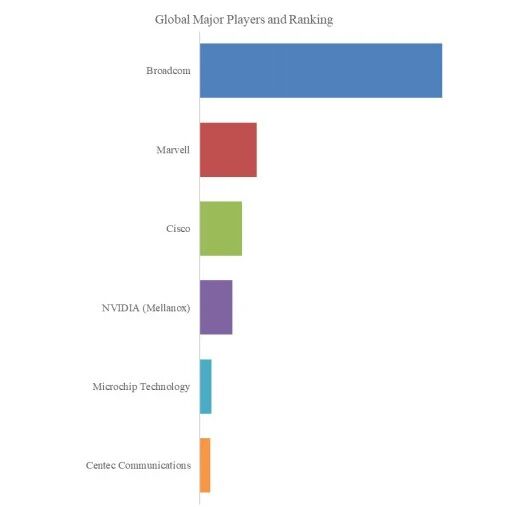
Core Viewpoint - The global Ethernet switch integrated circuit market is projected to grow from $4.86 billion in 2024 to $8.37 billion by 2031, with a compound annual growth rate (CAGR) of 7.26%, driven by the demand for higher-speed Ethernet and advancements in cloud computing, AI, and digital transformation [2][13]. Market Growth and Trends - The market is experiencing a significant shift towards higher-speed categories, particularly from 25G/100G to 200G/400G and even 800G switch architectures, reshaping revenue distribution and competitive dynamics [2][11]. - The revenue share of ≤ 25G chips is expected to decline from 25.63% in 2020 to approximately 9.34% by 2031, indicating a trend towards commoditization and integration into lower-end enterprise and industrial network devices [7][9]. - The 100G-400G segment remains a key revenue contributor, with its market share slightly decreasing from 47.31% in 2020 to 41.49% in 2024, while still experiencing revenue growth [8][11]. Competitive Landscape - Broadcom is the undisputed global leader with a market share of 54.59% in 2024, followed by Marvell at 12.95% and Cisco at 9.60%, which is expected to decline to 5.96% by 2030 due to a shift towards commercial chip adoption [4][9]. - The market is highly concentrated, with Broadcom and Marvell positioned as long-term winners due to their ability to invest heavily in R&D and innovation [11][13]. Product Type Evolution - The market is transitioning from traditional ≤ 25G and 25G-100G categories to higher-speed 100G-400G and 400G+ segments, driven by the expansion of cloud service providers and AI data centers [7][8]. - The 400G+ segment is the fastest-growing, expected to increase from $55 million in 2020 to $921 million in 2024, and projected to reach $3.24 billion by 2030, accounting for over 40% of total market revenue [8][11]. Application Trends - Commercial Ethernet switch integrated circuit solutions dominate the market, contributing 86.92% of total revenue in 2024, with expectations to exceed 92% by 2031, reflecting a trend of outsourcing hardware innovation to specialized semiconductor suppliers [9][11]. - The share of in-house developed integrated circuits is declining, from 18.37% in 2020 to an anticipated drop below 8% by 2031, due to the increasing complexity and costs associated with developing advanced switching chips [9][11]. Regional Insights - The Asia-Pacific region is the largest consumer market for Ethernet switch integrated circuits, driven by rapid cloud computing expansion in China, enterprise upgrades in Japan, and digital infrastructure development in India [11][13]. - North America remains at the technological forefront, primarily due to major cloud operators like Amazon, Google, Microsoft, and Meta adopting 400G/800G switch architectures [11][13].


Cisco CFO highlights rival’s integration as M&A lesson: Trial Balance
Yahoo Finance· 2025-12-15 10:00
This story was originally published on CFO.com. To receive daily news and insights, subscribe to our free daily CFO.com newsletter. The Trial Balance is CFO.com’s weekly preview of stories, stats and events to help you prepare. Part 1 — Cisco CFO uses rival’s M&A deal to frame integration risk Cisco CFO Mark Patterson used a Dec. 11 investor conference to frame rival Hewlett Packard Enterprise’s Juniper Networks acquisition as a source of customer uncertainty, and a competitive advantage for Cisco, highl ...

中国驻美国大使会见AMD首席执行官苏姿丰
Zhong Guo Ji Jin Bao· 2025-12-14 06:20
Group 1 - The Chinese Ambassador to the United States, Xie Feng, met with AMD's Chair and CEO, Lisa Su, to discuss AMD's operations in China and Sino-U.S. economic cooperation [1] - On December 10, Xie Feng also met with Cisco's Chair and CEO, Chuck Robbins, to exchange views on Sino-U.S. economic cooperation and Cisco's operations in China [1]

Cisco Systems, Inc. (CSCO) Shares Hit a record high For The First Time In Over 25 Years, Bloomberg Reports
Yahoo Finance· 2025-12-13 17:40
Core Insights - Cisco Systems, Inc. (NASDAQ:CSCO) shares reached a record high for the first time in over 25 years, closing at $80.25, surpassing its previous peak during the dot-com bubble [2] - The company's market valuation has increased significantly, with shares rising over 800% since their low of around $60 billion in late 2002, although it remains more than 40% below its dot-com peak valuation of over $500 billion [3] Financial Performance - Cisco anticipates fiscal-year revenues to reach up to $61 billion by the end of July, exceeding Wall Street projections by approximately $1 billion [4] - The stock increased by 0.9% on a day when the S&P 500 and Nasdaq 100 also saw gains, indicating a positive market environment following the Federal Reserve's interest rate cuts [2] Market Position and Analyst Sentiment - UBS analyst David Vogt upgraded Cisco shares to "buy," highlighting the growing demand for AI infrastructure solutions as a key driver for the company's future growth [5] - Cisco is recognized as one of the largest software firms globally and the leading supplier of networking equipment, positioning it well to capitalize on increasing global investments in AI infrastructure [5]
Jim Cramer on Cisco: “This Company’s at the Heart of the AI Revolution”
Yahoo Finance· 2025-12-13 15:34
Group 1 - Cisco Systems, Inc. has seen a significant change in its valuation, dropping from a forward price to earnings multiple of over 130 in 2000 to less than 19 times forward earnings currently, indicating a more stable and mature company profile [1] - The company is recognized for creating networking, security, and collaboration tools that help organizations maintain connectivity and security [2] - Despite its potential as an investment, there are opinions suggesting that certain AI stocks may offer greater upside potential and carry less downside risk compared to Cisco [2]
Why Is Cisco (CSCO) Up 2.4% Since Last Earnings Report?
ZACKS· 2025-12-12 17:30
Core Viewpoint - Cisco Systems reported strong first-quarter fiscal 2026 earnings, exceeding estimates and showing year-over-year growth in revenues and earnings per share, indicating positive momentum for the company [3][4][12]. Financial Performance - Non-GAAP earnings for Q1 fiscal 2026 were $1 per share, beating the Zacks Consensus Estimate by 2.04% and increasing 9.9% year over year [3]. - Revenues reached $14.88 billion, surpassing estimates by 0.71% and reflecting a 7.5% year-over-year increase [4]. - Total Annual Recurring Revenues (ARR) were $31.4 billion, up 5%, with product ARR growth of 7% [4]. Revenue Breakdown - Networking revenues were $7.77 billion, up 15% year over year [5]. - Security revenues decreased by 2% to $1.98 billion, while collaboration revenues fell by 3% to $1.06 billion [5]. - Total product revenues were $11.08 billion, comprising 74.4% of total revenues, with a 9.5% year-over-year increase [6]. Regional Performance - Americas revenues increased by 9% to $8.99 billion, EMEA revenues climbed 5% to $3.78 billion, and APJC revenues also rose by 5% to $2.11 billion [7]. Operating Metrics - Non-GAAP gross margin was 68.1%, expanding 120 basis points year over year [8]. - Non-GAAP operating income was $5.12 billion, up 8.4% year over year, with an operating margin of 34.4% [9]. Balance Sheet Highlights - Cash and cash equivalents totaled $15.7 billion, down from $16.1 billion [10]. - Total debt remained stable at $28.1 billion [10]. - Remaining performance obligations (RPO) increased by 7% to $42.9 billion [10]. Shareholder Returns - Cisco returned $3.6 billion to shareholders through share buybacks and dividends in Q1 fiscal 2026 [11]. Future Guidance - For Q2 fiscal 2026, Cisco expects non-GAAP earnings between $1.01 and $1.03 per share, with revenues projected between $15 billion and $15.2 billion [12]. - For the full fiscal 2026, the company anticipates non-GAAP earnings between $4.08 and $4.14 per share, with revenues expected between $60.2 billion and $61 billion [13]. Market Sentiment - Estimates for Cisco have trended upward over the past month, indicating positive market sentiment [14]. - Cisco holds a Zacks Rank 3 (Hold), suggesting an expectation of in-line returns in the coming months [16].

Cisco Stock Just Set a New All-Time High for the First Time in 25 Years. Should You Buy CSCO Here?
Yahoo Finance· 2025-12-12 16:39
Core Insights - Cisco Systems (CSCO) has surpassed its dot-com-era peak for the first time in 25 years, with shares reaching $80.82, exceeding the previous record of $80.06 set on March 27, 2000 [1][2] - The company has spent 25 years rebuilding investor confidence after a 90% value loss following the tech bubble burst in 2002, and is now positioned to benefit from AI infrastructure spending [2][5] Financial Performance - Cisco's market capitalization is valued at $317 billion, making it one of the largest tech companies globally [4] - CSCO stock has increased by 35% over the past year and 80% over the last five years, with cumulative returns closer to 110% since December 2020 when adjusted for dividend reinvestments [4] AI Infrastructure Orders - In the fiscal first quarter, Cisco secured $1.3 billion in AI infrastructure orders from hyperscale customers, driven by demand for switching systems and coherent optics [6] - The full-year order target has been raised to at least $4 billion, which is double the previous year, with projections for AI-related revenue to triple to over $3 billion from $1 billion recognized in fiscal 2025 [6] Market Positioning - Cisco has secured four new design wins and serves five of the six largest cloud providers for AI infrastructure, positioning itself as an open alternative to Nvidia's proprietary stack [7] - Demand for scale-across networking has led to significant growth beyond traditional data center interconnect applications, with Acacia Optics holding approximately 25% market share in hyperscale deployments [8]
思科重返互联网泡沫鼎盛时期
美股研究社· 2025-12-12 11:07
Core Viewpoint - Cisco has reached a historical high for the first time in over 25 years, closing at a price that surpasses its previous peak during the internet bubble [1]. Group 1: Cisco's Performance - Cisco's current market capitalization is $317 billion, significantly lower than its peak market cap of $550 billion in 2000 [2]. - Investors who bought Cisco stock at the 2000 peak are finally seeing a profit, although the current valuation is much lower than it was at that time [2]. Group 2: Comparison with Other Companies - General Electric (GE) also recently surpassed its historical high, reaching $314.28 in October before stabilizing around $280 [6]. - GE's current market cap has decreased by several hundred billion dollars compared to its 2000 valuation, and the company has undergone significant restructuring and asset divestitures over the past two decades [6]. - The current GE is focused on the aerospace sector, making it difficult to directly compare with its 2000 counterpart, which was a large diversified industrial group [6]. Group 3: Historical Context - The peak of the internet bubble occurred in March 2000, with the Nasdaq index reaching its highest point [6]. - Among the top ten companies by market capitalization in the Russell 1000 index at that time, only Microsoft has maintained a strong performance, with a cumulative increase of over 700% since its peak in late 1999 [7]. - Cisco and GE are the only two companies from that era that have recently returned to their historical highs, while Intel and Nokia have not yet recovered to their 1999-2000 peak prices [7].

Don't Fight the AI Bubble. Even Cisco Eventually Won.
Barrons· 2025-12-12 08:30
Core Viewpoint - The latter stages of a bubble are often the most advantageous time for investors to be engaged in the market [1] Group 1 - Investors face a dilemma as the best investment opportunities may arise during the final phases of a market bubble [1]