The Boeing Company

Search documents
Boeing Wins Order to Supply 17 737-8 Airplanes to Japan Airlines
ZACKS· 2025-03-20 15:30
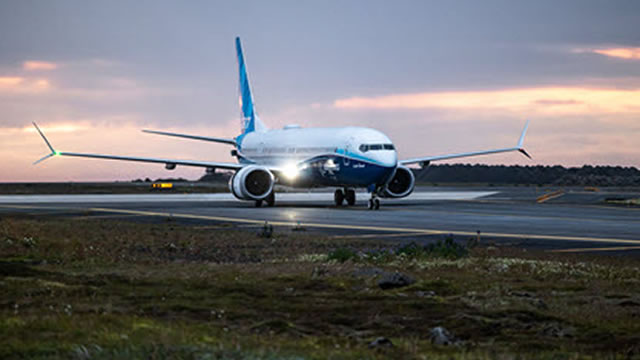
Group 1: Boeing's Recent Developments - Boeing secured an order from Japan Airlines for 17 737-8 commercial aircraft, in addition to 21 aircraft ordered in March 2023, with deliveries expected by 2026 [1] - This contract is anticipated to significantly enhance Boeing's commercial airplane business segment [1] Group 2: Aircraft Specifications and Market Demand - The 737-8 model can carry up to 210 passengers and has a range of 3,500 nautical miles (6,480 km), offering a 20% reduction in fuel use and emissions compared to previous models [2] - The demand for the 737 MAX family is bolstered by its efficiency and environmental performance, contributing to solid order growth [3] Group 3: Market Growth and Opportunities - Rising air passenger traffic and the demand for fuel-efficient aircraft are driving growth in the commercial aviation market [4] - Mordor Intelligence forecasts a compound annual growth rate of over 6.5% for the commercial aviation market from 2025 to 2030, presenting strong expansion opportunities for Boeing [5] Group 4: Boeing's Global Presence - Boeing has a strong global footprint, with over 10,000 commercial jetliners in service, accounting for nearly half of the global fleet [6] Group 5: Competitors in the Aerospace Market - Other aerospace companies like Airbus and Embraer are also positioned to benefit from the growing air traffic trends, with Airbus having over 12,000 commercial aircraft in service and a long-term earnings growth rate of 7.5% [7][8] - Embraer, the third-largest manufacturer of commercial aircraft, has a product portfolio that includes sustainable single-aisle aircraft and an expected sales improvement of 15.1% for 2025 [8][9]


Lockheed Wins a $123M Contract to Aid JASSM & LRASM Missile Program
ZACKS· 2025-03-17 15:46
Core Insights - Lockheed Martin Corporation (LMT) has secured a contract worth $122.6 million for tooling and test equipment to enhance production of Joint Air-to-Surface Standoff Missile (JASSM) and Long-Range Anti-Ship Missile (LRASM) programs, with completion expected by July 14, 2028 [1] - The JASSM missile provides long-range precision engagement capabilities for air-to-ground missions, allowing for the destruction of high-value targets from a safe distance [2] - The LRASM is designed for precision-guided anti-ship capabilities, enabling semi-autonomous navigation to targets while maintaining a safe standoff range [3] Market Growth Prospects - Increased military conflicts and national security focus have led to a projected compound annual growth rate of 5% for the global missiles and missile defense systems market from 2025 to 2030 [4] - Lockheed's Missile and Fire Control unit is a recognized developer in this sector, operating in over 50 countries and involved in major programs like the Patriot Advanced Capability-3 and Terminal High Altitude Area Defense [5] Competitor Analysis - Northrop Grumman Corporation (NOC) is also positioned to benefit from the expanding missile market, with a long-term earnings growth rate of 4.2% and a projected 3% sales growth in 2025 [6][7] - RTX Corporation (RTX) has a long-term earnings growth rate of 9.7% and is expected to see a 4.4% sales growth in 2025, focusing on missile defense systems [8] - The Boeing Company (BA) has a strong long-term earnings growth rate of 17.4% and is projected to achieve a significant 25.6% sales growth in 2025 [9][10] Stock Performance - LMT shares have increased by 8.8% over the past month, outperforming the industry average growth of 0.7% [11]


日本国防工业的新维度
2025-03-17 06:30
Summary of Key Points from the Conference Call on Japan's Defense Industry Industry Overview - The discussion focuses on Japan's defense industry, particularly the anticipated upward revision of the defense budget for FY25-27, with a target of 3% of GDP for the next five-year plan [1][2][3]. Core Insights - **Defense Budget Increase**: Mr. Koji Imaki suggests that Japan's defense budget should be revised to 3% of GDP, up from the current target of 2%, due to international pressures and comparisons with NATO and EU defense spending [2][3][4]. - **Technological Advancements**: Emphasis on enhancing digital engineering for unmanned defense equipment and next-generation fighter programs, with a focus on AI technology [3][4][5]. - **Aging Workforce**: The aging population in Japan is leading to a shortage of engineers, necessitating the adoption of AI and digital technologies to maintain production capacity [3][83]. - **Global Combat Air Programme (GCAP)**: Japan, the UK, and Italy are collaborating on the development of the sixth-generation fighter plane, with challenges anticipated due to the ambitious timeline of 10 years for development [4][66]. Financial Projections - **Defense Budget Allocation**: The total defense budget for FY23-27 is projected to be ¥43.5 trillion, with significant increases in various capabilities, including unmanned systems and cross-domain operations [9][29][39]. - **Specific Budget Increases**: Notable increases include ¥5 trillion for counter-strike capabilities and a 90% increase for unmanned systems, indicating a shift in focus towards advanced technologies [41][43]. International Opportunities - **Overseas Contracts**: Mr. Imaki identifies potential overseas opportunities, particularly the Australian Sea 3000 project, where Japanese companies like Mitsubishi Heavy Industries are well-positioned [5][76]. - **Export Potential**: The only notable export recorded was a ¥15 billion contract for surveillance radars to the Philippines, highlighting the need for Japan to expand its defense exports [5][49]. Strategic Considerations - **Defense Policy Shifts**: The Japanese government is expected to review its arms export policies, which have historically been restrictive, to enhance international collaboration and competitiveness [30][71]. - **Joint Development Initiatives**: The focus on joint development with allies, such as the US, is crucial for enhancing Japan's defense capabilities and industrial base [67][75]. Additional Insights - **Emerging Start-ups**: The rise of start-ups in the defense sector is noted, particularly those leveraging dual-use technologies like AI and quantum computing, which could play a significant role in future defense contracts [84]. - **Human Resource Challenges**: The defense industry faces challenges in securing a skilled workforce due to demographic shifts, emphasizing the need for technological solutions to compensate for labor shortages [82][83]. Conclusion - The future of Japan's defense industry is poised for significant transformation, driven by increased budget allocations, technological advancements, and a strategic pivot towards international collaboration and export opportunities [78][79].
Lockheed Secures a Contract to Aid Trident II D5 Missile Program
ZACKS· 2025-03-11 16:35
Group 1: Contract and Production Details - Lockheed Martin Corporation (LMT) secured a contract valued at $63.4 million for the production of Trident II D5 missiles and providing deployed systems support, with completion projected by September 30, 2029 [1] - The majority of the work will be carried out in Culpepper, VA; Magna, UT; and Denver, CO [1] Group 2: Significance of Trident II D5 Missile - The Trident II D5 missile is a powerful sea-based strategic deterrent known for its accuracy, reliability, and long-range strike capability, with a proven track record of 191 successful test launches since 1989 [2] - Its advanced guidance system and adaptability for future upgrades extend its service life until 2042, making it a critical asset for national defense [2] Group 3: Market Growth Prospects - Rising military conflicts and national security concerns are driving nations to focus on missile defense systems, with a forecasted compound annual growth rate of 5% for the global missiles and missile defense systems market from 2025 to 2030 [5] - Lockheed's Missile and Fire Control unit is recognized for developing high-performance missiles and operates in over 50 countries, with major programs including the Patriot Advanced Capability-3 and THAAD [6] Group 4: Competitors and Industry Landscape - Northrop Grumman Corporation (NOC) and RTX Corporation (RTX) are also positioned to benefit from the expanding missile market, with NOC focusing on high-speed strike weapons and RTX known for its missile defense systems [7][8] - Boeing Company (BA) manufactures various missile defense systems and has a long-term earnings growth rate of 17.4%, indicating strong market presence [10][11] Group 5: Stock Performance - LMT shares have gained 8.5% in the past month, outperforming the industry's 1.9% decline [12]

Boeing Secures a Contract to Aid F/A-18 Jet Program for the Navy
ZACKS· 2025-03-07 17:50
Group 1: Contract Details - Boeing has secured a contract valued at $33.2 million from the Naval Air Systems Command, which is expected to be completed by April 2026 [2] - The contract involves the production and delivery of 41 Distributed Targeting Processor-Networked (DTP-N) B Kits, five DTP-N B Kit Lab Assets, and nine Processor eXpress Mezzanine Cards, along with associated cybersecurity and support for F/A-18 service life modifications [2][3] Group 2: Significance of F/A-18 Jets - Boeing's F/A-18 Super Hornet is capable of performing a wide range of tactical missions, including air superiority, precision strikes, and reconnaissance [5] - The latest model, Block III, is noted for being the most networked and survivable version of the F/A-18 [5] Group 3: Market Growth Prospects - The demand for military aircraft is increasing globally, driven by nations focusing on enhancing aerial supremacy and adopting advanced technologies [6] - The global fighter aircraft market is projected to grow at a CAGR of 3.7% from 2025 to 2030, indicating significant opportunities for manufacturers like Boeing [7] Group 4: Competitor Analysis - Lockheed Martin has a long-term earnings growth rate of 7.8% and is involved in advanced military jet programs [8] - Northrop Grumman has a long-term earnings growth rate of 4.2% and produces advanced aircraft systems [9] - Embraer has shown strong earnings performance with an average surprise of 138.39% and a projected sales growth of 13.9% for 2025 [10] Group 5: Stock Performance - Boeing's stock has gained 0.9% over the past three months, outperforming the industry, which has seen a decline of 0.5% [11]

Lockheed Secures a $127M Contract to Aid F-35 Jet Program
ZACKS· 2025-03-06 17:25
Core Viewpoint - Lockheed Martin Corporation (LMT) has secured a $127 million modification contract to support the F-35 jet program, which is expected to be completed by March 2026 [1][2]. Group 1: Contract Details - The contract involves providing continued flight test support, including administrative, maintenance, and test preparation for various labs related to the F-35 jet's air system [2]. - The work will primarily take place in Fort Worth, TX; Palmdale, CA; and Patuxent River, MD, serving the U.S. Navy, Air Force, and non-U.S. Department of Defense cooperative program partners [3]. Group 2: Importance of F-35 Jets - The F-35 fighter jet features advanced sensors and communication technologies, allowing it to operate effectively across multiple domains, including air, land, sea, space, and ground-based platforms [4]. - Since its launch, Lockheed has delivered 1,102 units of the F-35 as of December 31, 2024, indicating strong demand in the military aviation sector [5]. Group 3: Market Growth Potential - Rising military conflicts and technological advancements in combat jets are driving nations to increase defense spending, with a forecasted compound annual growth rate of 4.7% for the military aviation market from 2025 to 2030 [6]. - Lockheed's robust portfolio of combat jets, including the F-21, F-2 Support Fighter, F-16 Fighting Falcon, and F-22 Raptor, positions the company well to capitalize on these market opportunities [7]. Group 4: Competitors in the Aerospace Sector - Northrop Grumman Corporation (NOC) is expected to benefit from the expanding military aviation market, with a long-term earnings growth rate of 4.2% and a projected 3% year-over-year sales growth for 2025 [8][9]. - Embraer (ERJ) has a strong earnings surprise history and is projected to achieve a 13.9% year-over-year sales growth for 2025 [10]. - Boeing Company (BA) boasts a long-term earnings growth rate of 17.4% and an expected 25.6% improvement in sales for 2025 [11]. Group 5: Stock Performance - Over the past year, Lockheed shares have increased by 7.1%, contrasting with a 4.9% decline in the industry [12].

Boeing: Why China Loves The 737 MAX
Seeking Alpha· 2025-03-03 17:16
If you want full access to all our reports, data and investing ideas, join The Aerospace Forum , the #1 aerospace, defense and airline investment research service on Seeking Alpha, with access to evoX Data Analytics, our in-house developed data analytics platform.The Boeing Company (NYSE: BA ) is currently going through a turnaround. That is nothing new. The company has tried to execute a turnaround since it replaced Dennis Muilenburg as the CEO of the company. His successor, David Calhoun, attempted a turn ...
Spirit AeroSystems Reports Fourth Quarter 2024 Results
Prnewswire· 2025-02-28 21:20
Core Viewpoint - Spirit AeroSystems reported a challenging fourth quarter for 2024, with significant operating losses and a decrease in revenue compared to the previous year, primarily due to the impacts of the Boeing Memorandum of Agreement and production challenges. The company is preparing for its anticipated acquisition by Boeing in mid-2025, focusing on operational improvements and transition plans to ensure long-term success. Financial Performance - Spirit's revenue for the fourth quarter of 2024 was $1.65 billion, a decrease of 9% from $1.81 billion in the same period of 2023 [27] - The operating loss for the fourth quarter of 2024 was $577 million, compared to an operating income of $215 million in the fourth quarter of 2023 [27] - The net loss for the fourth quarter of 2024 was $631 million, translating to a loss per share of $(5.38), compared to a profit of $75 million and earnings per share of $0.66 in the same period of 2023 [27][7] Operational Highlights - Deliveries increased significantly in the fourth quarter, with Boeing 737 deliveries up 133% compared to the previous quarter, A220 deliveries up 37%, and A350 deliveries up 15% [2] - Spirit's backlog at the end of the fourth quarter of 2024 was approximately $47 billion, encompassing work packages on all commercial platforms in the Airbus and Boeing backlog [4] Cash Flow and Liquidity - Cash provided by operations improved to $137 million in the fourth quarter of 2024, up from $113 million in the same period of 2023 [28] - Free cash flow for the fourth quarter of 2024 was $91 million, compared to a negative cash flow of $1.27 billion in the previous year [28] - The company received advance payments from Boeing of up to $350 million and from Airbus of $107 million, with $200 million and $70 million received by the end of the fourth quarter, respectively [9] Segment Performance - The Commercial segment revenue decreased by 16.6% in the fourth quarter of 2024, primarily due to the Boeing MOA impacts, with an operating loss of $468.3 million [30] - The Defense & Space segment revenue increased by 30.9% year-over-year, driven by higher activity on specific programs, although it recorded net forward losses of $30 million [20] - The Aftermarket segment revenue increased by 29.8% compared to the previous year, primarily due to higher spare part sales, but the operating margin decreased due to sales mix [22] Acquisition and Future Outlook - The anticipated acquisition by Boeing is expected to close in mid-2025, subject to regulatory approvals and other conditions [13] - Management is focused on improving liquidity and operational efficiency, with plans dependent on various factors including customer advance repayments and production forecasts [11]


Boeing Outperforms Aerospace Sector in 6 Months: Should You Buy the Stock Now?
ZACKS· 2025-02-28 19:16
Core Viewpoint - Boeing's stock has shown a modest increase of 0.9% over the past six months, contrasting with a decline in the aerospace-defense industry and broader aerospace sector [1]. Group 1: Company Performance - Boeing's performance is less impressive compared to peers like Embraer, Airbus, and RTX Corp., which saw stock increases of 44%, 10.3%, and 6.7% respectively [2]. - The consensus estimate for Boeing's long-term earnings growth rate is 17.4%, surpassing the industry's 11.4% [7]. - Boeing's projected sales for the first quarter of 2025 indicate a 17.3% improvement year-over-year, while full-year 2025 sales are expected to rise by 25.6% [8]. Group 2: Growth Prospects - Rising demand for air travel and the need to replace aging fleets are expected to drive Boeing's growth, with new aircraft offering 25% to 40% improved fuel efficiency [4]. - Boeing anticipates a $4.4 trillion market opportunity in commercial aviation support and services over the next two decades, with a robust backlog of $21.40 billion in its jet service business [5]. - The defense segment secured contracts worth $8 billion in Q4 2024, leading to a backlog of $64.02 billion, enhancing revenue growth prospects [6]. Group 3: Financial Stability - As of the end of 2024, Boeing's cash and cash equivalents totaled $26.28 billion, while long-term debt stood at $52.59 billion, indicating a strong solvency position in the near term [12]. Group 4: Challenges and Risks - Boeing faces challenges such as the ongoing issues with the 737 Max program, which has hindered growth [13]. - Industry-specific challenges, including a shortage of skilled labor and supply chain issues, may impact Boeing's ability to meet demand [16]. - The trailing 12-month return on invested capital (ROIC) is negative, indicating insufficient returns on investments [17]. Group 5: Investment Considerations - Investors may consider waiting for a better entry point due to Boeing's poor ROIC and declining earnings estimates [19]. - Current shareholders may continue to hold the stock, given its solid sales growth potential in 2025 and better performance compared to its sector and industry [20].