Airbus SE

Search documents
Occidental's Billion-Dollar Carbon Credit Plan Takes Shape
MarketBeat· 2025-03-26 11:30
Core Viewpoint - Occidental Petroleum is positioning itself as a leader in the decarbonization movement while diversifying its revenue streams to mitigate oil price volatility [2][3]. Group 1: Carbon Capture Initiatives - Occidental's carbon capture ambitions began in 2019 through a partnership with Carbon Engineering, supported by Bill Gates [2]. - The company plans to invest up to $1 billion in its first large-scale direct air capture (DAC) plant, STRATOS, located in Texas's Permian Basin [2][3]. - In 2023, Occidental acquired Carbon Engineering for $1.1 billion, securing DAC technology ownership [3]. Group 2: 1PointFive Subsidiary - Occidental formed a subsidiary, 1PointFive, to pre-sell carbon credits, aiming to limit global temperature rise to 1.5 degrees Celsius by 2050 [4]. - 1PointFive has already secured a deal with Airbus to sell 400,000 tonnes of carbon dioxide removal credits after STRATOS launches [4]. Group 3: STRATOS Plant and Future Plans - STRATOS is set to launch in mid-2025 with an annual capacity of 500,000 tons, requiring significant infrastructure [5]. - The carbon credits generated can be valued between $500 to $1,100 per metric ton, providing various monetization options [6]. Group 4: Revenue Potential and Partnerships - 1PointFive has struck significant carbon credit deals, including a 10-year agreement with Amazon for 250,000 metric tons [7]. - A deal with Microsoft for 500,000 metric tons over six years could generate between $250 million and $500 million, depending on the price per ton [8]. - If Occidental successfully opens 100 more DAC plants by 2035, the revenue potential could reach billions [8].



Boeing Stock is Edging Out Airbus Again, Here's How
MarketBeat· 2025-03-04 12:33
Core Insights - Boeing faced significant challenges in 2024, including quality control issues, public relations crises, and a union strike, but managed to resolve the strike and return to normal operations in 2025 [1] - Boeing's backlog remains strong at $500 billion, providing a solid foundation for future operations despite ongoing headcount reductions [1] Delivery Performance - In January 2025, Boeing delivered 45 new aircraft, surpassing Airbus's 25 deliveries, marking the first time Boeing outperformed Airbus in deliveries since March 2023 [2] - Boeing's deliveries included 40 Boeing 737 MAX jets, with significant contributions from major customers like United Airlines and Southwest Airlines [2] Financial Results - Boeing reported a non-GAAP loss of $5.90 per share for Q4 2024, significantly missing analyst estimates of a loss of $3.22 per share [4] - Revenues for Q4 2024 decreased by 30.8% year-on-year to $15.24 billion, falling short of consensus estimates of $15.80 billion [5] Segment Performance - The Commercial Airplanes segment saw revenues drop 55% year-on-year to $4.76 billion, with a negative operating margin of 43.9% [7] - The Defense, Space and Security segment's revenues fell 20% year-on-year to $5.41 billion, also reporting a negative operating margin of 41.9% [8] - The Global Services segment experienced a revenue increase of 6% year-on-year to $5.12 billion, with a positive operating margin of 19.5% [9] Backlog and Orders - The Commercial Airplanes segment has a backlog of over 5,500 planes valued at approximately $435 billion, with 204 net orders booked in Q4 2024 [7] - The Defense, Space and Security segment's backlog stands at $64 billion, with 29% of orders coming from international customers [8]

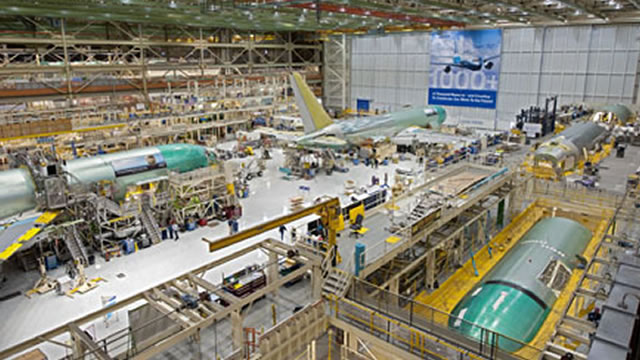
Spirit AeroSystems Reports Fourth Quarter 2024 Results
Prnewswire· 2025-02-28 21:20
Core Viewpoint - Spirit AeroSystems reported a challenging fourth quarter for 2024, with significant operating losses and a decrease in revenue compared to the previous year, primarily due to the impacts of the Boeing Memorandum of Agreement and production challenges. The company is preparing for its anticipated acquisition by Boeing in mid-2025, focusing on operational improvements and transition plans to ensure long-term success. Financial Performance - Spirit's revenue for the fourth quarter of 2024 was $1.65 billion, a decrease of 9% from $1.81 billion in the same period of 2023 [27] - The operating loss for the fourth quarter of 2024 was $577 million, compared to an operating income of $215 million in the fourth quarter of 2023 [27] - The net loss for the fourth quarter of 2024 was $631 million, translating to a loss per share of $(5.38), compared to a profit of $75 million and earnings per share of $0.66 in the same period of 2023 [27][7] Operational Highlights - Deliveries increased significantly in the fourth quarter, with Boeing 737 deliveries up 133% compared to the previous quarter, A220 deliveries up 37%, and A350 deliveries up 15% [2] - Spirit's backlog at the end of the fourth quarter of 2024 was approximately $47 billion, encompassing work packages on all commercial platforms in the Airbus and Boeing backlog [4] Cash Flow and Liquidity - Cash provided by operations improved to $137 million in the fourth quarter of 2024, up from $113 million in the same period of 2023 [28] - Free cash flow for the fourth quarter of 2024 was $91 million, compared to a negative cash flow of $1.27 billion in the previous year [28] - The company received advance payments from Boeing of up to $350 million and from Airbus of $107 million, with $200 million and $70 million received by the end of the fourth quarter, respectively [9] Segment Performance - The Commercial segment revenue decreased by 16.6% in the fourth quarter of 2024, primarily due to the Boeing MOA impacts, with an operating loss of $468.3 million [30] - The Defense & Space segment revenue increased by 30.9% year-over-year, driven by higher activity on specific programs, although it recorded net forward losses of $30 million [20] - The Aftermarket segment revenue increased by 29.8% compared to the previous year, primarily due to higher spare part sales, but the operating margin decreased due to sales mix [22] Acquisition and Future Outlook - The anticipated acquisition by Boeing is expected to close in mid-2025, subject to regulatory approvals and other conditions [13] - Management is focused on improving liquidity and operational efficiency, with plans dependent on various factors including customer advance repayments and production forecasts [11]