Abbott Laboratories

Search documents
Global Infant Milk Formula Market to Surpass $22.35 Billion by 2034 as Demand for Nutrient-Rich Formula Rises
Globenewswire· 2025-03-11 12:30
Market Overview - The global infant milk formula market is projected to reach a revenue of US$ 6.3 billion in 2024, with an expected CAGR of 13.5% from 2024 to 2034, ultimately reaching a valuation of US$ 22.35 billion by 2034 [1][7]. Consumer Trends - Changing consumer habits, increased spending power, and higher female employment have positively impacted the market, as busy lifestyles lead parents to seek convenient nutritional solutions for their infants [4][6]. Product Insights - Infant milk formula is seen as a vital alternative for mothers unable to breastfeed, providing essential nutrients that may not be available in cow or other milk alternatives [2][6]. - The starting milk formula segment is anticipated to reach a valuation of US$ 2.49 billion in 2024 [7]. Regional Insights - North America is expected to hold a market share of 24.3% by 2034, with the United States alone projected to expand at a CAGR of 14% and occupy 45.6% of the North American market [7]. - East Asia is forecasted to grow at a CAGR of 13.8% from 2024 to 2034, with Japan accounting for a 29.4% market share in the region by 2034 [7]. Competitive Landscape - Key players in the infant milk formula market include Wyeth, Feihe, Danone, Mead Johnson & Company, Abbott Laboratories, and others, focusing on product development and market expansion [8][11]. - The rise of organic infant formulas presents significant growth opportunities as parents prioritize safe and high-quality products [11]. Market Segmentation - The market is segmented by product type (starting milk formula, follow-on milk formula, toddler milk formula) and distribution channels (specialty stores, supermarkets, online retail, pharmacies) across various regions [13][14].


Neurology Devices Market is Expected to Reach USD 22,335.5 Million by 2035, Growing at 6.7% CAGR | Fact.MR Report
Globenewswire· 2025-03-10 11:30
Market Overview - The global neurology devices market is projected to reach a valuation of USD 11,678 million in 2025, with an expected CAGR of 6.7% from 2025 to 2035 [1][8] - The market created an opportunity of USD 2,245 million growing at a CAGR of 5.9% between 2020 to 2025 [8] Neurological Disease Burden - Over 1 in 3 adults worldwide are affected by neurological diseases, making it the largest cause of disease and impairment globally [2] - From 1990 to 2021, the overall disability and early death due to neurological diseases rose by 18%, with 3.4 million people (43.1%) living with such conditions in 2021 [3] Technological Advancements - Continuous growth in neurology devices is attributed to the development of minimally invasive devices utilizing artificial intelligence for superior diagnosis and treatment [4] - Companies are innovating and forming strategic partnerships to enhance market dominance in response to the rising demand for improved neurological treatments [9] Market Drivers - The increasing prevalence of neurological disorders, such as Alzheimer's and Parkinson's diseases, is driving demand for treatment devices and diagnostic equipment [5] - The aging population is more vulnerable to neurological disorders, further increasing the demand for advanced neurology devices [5] Healthcare Spending and Accessibility - Rising healthcare spending in emerging economies is improving patient access to advanced neurology devices, supported by government initiatives and favorable reimbursement policies [6] Key Players and Innovations - Leading companies in the neurology devices market include Medtronic, Boston Scientific Corporation, Stryker Corporation, and Abbott Laboratories [9][17] - Significant investments in research and development are being made, such as Precision Neuroscience's funding of USD 102 million for brain-computer interface technology [11] Clinical Trials and New Technologies - A partnership between Amber Therapeutics and Oxford University conducted a clinical trial of Picostim, demonstrating an 80% reduction in seizures for neurological disorder treatment [12] - Inbrain Neuroelectronics introduced a brain implant made from graphene, aimed at improving outcomes in brain cancer surgeries and treating conditions like Parkinson's disease and epilepsy [13] Market Segmentation - The study categorizes the market based on device type, application (e.g., Alzheimer's, Parkinson's), and end user (e.g., hospitals, neurology clinics) across major global regions [15]
2 Dependable Dividend Stocks That Can Pay You for Life
The Motley Fool· 2025-03-07 13:15
Core Insights - High dividend yields can be attractive, but companies must have a reliable business model to avoid payout cuts [1] - Medtronic and Abbott Laboratories are highlighted as strong dividend stocks in the healthcare sector [2] Medtronic - Medtronic operates in various therapeutic areas, including diabetes care, neuroscience, cardiovascular health, and medical-surgical, with around 120 product approvals in the last year [3][4] - The company has a strong position in healthcare and innovative capabilities, contributing to consistent financial performance [4][6] - Medtronic has raised its dividends for 47 consecutive years, with a forward yield of 3%, significantly higher than the S&P 500 average of 1.3% [8] Abbott Laboratories - Abbott Laboratories has increased its dividends for 52 consecutive years, indicating strong financial health and operational diversity [9] - The company has a diversified business model, including pharmaceuticals, diagnostics, and nutrition, which helps mitigate risks in its medical device segment [9][10] - Abbott's FreeStyle Libre is a leading continuous glucose monitoring system, with significant growth potential as only 1% of adults globally have access to CGM technology [10][11] - The forward yield for Abbott is 1.7%, supported by a strong underlying business and growth prospects [14]



Strong Earnings Lift Abbott Laboratories Shares
FX Empire· 2025-03-07 10:28
Core Viewpoint - The content emphasizes the importance of conducting personal due diligence and consulting competent advisors before making any financial decisions, particularly in the context of investments and trading [1]. Group 1 - The website provides general news, personal analysis, and third-party content intended for educational and research purposes [1]. - It explicitly states that the information should not be interpreted as recommendations or advice for any financial actions [1]. - The content is not tailored to individual financial situations or needs, highlighting the necessity for users to apply their own discretion [1]. Group 2 - The website includes information about complex financial instruments such as cryptocurrencies and contracts for difference (CFDs), which carry a high risk of losing money [1]. - Users are encouraged to perform their own research and understand the risks involved before investing in any financial instruments [1].
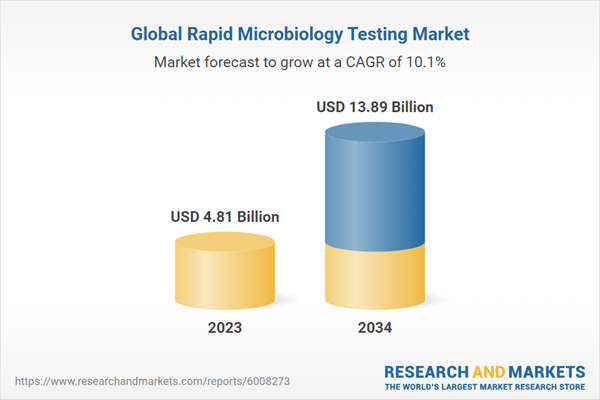
Rapid Microbiology Testing Research Report 2024: Global Market to Reach $13.89 billion by 2034, Growing at a CAGR of 10.12% - Emerging Markets, and Partnerships & Collaborations Fueling Opportunities
Globenewswire· 2025-03-06 10:51
Market Overview - The global rapid microbiology testing market was valued at USD 4.81 billion in 2023 and is projected to reach USD 13.89 billion by 2034, with a compound annual growth rate (CAGR) of 10.12% from 2024 to 2034 [2][11][13] Market Drivers - Key factors driving market growth include the rising incidence of infectious diseases, emphasis on early and accurate disease detection, increased public awareness regarding food safety, government initiatives, and growth opportunities in developing countries [2][4] Product Segmentation - The instruments segment generated the highest revenue in 2023 due to automation, efficiency, and broader testing capabilities. The reagents and kits segment is expected to grow at the fastest CAGR during the forecast period, driven by demand for specific and user-friendly tests [5] Application Segmentation - The clinical disease diagnosis segment was the highest revenue-generating application in 2023, reflecting the critical need for prompt diagnosis and treatment of infectious diseases. The food and beverage testing segment is anticipated to grow at the fastest CAGR due to increasing concerns about food safety and stringent regulations [6] Method Segmentation - Nucleic acid-based rapid microbiology testing accounted for the highest revenue in 2023, attributed to its high sensitivity and specificity for pathogen detection. The growth-based rapid microbiology testing segment is expected to grow at the fastest CAGR, owing to its simplicity and affordability [7] End-User Segmentation - Laboratories and hospitals represented the highest revenue-generating end-user segment in 2023, driven by the need for rapid diagnosis and treatment. The food and beverage company segment is projected to grow at the fastest CAGR due to heightened focus on food safety and quality control [8] Regional Insights - North America is expected to hold the largest revenue share during the forecast period, supported by a well-established healthcare infrastructure and early adoption of advanced technologies. The Asia Pacific region is predicted to grow at the fastest CAGR, driven by rising healthcare awareness and increasing disposable income [9]
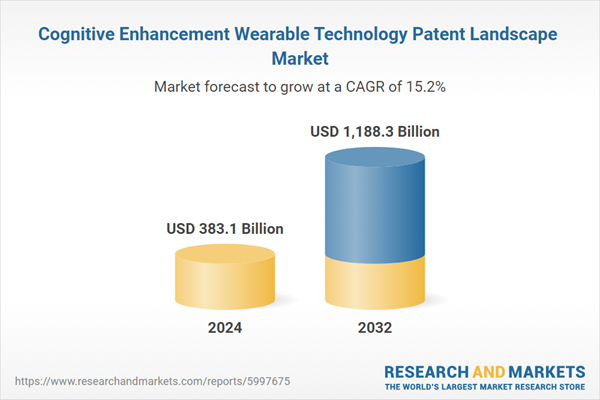
Cognitive Enhancement Wearable Technology Patent Landscape Report, 2017-2023 & 2024-2032 with Patent Profiles of Abbott Laboratories, IBM, Nestec, University of California, and Koninkl Philips Electronics
Globenewswire· 2025-03-04 15:36
Market Overview - The cognitive enhancement wearable technology market was valued at USD 332.6 billion in 2023 and is projected to grow at a CAGR of 15.2%, reaching USD 1.18 trillion by 2032 [1][19]. - The estimated market value in 2024 is USD 383.1 billion, with a forecasted value of USD 1,188.3 billion by 2032 [19]. Patent Landscape - The market is characterized by a dynamic patent landscape, with significant innovations in EEG and neurostimulation technologies, advanced miniaturization, and digital integration driving extensive patent filings [2][9]. - The United States leads with over 600 patents, followed by Europe with approximately 500 patents, and Asia-Pacific with 450 patents [4][13]. Key Companies - Abbott Lab is a leader in the patent landscape with over 300 patents filed historically and 120 currently in progress, focusing on advanced EEG and neurostimulation technologies [15]. - IBM Corporation has filed 250 patents historically and is pursuing 100 patents, emphasizing miniaturized and user-friendly devices [16]. - Nestec SA holds 200 patents historically and 90 currently active, focusing on the integration of wearable devices with digital platforms [17]. Technology Analysis - EEG technology dominates the cognitive enhancement wearable technology segment, with over 400 patents filed historically and 150 currently active [10]. - Headbands lead the device type segment with over 300 patents filed historically and 120 currently active, reflecting their convenience in consumer and clinical settings [11]. Future Projections - The patent landscape is expected to see over 200 additional patents focusing on advancements in EEG technology and over 180 additional patents for headband designs [10][11]. - Future projections for Abbott Lab suggest over 150 additional patents, while IBM Corporation anticipates around 130 more patents [15][16].