Merck KGaA

Search documents
Rapid Microbiology Testing Research Report 2024: Global Market to Reach $13.89 billion by 2034, Growing at a CAGR of 10.12% - Emerging Markets, and Partnerships & Collaborations Fueling Opportunities
Globenewswire· 2025-03-06 10:51
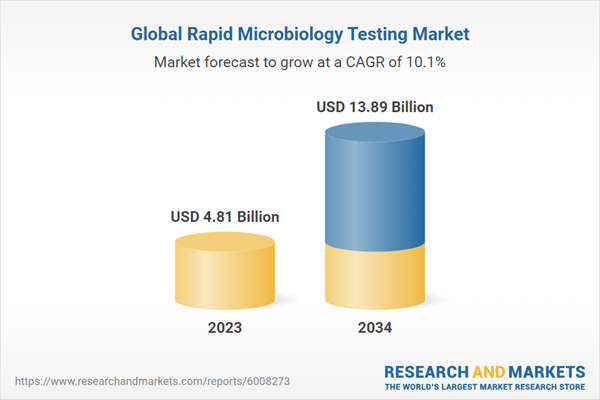
Market Overview - The global rapid microbiology testing market was valued at USD 4.81 billion in 2023 and is projected to reach USD 13.89 billion by 2034, with a compound annual growth rate (CAGR) of 10.12% from 2024 to 2034 [2][11][13] Market Drivers - Key factors driving market growth include the rising incidence of infectious diseases, emphasis on early and accurate disease detection, increased public awareness regarding food safety, government initiatives, and growth opportunities in developing countries [2][4] Product Segmentation - The instruments segment generated the highest revenue in 2023 due to automation, efficiency, and broader testing capabilities. The reagents and kits segment is expected to grow at the fastest CAGR during the forecast period, driven by demand for specific and user-friendly tests [5] Application Segmentation - The clinical disease diagnosis segment was the highest revenue-generating application in 2023, reflecting the critical need for prompt diagnosis and treatment of infectious diseases. The food and beverage testing segment is anticipated to grow at the fastest CAGR due to increasing concerns about food safety and stringent regulations [6] Method Segmentation - Nucleic acid-based rapid microbiology testing accounted for the highest revenue in 2023, attributed to its high sensitivity and specificity for pathogen detection. The growth-based rapid microbiology testing segment is expected to grow at the fastest CAGR, owing to its simplicity and affordability [7] End-User Segmentation - Laboratories and hospitals represented the highest revenue-generating end-user segment in 2023, driven by the need for rapid diagnosis and treatment. The food and beverage company segment is projected to grow at the fastest CAGR due to heightened focus on food safety and quality control [8] Regional Insights - North America is expected to hold the largest revenue share during the forecast period, supported by a well-established healthcare infrastructure and early adoption of advanced technologies. The Asia Pacific region is predicted to grow at the fastest CAGR, driven by rising healthcare awareness and increasing disposable income [9]

Mersana Therapeutics(MRSN) - 2024 Q4 - Earnings Call Transcript
2025-03-03 14:00
Financial Data and Key Metrics Changes - At the end of 2024, the company reported cash, cash equivalents, and marketable securities totaling $134.6 million, which is expected to support operations into 2026 [16] - Net cash used in operating activities for Q4 2024 was $19.3 million, a significant decrease from $32 million in the same quarter of 2023 [16] - Collaboration revenue for Q4 2024 was $16.4 million, up from $10.7 million in Q4 2023, primarily due to increased revenue from collaborations with J&J, Merck, and GSK [17] - Research and development expenses for Q4 2024 were $22.3 million, slightly up from $21.5 million in Q4 2023, with $1.7 million attributed to non-cash stock-based compensation [18] - General and administrative expenses decreased to $8.9 million in Q4 2024 from $10.1 million in Q4 2023, reflecting reduced employee compensation and consulting fees [18] - The net loss for Q4 2024 was $14.1 million, compared to a net loss of $19.5 million in Q4 2023 [18] Business Line Data and Key Metrics Changes - The lead ADC, Emily, reported a confirmed objective response rate (ORR) of 23% across all tumor types with high B7H4 expression, defined as an IHC score of 70% or more [7][9] - The expansion portion of the trial for Emily was initiated for patients with triple-negative breast cancer (TNBC) who have previously been treated with at least one TOPO1 ADC [8] - The company is exploring doses up to 95 mg/m² for Emily, with the top dose of 67.4 mg/m² being well tolerated in the expansion cohort [14][51] Market Data and Key Metrics Changes - The competitive landscape for B7H4 ADCs has shifted favorably for Emily, as a primary competitor, Pfizer, discontinued its B7H4 ADC candidate [12][40] - The company believes it is well-positioned in the B7H4 ADC space, being the most advanced in clinical development with positive efficacy data in the post-TOPO breast cancer setting [40] Company Strategy and Development Direction - The company is focused on advancing its lead candidates, Emily and XMT-2056, with ongoing clinical trials and collaborations [15] - There is an emphasis on the potential for Emily to be used in combination with standard care treatments, such as platinum chemotherapy, due to its favorable safety profile [41] - The company is also exploring additional indications for Emily beyond TNBC, given the clinical activity observed across various tumor types [13] Management's Comments on Operating Environment and Future Outlook - Management expressed confidence in the clinical activity of Emily, particularly in a high unmet need population of TNBC patients [8] - The company is optimistic about its cash runway and operational plans, expecting to support its commitments into 2026 without relying on future milestone payments [16] - Management highlighted the importance of ongoing investigator interest and engagement in their clinical studies [13] Other Important Information - The company has made progress in its collaborations with J&J and Merck KGa, which are expected to contribute to its research and development efforts [15] - The company has amended its clinical trial protocol to mitigate proteinuria issues observed at higher doses of Emily [14][22] Q&A Session Summary Question: Progress on mitigating AST elevation and proteinuria related to Emily - Management indicated that AST elevation does not lead to meaningful dose delays and is a transient, reversible phenomenon [21] - For proteinuria, mitigation strategies such as ACE inhibitors are being implemented, allowing for dose reductions instead of delays [23] Question: Distribution of patients with prior lines of therapy in the expansion cohort - Management stated it is too early to determine the distribution of patients with fewer prior lines of therapy, but confirmed that patients with more than four prior lines are excluded [29] Question: Establishing the final biomarker cutoff for B7H4 high - Management expects the TPS score to capture roughly 40% to 50% of the TNBC population [34] Question: Competitive landscape and Pfizer's discontinuation - Management noted that the discontinuation of Pfizer's program has led to increased interest in their study, positioning Emily favorably in the market [54]