Thales

Search documents
To the Moon: Viasat Selected to Design Lunar Orbiting Satellite System Alongside Telespazio
Globenewswire· 2025-03-25 12:00
Core Viewpoint - Viasat is set to lead the lunar orbiting satellite communications segment of the European Space Agency's Moonlight Program, collaborating with Telespazio and various European and UK companies to establish Europe's first lunar orbiting satellite network [1][2][3] Group 1: Project Overview - The Moonlight program aims to develop a lunar orbiting Navigation and Communication system to enhance navigation and communication services for both European and international missions on the Moon's surface and in lunar orbit [3] - The communications system will function as a data highway for communication between Earth and the Moon, facilitating interactions among people, spacecraft, and lunar vehicles to support scientific and exploration projects [4] Group 2: Viasat's Role - Viasat is responsible for designing and developing the communication network, defining end-to-end communication services for lunar landers, rovers, orbiters, and other technologies [5] - The initial design phase of the communication system is fully funded by the European Space Agency, with Viasat's engineering and technology operations based in London [11] Group 3: Timeline and Phases - The Moonlight services will be deployed in phases, with initial capabilities expected by the end of 2028 and full operations targeted for 2030 [6] Group 4: Industry Impact - The Moonlight initiative is expected to showcase Viasat's and the UK's leadership in emerging commercial markets, particularly the lunar economy, by providing reliable navigation and communication services for future lunar missions [7][8] - The program is anticipated to support additional commercial activities on the Moon, including space tourism and manufacturing programs utilizing rare lunar materials [4]



Smart Ticketing Market Report 2025-2030, with Confidex, CPI Card Group, Cubic, HID, Thales, Giesecke & Devrient, Infineon Technologies, NXP Semiconductors, IDEMIA & Xerox
Globenewswire· 2025-03-14 09:16
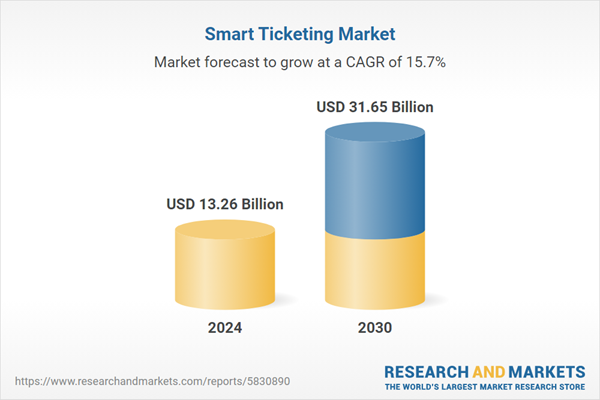
Market Overview - The Smart Ticketing Market was valued at USD 13.26 billion in 2024 and is projected to reach USD 31.65 billion by 2030, with a compound annual growth rate (CAGR) of 15.70% [2][9] - The market growth is driven by the widespread adoption of smartphones and mobile ticketing channels, allowing users to purchase, store, and validate tickets on mobile devices [2][4] Key Trends - Smart ticketing systems generate extensive data on passenger journeys and travel patterns, which operators leverage for insights to optimize operations and enhance passenger experience [4] - The COVID-19 pandemic has accelerated the demand for contactless ticketing solutions, leading to increased popularity of mobile ticketing applications and QR code-based systems [5] Segment Analysis - The hardware segment accounted for the largest share of 51.4% in 2024, enabling transport operators to issue and read tickets via a single interface [8] - The e-ticket segment held the largest market share in 2024, driven by a surge in contactless payments due to the pandemic [8] - The smart card segment dominated the market in 2024, with benefits such as durability and efficiency driving its adoption [8] Regional Insights - Europe dominated the smart ticketing market in 2024, accounting for a revenue share of 34.48%, identified as a lucrative region [8] - The smart ticketing market in the Asia Pacific is anticipated to grow at a CAGR of 16.9% during the forecast period [8] Competitive Landscape - Key companies profiled in the report include Confidex, CPI Card Group, Cubic, Thales, Giesecke & Devrient, HID Global Corporation, Infineon Technologies, NXP Semiconductors, IDEMIA, and Xerox [8][9]