Infosys Limited

Search documents
Anti-Money Laundering Solution Market to Surpass USD 7.74 Billion by 2033, Driven by Rising Financial Crimes and Regulatory Compliance Pressure | SNS Insider
Globenewswire· 2026-02-25 04:00
Austin, Feb. 24, 2026 (GLOBE NEWSWIRE) -- The Anti-Money Laundering Solution Market size was valued at USD 2.07 billion in 2025 and is expected to reach USD 7.74 billion by 2033 and grow at a CAGR of 17.88% over the forecast period. The industry is expanding as a result of rising worldwide digital transactions, stricter regulatory and compliance requirements, and an increase in financial crimes. Financial institutions can identify suspicious activity, maintain compliance, and lessen the risk of financial cr ...


US visa fee hike to cost $100-250 million for IT companies: Moody's
The Economic Times· 2026-02-12 06:51
Core Insights - The increase in US visa fees is projected to raise operating expenses for Indian IT services firms by $100 million to $250 million, which is about 1% of their revenues [1][12] - Despite the higher costs, most large Indian IT firms can absorb these expenses without significant deterioration in their financial profiles due to their high profitability and robust financial positions [1][12] Financial Impact - The immediate margin impact on top-tier IT firms is expected to be modest, with the increase in operating expenses constituting around 1% of revenues and EBITA margin hit limited to around 100 basis points [5][12] - Indian IT majors have EBITA margins of 19%-26%, which exceed global peers' margins of 10%-17%, and many maintain substantial net cash positions, such as $7 billion at TCS and $4 billion at Infosys as of December 31, 2025 [6][12] Industry Dependency on H-1B Visas - The business model of the Indian IT industry relies heavily on H-1B visas, with the computer-related technology sector accounting for approximately 70% of such visas issued over the last five years [2][12] - Leading Indian IT companies like Tata Consultancy Services and Infosys are among the top H-1B sponsors, indicating their reliance on this visa category [2][12] Challenges for Smaller Firms - Small and mid-sized companies may struggle to absorb the increased visa costs due to lower margins and limited liquidity, potentially compromising profitability or delaying investments in growth areas like AI and cloud [7][12] - This situation could lead to accelerated industry consolidation, as scale and financial strength become critical differentiators [7][12] Talent Shortages and Demand - Structural talent shortages in the US are expected to sustain demand for Indian IT services, with an estimated annual shortfall of around 200,000 workers in the US computer and IT sector [8][12] - Indian nationals account for 70%-75% of all H-1B visa approvals since 2020, and India produces about 2.5 million STEM graduates annually compared to 850,000 in the US [9][12] Investments in Automation and AI - Indian IT firms are increasing investments in automation and artificial intelligence to mitigate visa-related risks and improve efficiency, with many embedding generative AI to automate routine tasks [10][12] - This shift towards AI comes with near-term costs, as capital spending on AI infrastructure and employee training is expected to grow, putting pressure on free cash flow over the next 1 to 2 years [11][12]


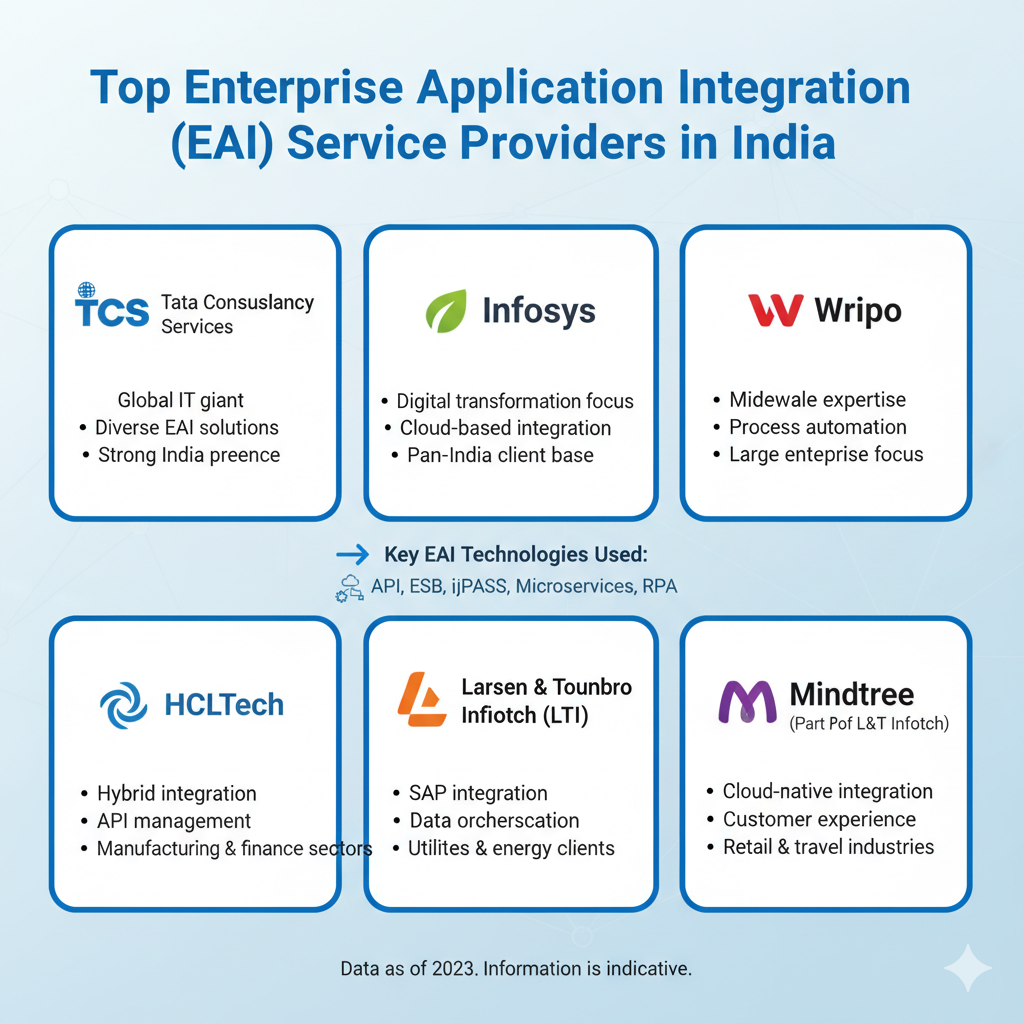
Top Enterprise Application Integration (EAI) Service Providers in India
Medium· 2025-11-06 06:21
Core Insights - The article discusses the importance of Enterprise Application Integration (EAI) in connecting various software systems within companies to enhance data flow and operational efficiency [3][28] - It highlights the top EAI service providers in India, emphasizing their strengths and suitability for different business needs [7][8][9][10][17][18] EAI Overview - EAI is defined as the process of connecting different software systems used by a company, facilitating automatic information sharing between systems like CRM and ERP [3] - The benefits of EAI include faster work processes, reduced errors, and improved data control [3][28] Types of EAI - Common types of EAI include: - Point-to-point: Direct connection between two systems - Enterprise Service Bus (ESB): Central system connecting multiple applications - iPaaS (Integration Platform as a Service): Cloud-based integration - API-led integration: Utilizes APIs for easy app connections [6] Reasons for India's EAI Success - Indian companies excel in EAI due to lower service costs, skilled engineers, strong cloud and API experience, and 24/7 support [5][6] Top EAI Service Providers in India 1. **Tata Consultancy Services (TCS)** - Best for large companies with multiple systems or global branches; known for reliability and experience [7] 2. **Wipro Limited** - Ideal for businesses transitioning to cloud systems; offers quick and modern solutions [8] 3. **Infosys Limited** - Suitable for companies needing advisory and implementation support; recognized for technical skills and reliable support [9] 4. **HCLTech** - Focuses on businesses undergoing digital transformation; strong in automation and hybrid setups [10] 5. **Sify Technologies** - Best for public and private enterprises in India; known for affordability and flexibility [17] 6. **Flexsin Technologies** - Targets small to mid-size businesses; offers quick delivery and cost-effective solutions [18] Selection Criteria for EAI Providers - Companies should consider: - Listing systems to connect - Choosing the right integration type (ESB, iPaaS, API-led) - Provider's experience with specific software - Security and compliance measures - Requesting demos or proof of concept - Comparing total costs and support options [21] Real-World Examples - Wipro helped a utility company reduce costs by 30% through cloud integration [22] - Sify connected over 600 bank branches across India using cloud tools for improved service [23] Conclusion - EAI is crucial for enhancing operational efficiency and decision-making in companies; selecting the right provider is essential for successful integration [28]

NiftyIT Index slumps 3% on new US visa fee
BusinessLine· 2025-09-22 15:25
Core Viewpoint - The imposition of a $100,000 fee on new H-1B applications by the US is expected to significantly impact Indian IT companies, leading to increased operating costs and a decline in stock performance within the sector [1][5]. Group 1: Market Performance - Information technology stocks were the worst performers on Monday, with the Nifty IT index dropping 3 percent and experiencing over $10 billion in market capitalisation erosion [1]. - The NiftyIT index has seen losses ranging from 1.7 to 4.7 percent, with mid-size companies like Persistent Systems, Coforge, LTIMindtree, and Mphasis falling between 4.3 to 4.7 percent [2]. - Over the past week, the NiftyIT index has declined by over 1000 points, attributed to slower deal-making in the US and pricing pressures [2]. Group 2: Revenue Impact - Despite a reduced dependency on H-1B visas, the US still represents nearly 60 percent of revenues for Indian IT companies, indicating a potential near-term negative impact on stock prices due to protectionist risks [3]. - Approximately 71 percent of H-1B visa beneficiaries are Indians, highlighting the significance of this visa category for the Indian IT sector [3]. Group 3: Cost Implications - The new H-1B visa fee will increase operating costs for Indian IT services companies, compounded by a potential 25 percent tax under the proposed HIRE Act for US companies outsourcing to foreign entities [5]. - The top 12 IT companies are expected to see an impact on their earnings ranging from 1.5 to 12 percent due to the new visa costs, affecting them by 14 to 188 basis points [6]. Group 4: Industry Outlook - InCred equities downgraded the IT sector's rating to Neutral from Overweight, citing new regulations as a factor contributing to macroeconomic uncertainty [7]. - Key challenges for FY27 revenues and EBIT margins include rising cost pressures, a decrease in onsite roles, and potential offshoring of existing onsite roles [7].