Penn State

Search documents
Why is knowledge getting so expensive? | Jeffrey Edmunds | TEDxPSU
TEDx Talks· 2025-11-16 14:30
Ebook Licensing Issues in Libraries - Libraries are facing a shift from owning physical books to licensing ebooks, leading to a loss of control over their collections [1] - Unlike print books, ebooks are not owned but licensed, which means libraries don't have the same rights, including the right to resell [1] - Publishers are removing thousands, even hundreds of thousands, of ebooks from library catalogs monthly due to licensing restrictions [1] - The cost of licensing ebooks is artificially high, often more expensive than buying print books, and has risen faster than inflation [1] - Publishers impose non-disclosure clauses, preventing libraries from discussing ebook prices with each other [1] - Publishers bundle ebooks, forcing libraries to license unwanted content [1] Scholarly Publishing and Open Access Solutions - Scholarly publishing relies on research and manuscripts created at universities, funded by tuition, taxpayer dollars, and grants [1][2] - Libraries are spending significant amounts on ebooks, with Penn State spending over $13 million annually [2] - Open Access literature, like the journal Glossa, offers a free alternative to costly subscriptions, such as Lingua's $2,500 annual fee [2] - Open Educational Resources (OER) address rising textbook costs, with 65% of Penn State students avoiding textbook purchases due to expense [2] - Libraries are working to identify and make discoverable over 120万 resources that are freely available online [2]

Making sense of the first College Football Playoff rankings
NBC News· 2025-11-07 17:06
College Football Playoff Expansion - The expansion to a 12-team playoff field, coupled with new rules, is leading to the inclusion of unexpected teams [3] - Certain conference champions, like Memphis from the American Athletic Conference, receive guaranteed bids regardless of their overall ranking [4] - Virginia's high ranking within the ACC would currently secure them a playoff spot [5] Team Dynamics and Coaching - Indiana's football program has become competitive, partly due to NIL (Name, Image, Likeness) deals [6] - Indiana's coach, Kurt Senetti, has successfully recruited players and coached the team to a higher level of performance [7][8] - Quarterback Fernando Mendoza's performance has significantly contributed to the team's success [8] Instability and High Expectations - Several traditionally strong college football programs, including LSU, Florida, Auburn, and Penn State, have experienced significant setbacks, leading to coaching changes [9] - The transfer portal and NIL deals have increased the level of chaos and unpredictability in college football [10] - High expectations and increased financial investment from schools and boosters have created a high-pressure environment for coaches, where even a three-game losing streak can result in termination [11]
$10,000 Tickets, Bourbon Deals: Colleges Hunt Revenue to Pay Athletes
Bloomberg Television· 2025-10-06 20:14
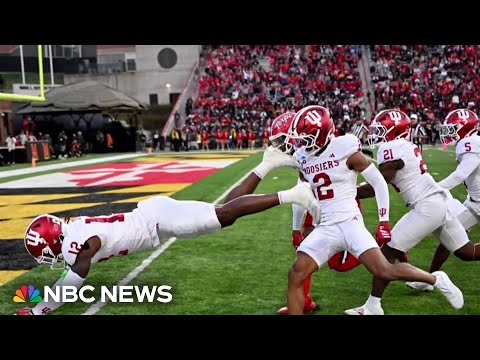
Revenue Generation Strategies in Collegiate Sports - Universities are exploring creative revenue streams for sports programs, such as Penn State's $10,000 tunnel club access [1] - Power four conferences universities, including the Big 10 and SEC, are paying players up to 205 million or 20.5% this year [3] - The University of Michigan generated revenue by hosting a concert that sold 115,000 tickets [4] Impact of Revenue Sharing with Student Athletes - Colleges are now sharing revenue with student athletes due to federal settlements regarding name, image, and likeness [2][3] - Universities are seeking ways to generate revenue to compensate players [3] - Ohio State's sponsorship deals brought in $44 million in gross revenue last year and are expected to increase this year, with total sales reaching $260 million [5] Sponsorship and Advertising - Ohio State announced a multi-year sponsorship deal with Andril, a defense contractor [6] - Some athletic directors are advocating for branded ads on player jerseys, which is currently banned by the NCAA [7] Potential Concerns and Future Trends - Critics worry that the focus on revenue generation may detract from the core educational missions of colleges [7] - Expect to see more stadiums selling alcohol, premium tickets, and exclusive member experiences [7]