Archaeology

Search documents
X @The Economist
The Economist· 2025-08-25 09:00
Archaeology & History - Archaeological excavations of the city have been ongoing for over three centuries [1] - The city has been utilized and potentially misused by various generations since its discovery [1] - Current excavations are described as pristine [1]
X @BBC News (World)
BBC News (World)· 2025-08-23 22:45
Research Focus - Researchers recreated faces of 2,500-year-old skulls found in India [1]
X @The Economist
The Economist· 2025-08-17 14:00
General Observation - Pompeii is often called a "lost city" [1] - Much of Pompeii remains unknown despite its exposure [1]
X @The Economist
The Economist· 2025-08-16 18:30
Archaeological Discovery - Excavations have uncovered new and pristine relics from the ancient city [1] Visual Documentation - Photo documentation is available by Danilo Scarpati [1]
X @The Economist
The Economist· 2025-08-15 15:40
Archaeological Findings - Pompeii has been used and abused by almost every generation since archaeologists began uncovering it three-odd centuries ago [1] - New excavations are pristine [1]
X @BBC News (World)
BBC News (World)· 2025-08-07 05:09
Archaeological News - People returned to live in Pompeii's ruins, according to archaeologists [1]
X @The Wall Street Journal
The Wall Street Journal· 2025-07-15 23:25
Archaeologists have unearthed a woman-dominated Neolithic Dawenkou culture in what is considered the birthplace of Chinese civilization https://t.co/bgcoklLUvo ...
Informative Pasts, Sustainable Futures: Archaeology, Heritage and AI | Gai Jorayev | TEDxUIC
TEDx Talks· 2025-07-09 15:35
Heritage Data & AI Integration - The heritage sector is experiencing a data deluge due to advancements in technology like laser scanners and drones, leading to unprecedented speed in data collection [2][3][7] - There's a growing movement towards making heritage-related data linked, accessible, and open, adhering to FAIR principles (Findable, Accessible, Interoperable, Reusable) [8][9] - AI systems, both multimodal and unimodal, are being explored to connect the dots in heritage data analysis, potentially surpassing human capabilities in integrating diverse information [15][16][17] - Heritage data often presents challenges for AI models due to its irregularity, lack of comparability, and patchy nature, requiring models capable of reasoning with such data [19][20][25][26] Societal Implications & Collaboration - Archaeological and heritage evidence holds significant potential to inform modern societies on addressing global challenges like the climate crisis, offering insights into sustainable practices and resilient communities [10][11] - Collaboration between heritage specialists and AI experts is crucial for developing AI models that account for data biases, ethical considerations, and the unevenness of data access globally [28][29][30] - AI is envisioned as a collaborative tool to assist in synthesizing information and identifying new hypotheses, rather than replacing human expertise in the heritage field [31][32] - Explainable AI is essential for building trust and transparency in AI-driven heritage analysis, along with prioritizing replicability in a world marked by digital inequalities [33] Future Directions & Sustainability - The heritage sector aims to leverage AI to enhance the ability to discover, conserve, and manage heritage, contributing to broader sustainability goals [36][37] - The ultimate question is whether the fusion of heritage knowledge and AI can help humanity not only survive but also thrive, addressing modern problems and ensuring long-term outcomes [37]

X @BBC News (World)
BBC News (World)· 2025-07-06 13:35
Archaeologists unveil 3,500-year-old city in Peru https://t.co/w1FwsoIAPS ...
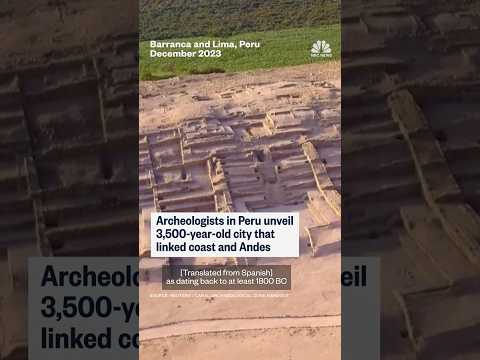
Archaeologists in Peru unveil 3,500-year-old city that linked coast and Andes
NBC News· 2025-07-04 05:57
Peñico ha sido identificado cronológicamente como del año de fundación de 1800 ates de Cristo, por lo menos. Y como ustedes pueden ver, pues es un periodo bastante largo que antiguamente eh de acuerdo a los marcos teóricos establecidos generalmente europeos, eh esto era llamado como periodo preserámico o arcaico, ¿no. Tenemos que considerar pues las características también que tiene el territorio, ¿no.Ellos se han ubicado en un lugar estratégico para el comercio, para el intercambio con sociedades de costa, ...