Investor protection

Search documents
X @Cointelegraph
Cointelegraph· 2025-09-19 18:31
Regulatory Focus - SEC chair Gary Gensler prioritized investor protection [1] - Gensler expresses "no regrets" about his legacy [1]
Gemini's Tyler Winklevoss has a curt response to Gary Gensler: 'Total disgrace..'
Yahoo Finance· 2025-09-19 17:18
Core Insights - Tyler Winklevoss, co-founder of Gemini, expressed dissatisfaction with former SEC Chair Gary Gensler's policies on cryptocurrency, particularly after Gensler's recent CNBC interview [1][5] - Gensler highlighted that during his tenure, the SEC dealt with nearly 100 fraud cases and defended his regulatory approach, emphasizing investor protection as a core mission [1][3] - Gensler characterized crypto trading as driven by momentum and hype rather than fundamentals, suggesting that many of the thousands of tokens in circulation are speculative and likely to collapse [2][3] Group 1: SEC Policies and Statements - Gensler stated that reforms achieved during his leadership included shortening the stock market settlement cycle from two days to one, enhancing market efficiency [2] - He opposed proposals to reduce corporate reporting from quarterly to semiannual, arguing that transparency is crucial for market stability and investor assessment [4] Group 2: Reactions from the Crypto Community - Winklevoss labeled Gensler as "a total disgrace to our country" in response to his defense of regulatory positions and the SEC's oversight of the crypto market [5] - Winklevoss, alongside his brother Cameron, is recognized as a significant figure in the crypto ecosystem, actively supporting pro-crypto initiatives and contributing nearly $23 million to related Political Action Committees [6][7]
Gary Gensler Says He Made The 'Right Calls' As SEC Chair: Crypto Trades Mostly On 'Hype' And Is Risky For Everyday Investors
Yahoo Finance· 2025-09-19 03:08
Core Viewpoint - Former SEC Chair Gary Gensler defended his regulatory approach to cryptocurrencies, emphasizing that it was focused on ensuring investor protection [1][2] Group 1: Gensler's Regulatory Stance - Gensler described cryptocurrencies as a "risky" asset class, primarily driven by momentum and hype, with most tokens lacking fundamental value, except for Bitcoin [2] - During his tenure, Gensler's SEC took a stringent regulatory approach, including lawsuits against major cryptocurrency platforms like Coinbase, Kraken, and Ripple Labs [3] Group 2: Current SEC Leadership - The current SEC Chair, Paul Atkins, has shifted the agency's approach, launching initiatives like "Project Crypto" to adapt to blockchain-based financial systems and collaborating with the CFTC to provide clearer industry guidelines [4] - Under Atkins, lawsuits against Coinbase and Kraken have been withdrawn, indicating a more lenient regulatory environment compared to Gensler's tenure [4]
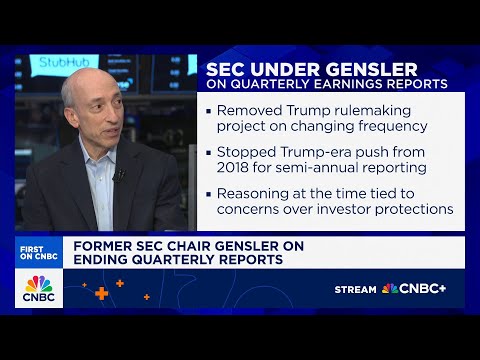
Fmr. SEC chair Gensler: Markets will be more volatile if companies only report earnings twice a year
CNBC Television· 2025-09-17 18:08
Regulatory Landscape & Policy - The SEC is considering President Trump's proposal to end quarterly reports, a policy previously removed under the Biden administration [1][2] - Transparency through quarterly reporting is seen as beneficial for market stability, with concerns that less frequent reporting (twice a year) could increase market volatility [2][3] - Corporate disclosure creates a public good, but also carries costs for companies [7] - Elections have consequences, leading to potential shifts in SEC priorities and approaches under different administrations [16] Market Dynamics & Investment - Long-term investing is considered a driver of the current economy, exemplified by significant spending (estimated at $200-300 billion annually) on artificial intelligence by mega-cap companies [5] - There's a debate on whether an AI bubble exists, with investors closely examining the field's profitability [12][13] - US capital markets have a lively competition between public and private markets, with liquid equity markets being four times larger than all of Europe [10] - Concentration is high, with the top 10 stocks representing 40% of the S&P [11] Crypto & Investor Protection - The previous SEC administration took a firm stance on crypto regulation, bringing approximately 100 cases to ensure investor protection [17] - Concerns exist regarding the speculative and risky nature of crypto assets, particularly tokens not tied to fundamentals [19]

Nasdaq Proposes Changes to its Listing Standards
Globenewswire· 2025-09-03 23:30
Core Points - Nasdaq proposed enhancements to its initial and continued listing standards to reinforce capital formation, investor protection, and market integrity [1][2] - The updates include increased requirements for minimum public float and capital raised during IPOs, along with stricter suspension and delisting procedures for non-compliant companies [1][2][5] Summary by Sections Revised Standards - The new standards aim to improve investor protection and market integrity, reflecting Nasdaq's commitment to adapt to market realities [2] - Enhanced requirements include a minimum public offering proceeds of $25 million for companies operating in China and a minimum market value of public float of $15 million for new listings [3][7] Liquidity Requirements - Nasdaq is recalibrating its minimum liquidity standards to align with current market dynamics and company valuations [2] - The proposed changes are part of a broader industry effort to examine trading behaviors in small company securities [2] Compliance and Oversight - Nasdaq will continue to refer cases of potentially manipulative trading to the SEC and FINRA, enhancing cooperation with regulators to maintain high standards [4] - The proposed rules will be submitted to the SEC for review, with a 30-day period for companies already in the listing process to comply with prior standards [5] Historical Context - The changes build on Nasdaq's previous regulatory leadership, including rules for IPOs from "restrictive markets" and adjustments to improve liquidity and compliance timelines [6][13] - Previous rules required companies from restrictive markets to have a minimum public offering size of $25 million, consistent with the new proposals [6][7]