Early cancer detection

Search documents
Mainz Biomed Initiates Feasibility Study of Biomarker Panel in Pancreatic Cancer Project
Globenewswire· 2025-06-10 13:01
Core Insights - Mainz Biomed is advancing its PancAlert project, focusing on a non-invasive blood test for early pancreatic cancer detection, aiming to confirm previous findings of 95% sensitivity and 98% specificity [1][5] Group 1: Project Development - The feasibility phase will verify candidate mRNA biomarkers and an accompanying machine learning algorithm in clinical blood samples to assess diagnostic performance [2][3] - The company plans to collaborate with Crown Bioscience, a CRO specializing in oncology, to support the verification process [2] Group 2: Objectives and Future Plans - The primary goal of the feasibility stage is to evaluate the robustness, reproducibility, and diagnostic performance of the assay, including sensitivity and specificity [3] - Following the feasibility phase, Mainz Biomed intends to conduct a validation study with a larger cohort, which is crucial for optimizing the test for clinical use and potential FDA submission [5] Group 3: Market Context - Early detection of pancreatic cancer is a significant unmet need in oncology, and the company is committed to improving patient outcomes through its diagnostic solutions [4] - The PancAlert project is part of Mainz Biomed's broader strategy to develop accessible molecular diagnostics for early cancer detection in areas with limited screening tools [5][7]


Mainz Biomed Announces Interim Read Out For Its eAArly DETECT 2 Clinical Study
Globenewswire· 2025-05-16 12:01
Core Insights - Mainz Biomed N.V. plans to provide an interim readout of its eAArly DETECT 2 feasibility study by the end of summer 2025, with top-line results expected in Q4 2025 [1][2] - The study aims to validate a next-generation colorectal cancer screening test that combines proprietary mRNA biomarkers, an AI-developed algorithm, and a FIT test on approximately 2,000 average-risk patients [1][3] - The company is on track to initiate its U.S. pivotal trial, ReconAAsense, in 2026 based on the outcomes of the eAArly DETECT 2 study [2][3] Study Details - The eAArly DETECT 2 study is expected to complete enrollment in the second half of 2025, targeting the reporting of top-line results by Q4 2025 [2] - The study will evaluate the effectiveness of five novel mRNA biomarkers acquired from Sherbrooke University in 2022, which have shown the ability to identify advanced adenomas and early-stage colorectal cancer [3] Company Mission - The company aims to advance its mission of eliminating colorectal cancer and reducing global cancer mortality rates through precise detection of advanced precancerous lesions and early-stage colorectal cancer [3]
Mainz Biomed Enters into Technology Partnership with EDX Medical Group
Globenewswire· 2025-04-29 12:01
Core Insights - Mainz Biomed has entered into a technology partnership with EDX Medical Group to enhance cancer diagnostics in the UK [1][3] - The partnership will allow EDX Medical to utilize Mainz Biomed's molecular diagnostic technology, expanding its product offerings [2] Company Overview - Mainz Biomed specializes in molecular genetics diagnostics, focusing on early cancer detection [1] - The company's flagship product, ColoAlert, is a non-invasive test for colorectal cancer, currently marketed in Europe and undergoing FDA clinical studies for US approval [4] - Mainz Biomed's product pipeline includes PancAlert, an early-stage pancreatic cancer screening test [4] EDX Medical Group Overview - EDX Medical Group, based in the UK, develops digital diagnostic products for various diseases, including cancer [1][5] - The company aims to improve disease detection and treatment personalization through advanced biological and digital technologies [6]
Mainz Biomed Provides First Quarter 2025 Corporate Update and Path to FDA Premarket Approval
Globenewswire· 2025-04-28 12:01
Core Insights - Mainz Biomed N.V. is focused on molecular genetics diagnostics for early cancer detection and is progressing towards FDA premarket approval for its products [1][4] Company Developments - The company reported significant progress in Q1 2025, driven by strong clinical results from three studies published in 2024 [1] - The eAArly DETECT 2 study has commenced, evaluating a next-generation colorectal cancer test with results expected by the end of 2025 [4] - Mainz Biomed has signed a license agreement with Liquid Biosciences to access novel mRNA biomarkers for early pancreatic cancer detection, achieving 95% sensitivity and 98% specificity in independent validation [4] - A strategic partnership with labor team w ag has been established to introduce the ColoAlert CRC screening test to the Swiss market, addressing the urgent need for early detection in Switzerland [4] - The enhanced ColoAlert CRC screening test has been launched in Germany, coinciding with Colorectal Cancer Awareness Month in March 2025 [4] Regulatory Compliance - Mainz Biomed has regained compliance with Nasdaq's minimum stockholders' equity requirement and the minimum bid price requirement, ensuring full compliance with all Nasdaq continued listing requirements [4]
Mainz Biomed Reports 2024 Financial Results and Provides Corporate Update
Newsfilter· 2025-04-01 12:01
Core Insights - Mainz Biomed reported a 33% year-over-year increase in lab network revenue, driven by strong demand for its ColoAlert® product in Europe [1][3] - The company achieved a 30% reduction in operating loss and an 18% decrease in net loss, attributed to targeted cost reductions and a sharper strategic focus [1][3] - Strategic partnerships with industry leaders, including collaborations with Thermo Fisher Scientific and Quest Diagnostics, mark significant progress for the company [3][5] Financial Performance - For the year ended December 31, 2024, Mainz Biomed's revenue was $893,991, slightly down from $895,479 in 2023 [9] - The gross profit increased to $574,883, resulting in a gross margin of 64%, up from 57% in the previous year [9] - Operating expenses decreased significantly to $19,270,291 from $27,154,341 in 2023, leading to a loss from operations of $18,695,408, down from $26,644,682 [10] Strategic Initiatives - The company is focusing on three key initiatives for 2025: expanding the ColoAlert® business in Europe, developing a next-generation colorectal cancer screening product, and conducting a 2,000 patient study (eAArly DETECT 2) [3][5] - Mainz Biomed's eAArly DETECT study demonstrated a 97% sensitivity for colorectal cancer and 82% for advanced precancerous lesions, with 100% detection of high-grade dysplasia in advanced precancerous patients [3][7] Corporate Developments - Mainz Biomed regained compliance with Nasdaq listing requirements, confirming its continued presence on the Nasdaq Capital Market [7] - The company has initiated the eAArly DETECT 2 study, which aims to validate its next-generation colorectal cancer test and is on track to report results by the end of 2025 [7][9] - A license agreement with Liquid Biosciences was signed to access novel mRNA biomarkers for early pancreatic cancer detection, showing promising preliminary results [7][9]
Urteste plans to start clinical trials for its pancreatic cancer test in Europe in Q3 2025
Globenewswire· 2025-03-27 15:21
Core Viewpoint - Urteste S.A. plans to initiate clinical trials for its pancreatic cancer diagnostic test, Panuri, in Europe in Q3 2025, with a focus on obtaining certification and advancing towards commercialization [1][3]. Group 1: Clinical Trials and Regulatory Process - The clinical trials for the Panuri test will involve 550 patients and will be conducted in Poland and selected EU countries [2]. - Urteste is preparing the trial protocol in collaboration with Avania and will announce a tender for a Contract Research Organization (CRO) in Q2 2025 [2]. - The company will hold its fourth Q-submission meeting with the FDA in mid-2025 to finalize details for U.S. trials, with previous meetings yielding positive insights into regulatory expectations [3]. Group 2: Technology and Product Development - Urteste's technology detects cancer through enzyme activity measurement in urine samples, which can indicate the presence of cancer by changing urine color intensity [5][6]. - The company has developed 12 prototype diagnostic tests for various cancers, which account for nearly 70% of global cancer-related deaths [4]. - By mid-2025, Urteste will complete the internal validation of the Panuri test, which will be utilized in both European and U.S. clinical trials [4].

Mainz Biomed Enrolls First Patient in Its eAArly DETECT 2 Clinical Study
Newsfilter· 2025-03-27 13:01
Core Insights - Mainz Biomed has initiated the eAArly DETECT 2 study to evaluate its next-generation colorectal cancer test, aiming to confirm previous results in detecting advanced precancerous lesions [1][2][3] - The study will enroll approximately 2,000 average-risk patients and is expected to report top-line results in the fourth quarter of 2025 [1][2] - The company plans to finalize protocols for its U.S. pivotal study, ReconAAsense, based on the outcomes of the eAArly DETECT 2 study, with initiation targeted for 2026 [2] Group 1 - The eAArly DETECT 2 study aims to validate the effectiveness of five novel mRNA biomarkers acquired from Sherbrooke University in 2022, which can identify advanced adenomas and early-stage colorectal cancer [3] - The study integrates proprietary mRNA biomarkers, an AI-developed algorithm, and a FIT test to enhance diagnostic sensitivity and specificity for early-stage colorectal cancer [1][3] - The first patient has been enrolled, marking the formal commencement of the study after months of preparatory work [3] Group 2 - Mainz Biomed's flagship product, ColoAlert®, is a non-invasive early-detection diagnostic test for colorectal cancer, currently marketed across Europe [4] - The company is also developing PancAlert, an early-stage pancreatic cancer screening test based on real-time PCR multiplex detection of molecular-genetic biomarkers [4]
Analysis of China's $1.13 Billion Biopsy Devices Market, 2025-2033: Cardinal Health, Hologic, and Danaher Corporation Lead the Competition
Globenewswire· 2025-03-25 09:11
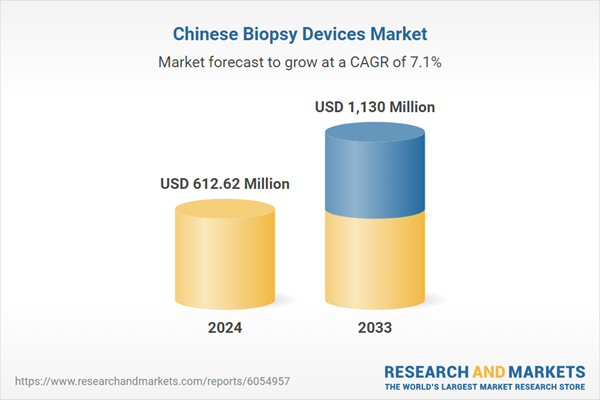
Market Overview - The China biopsy devices market is projected to grow from approximately US$ 612.62 million in 2024 to about US$ 1.13 billion by 2033, reflecting a compound annual growth rate (CAGR) of 7.06% during the period from 2025 to 2033 [2][16]. Growth Drivers - The rising prevalence of cancer in China, with an estimated 4,824,700 new cases and 2,574,200 cancer-related deaths in 2022, is significantly driving the demand for biopsy devices [4]. - Technological advancements in biopsy devices, such as ultrasound-guided systems and robotic-assisted devices, are enhancing diagnostic precision and patient comfort, thereby expanding the market [5]. - The expansion of healthcare infrastructure, including the establishment of high-tech diagnostic centers and easing of foreign investment restrictions, is improving access to advanced biopsy technologies across various regions [6]. Challenges - High costs associated with advanced biopsy technologies pose a significant barrier to widespread adoption, particularly in underdeveloped regions where budget constraints limit healthcare facilities' ability to invest [7]. - A limited number of skilled professionals trained to operate sophisticated biopsy devices and interpret data is hindering effective utilization, especially in rural areas [8]. Market Segmentation - The market for needle-based guns biopsy devices is experiencing substantial growth due to their minimally invasive nature and high precision in tissue sample acquisition [9]. - The breast biopsy devices market is expanding due to the increasing incidence of breast cancer and the growing awareness of the need for early diagnosis, with innovations like vacuum-assisted biopsy systems gaining prominence [10][11]. - The lung biopsy devices market is rapidly growing, driven by rising lung cancer cases linked to environmental pollution and smoking, with advanced imaging-guided techniques enhancing diagnostic accuracy [12]. - The CT scan biopsy devices market is also growing, fueled by the reliance on CT-guided biopsies for their accuracy in diagnosing deep-seated lesions [13]. - The MRI-guided biopsy devices market is witnessing significant growth due to the high-resolution imaging capabilities of MRI technology, which improves diagnostic outcomes [14]. Key Players - Major companies in the biopsy devices market include Cardinal Health, Hologic, Danaher, Becton, Dickinson and Company, Boston Scientific, Medtronic, and Olympus [18].