
Home Affordability

Search documents
D.R. Horton(DHI) - 2025 Q4 - Earnings Call Transcript
2025-10-28 13:32
Financial Data and Key Metrics Changes - D.R. Horton reported consolidated pre-tax income of $1.2 billion on revenues of $9.7 billion for Q4 2025, with a pre-tax profit margin of 12.4% [7] - For the full year, consolidated pre-tax income was $4.7 billion, with a pre-tax profit margin of 13.8% [7] - Net income for Q4 was $905.3 million, or $3.04 per diluted share, on consolidated revenues of $9.7 billion [9] - The average closing sales price for Q4 was $365,600, down 1% sequentially and down 3% year-over-year [9] - The company generated $3.4 billion of cash from operations in fiscal 2025, representing 10% of total revenues [19] Business Line Data and Key Metrics Changes - Home sales revenues for Q4 were $8.5 billion on 23,368 homes closed [9] - Net sales orders in Q4 increased 5% year-over-year to 20,078 homes, with order value increasing 3% to $7.3 billion [10] - The gross profit margin on home sales revenues in Q4 was 20%, down 180 basis points sequentially [11] - Rental operations generated $81 million of pre-tax income on $805 million of revenues in Q4 [16] Market Data and Key Metrics Changes - The average number of active selling communities was up 1% sequentially and up 13% from the prior year [10] - The company’s home building lot position at year-end consisted of approximately 592,000 lots, with 25% owned and 75% controlled through purchase contracts [15] - Lot costs increased by 8% year-over-year on a per square foot basis [60] Company Strategy and Development Direction - D.R. Horton remains focused on capital efficiency to generate strong operating cash flows and deliver compelling returns to shareholders [8] - The company plans to tailor product offerings and sales incentives based on demand in each market to maximize returns [8] - The strategic relationship with Forestar is vital for the company’s returns-focused business model, with Forestar reporting revenues of $671 million in Q4 [17] Management's Comments on Operating Environment and Future Outlook - Management anticipates that new home demand will continue to be impacted by affordability constraints and cautious consumer sentiment [21] - For fiscal 2026, the company expects consolidated revenues of approximately $33.5 billion to $35 billion and homes closed to be in the range of 86,000 to 88,000 [21] - Management expressed a positive outlook for the housing market over the medium to long term, despite current volatility and uncertainty in the economy [23] Other Important Information - The company repurchased 4.6 million shares for $689 million in Q4 and 30.7 million shares for $4.3 billion for the full year [19] - D.R. Horton’s fiscal year-end stockholders' equity was $24.2 billion, down 4% from a year ago, but book value per share was up 5% to $82.15 [20] Q&A Session Summary Question: How to think about the transition from 20% gross margin in Q4 to 20%-20.5% in Q1? - Management indicated that the unusual impact from litigation costs is not expected to persist into Q1, and the baseline would reflect a more normal impact from warranty and litigation going forward [27] Question: Can you discuss the starts pace and how quickly it can ramp up? - Management acknowledged that starts were intentionally lower to align inventory and indicated confidence in ramping up starts to meet demand as needed [28] Question: What is the outlook for rental operations in Q1? - Management expects rental operations to be a bit softer in Q1, with a heavier delivery expected in the back half of the year [32] Question: Can you provide insight into the Southeast market performance? - Management noted that while some areas in Florida are struggling with inventory balance, overall demand in the Southeast remains choppy [74] Question: What are the expectations for lot costs moving forward? - Management indicated that lot costs are expected to remain sticky, with an 8% year-over-year increase noted [60]

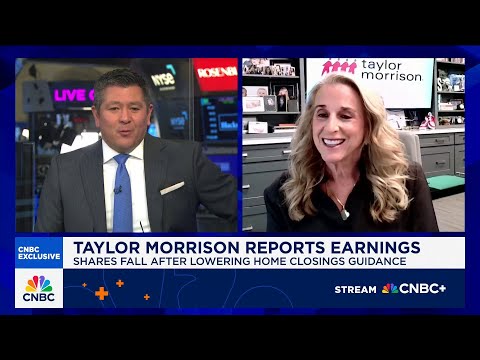
Taylor Morrison CEO: Solving home affordability requires collaboration among stakeholders
CNBC Television· 2025-10-22 16:43
Guidance and Market Conditions - Taylor Morrison modestly revised its 2025 closing guidance downward to a midpoint of 12,900 units, a reduction of approximately 100 units or about 1% [1][2] - The company maintained its margin guidance despite a choppy market environment, indicating confidence in pricing strategies in some areas [2] - Mortgage applications have decreased for four consecutive weeks, even with the 30-year fixed mortgage rate in the 63% range, suggesting a potential lag before the market responds to easier conditions [3] - Interest rates have decreased from nearly 7% a couple of months ago to just over 6%, which is expected to positively influence consumer confidence and buying activity [5] Affordability and Housing Supply - The industry is focused on delivering homes at prices affordable for first-time buyers, while macro factors significantly influence approximately 70% of the business [4] - Discussions with the administration are centered on addressing housing shortages and improving affordability, acknowledging the need for collaboration among stakeholders [7][8] - Builders are managing excess inventory thoughtfully, recognizing that the affordability issue requires a comprehensive solution involving multiple parties [8] - The industry is actively working to move inventory responsibly and as quickly as possible, despite mixed data on the number of lots owned and controlled, some of which are not yet entitled [10][11] Government Relations and Industry Challenges - The industry is engaging in productive conversations with the administration to address housing shortages and affordability [7] - Builders are working to balance delivering homes to consumers with pricing considerations [7] - The industry represents a relatively small part of the entire housing ecosystem, highlighting the complexity of the affordability issue [9] - The industry welcomes the administration's prioritization of housing affordability and is confident in making progress and creating new opportunities [11]

X @Anthony Pompliano 🌪
Anthony Pompliano 🌪· 2025-10-08 11:44
Market Analysis - The free market is the most effective mechanism for problem-solving [1] - Local housing regulations impede the free market, leading to decreased home affordability [2] Policy Recommendation - Deregulation and increased construction are recommended [3] - Market prices will adjust in response to deregulation and increased construction [4]
X @Anthony Pompliano 🌪
Anthony Pompliano 🌪· 2025-09-30 21:35
The lack of home affordability in America should be a national emergency.I sat down with @raunaqsingh87 to understand the new product they're launching today which allows homeowners to sell their home & their low rate mortgage.This is a real solution to a very painful problem https://t.co/f98GpMuvPA ...
Here’s a bigger risk for the housing market than what the Fed could do to mortgage rates
Yahoo Finance· 2025-09-23 19:31
Core Viewpoint - The Federal Reserve's potential actions to lower U.S. mortgage rates may not be beneficial and could lead to another boom-and-bust cycle in the housing market [1][2]. Group 1: Federal Reserve's Actions - Economists at Mizuho Securities express caution regarding the Federal Reserve's tools to artificially lower mortgage rates, emphasizing the risk of repeating past housing market mistakes [2][4]. - Current mortgage rates around 6.26% are not considered high historically, with the Federal Open Market Committee (FOMC) likely to be wary of using quantitative tools to depress long-term rates [4][5]. Group 2: Housing Market Dynamics - The issue of home affordability is more related to home prices than mortgage rates, indicating that simply lowering rates may not resolve the underlying problems in the housing market [5]. - The bond market has experienced "euphoria" due to expectations of lower rates, which has positively impacted the nearly $10 trillion market for government-backed mortgage bonds [5][6]. Group 3: Market Reactions - The recent rally in the mortgage bond market has led to a decrease in mortgage rates, prompting many borrowers to refinance, particularly into riskier adjustable-rate loans [6]. - Suggestions have been made, such as Pimco's recommendation for the Fed to reinvest proceeds from maturing mortgage bonds back into the sector to quickly reduce mortgage rates [6][7].
X @Anthony Pompliano 🌪
Anthony Pompliano 🌪· 2025-09-23 17:45
From the Desk of Anthony Pompliano0:00 Wall street’s Pessimist Has Finally Turned Bullish3:37 Home Affordability Is A Major Problem In America5:29 Tom Sosnoff Interview At The Independent Investor SummitEnjoy! https://t.co/aI5DIH9PK3 ...
America’s Next ‘Housing Bubble’ Is Here — 5 Ways To Avoid Disaster
Yahoo Finance· 2025-09-20 11:01
Core Insights - Home affordability has reached near-record lows due to soaring home prices during the pandemic and rising interest rates in 2022, with the Federal Reserve noting an all-time high in the ratio of the Case-Shiller Home Price Index to Consumer Price Index (CPI) inflation in 2022 [1] Group 1: Market Trends - Analysts are questioning whether an affordability bubble has formed, characterized by increasing home prices without corresponding increases in home values [2] - Home prices have begun to decline in several markets, including San Diego, San Francisco, and Austin, prompting real estate agents to advise buyers to negotiate aggressively for price reductions and other concessions [3] Group 2: Buying Strategies - Purchasing a fixer-upper at a discount can create immediate equity, providing insulation against price fluctuations [4] - Buyers are advised to plan for the long term, ideally staying in a home for at least five years to avoid being upside-down in case of temporary price drops [4][5] Group 3: Rental Considerations - In the event of needing to move sooner than expected, renting out the property could be a viable option, but potential landlords should be aware of the various expenses beyond the mortgage payment [6] - Most homes do not cash flow as rentals, but those that do can offer additional protection against a potential market downturn [7]
New Construction Offers a Boost in Home Affordability, but Tariffs May Stall Progress
Prnewswire· 2025-05-08 10:00
Core Insights - New homes are becoming more affordable in the current housing market, with the median list price for newly built homes decreasing to $448,393 in Q1 2025, the lowest price gap with existing homes in five years [1][4] - The construction of smaller homes and lower mortgage rates for new home buyers are contributing to this affordability trend [1][3] Market Dynamics - The U.S. is facing a shortage of approximately four million homes, with new construction helping to bridge the affordability gap left by a tight existing home market [2] - Builders are focusing on delivering smaller homes at lower prices, often providing financial incentives to make monthly payments more manageable [2][5] Mortgage Rate Trends - Buyers of newly built homes are securing mortgage rates about 0.5 percentage points lower than those purchasing existing homes, translating to over $160 in monthly savings on a median-priced new home [3][9] Price Premium Analysis - The premium on newly built homes has decreased to 13.5% in Q1 2025, the lowest since tracking began in 2020, due to a 1.3% decline in new home prices compared to rising existing home prices [4][9] - Newly built homes now account for 18.5% of active listings, which is higher than during the pandemic years [4] Regional Insights - Among the 100 largest U.S. metropolitan areas, 26 markets have seen year-over-year declines in both median listing price and square footage of newly built homes, particularly in the South [6][7] - Notable price drops include Little Rock, Ark. with a 12.9% decrease, and significant reductions in Colorado Springs, Colo. and Oxnard, Calif. [7] Future Challenges - Proposed tariffs on key building materials, such as an increase in duties on Canadian lumber from 14% to 34%, could threaten the affordability gains achieved in recent quarters [8]


Which is more important, your interest rate or house price?
Yahoo Finance· 2024-08-06 19:51
When it comes to buying and owning a house, two significant variables will impact how much you spend on your mortgage: home prices and interest rates. Both play a crucial role in the total cost of your mortgage. This raises an essential question for home buyers: Is it better to buy a less expensive house with a higher interest rate or a more expensive house with a lower interest rate? The relationship between house prices and interest rates Deciding whether to prioritize a low home price or a low mortga ...