Uranium Exploration

Search documents
Stallion Uranium Refines Coyote Target with Highly Conductive Anomalies from Ground EM Survey, Mobilizes Stone Island VTEM Survey
Globenewswire· 2026-01-12 12:00
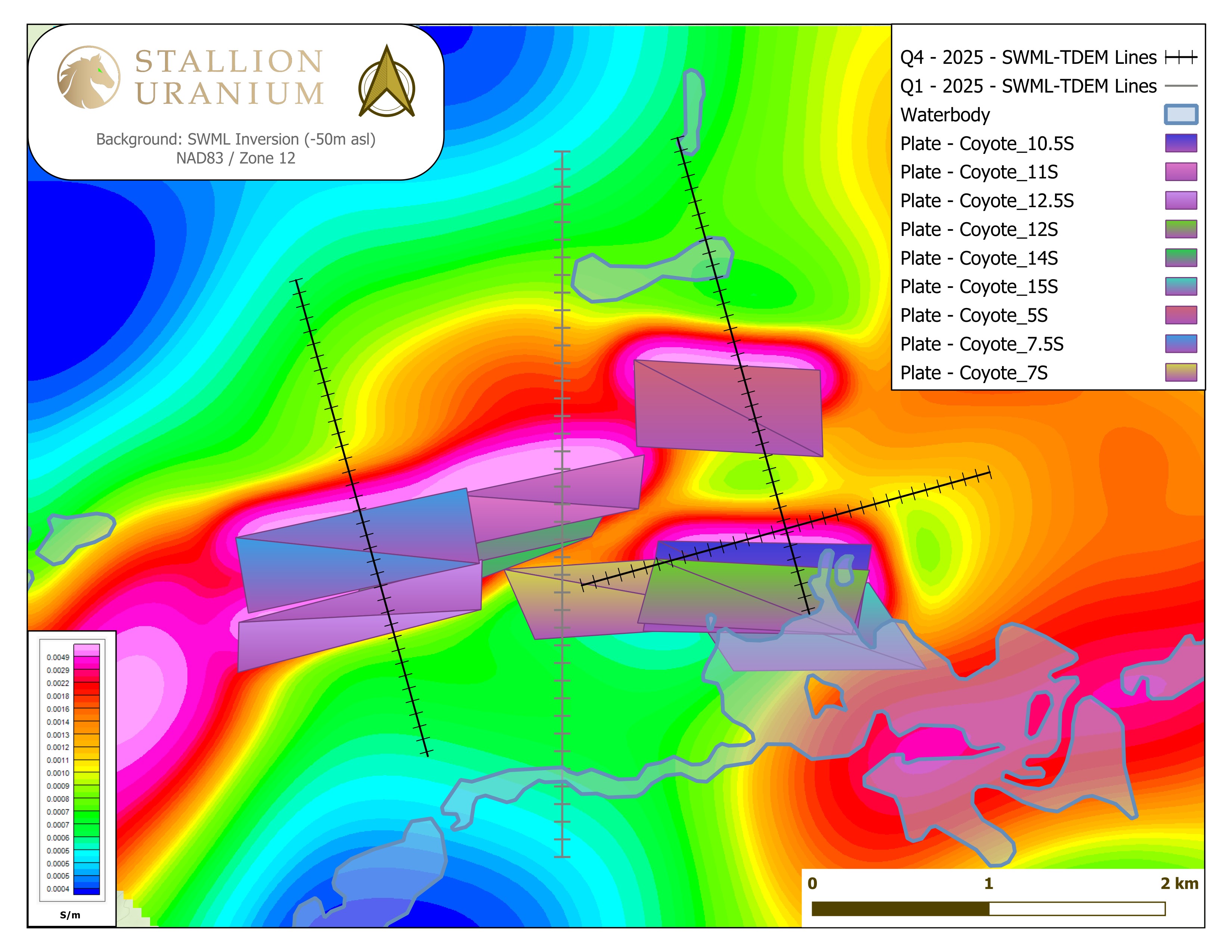
Core Viewpoint - Stallion Uranium Corp. has successfully completed a ground-based Step-Wise Moving Loop (SWML) Time-Domain Electromagnetic (TDEM) survey at the Coyote Target on its Moonlite Property, enhancing confidence in drill targeting for uranium exploration in the Athabasca Basin [1][2]. Survey Completion - The SWML TDEM survey was conducted by Abitibi Geophysics and has defined multiple high-quality conductors at the Coyote Target, with nine conductors identified, seven of which exhibit strong conductance levels [1][2][3]. - The survey significantly extends the existing electromagnetic grid, improving coverage and resolution across the Coyote Target area [3]. Conductor Identification - Nine discrete electromagnetic conductors were identified, including six strong conductors with conductance values exceeding 10 Siemens, which are significant for basement-hosted uranium exploration [5][6]. - The conductors are interpreted to be structurally controlled, with significant lateral and vertical offsets indicating faulting and structural disruption [3][5]. Structural Insights - The complexity of the conductor network occurs within a broader gravity-low anomaly, suggesting enhanced structural disruption favorable for uranium deposition [3][8]. - Electromagnetic modeling has provided improved constraints on conductor geometry, depth, and orientation, which will aid in precise drill collar placement [3][9]. Future Exploration Plans - Stallion Uranium has mobilized an airborne VTEM survey over its Stone Island Target, marking the first geophysical survey conducted on the Moonlite Project since the claims were staked [16][17]. - The VTEM survey aims to identify electromagnetic conductors and structural features beneath the Athabasca sandstone cover, which may be associated with uranium mineralization [17][18].

Skyharbour Announces Additional Uranium Property Staking Increasing Total Portfolio to Over 662,000 Hectares in the Athabasca Basin, Saskatchewan
Globenewswire· 2026-01-08 13:00
Core Insights - Skyharbour Resources Ltd. has acquired forty new uranium exploration claims in Northern Saskatchewan, increasing its total land package to 662,887 hectares across 43 projects, with a focus on the Athabasca Basin, known for high-grade uranium deposits [1][37] - The newly staked claims will be part of the Company's prospect generator business, aimed at attracting strategic partners to advance these assets [1] Summary of New Claims - The Carter North Project consists of ten mineral claims totaling 36,393 hectares, located adjacent to Cameco's North Williams Project and covering extensions of significant conductive corridors [3][6] - The Rover Project includes a single claim of approximately 793 hectares, situated near Cameco's McArthur River and Cigar Lake Mines, with historical exploration dating back to the late 1960s [9][11] - The East Dufferin Project comprises a single claim of 1,451 hectares, located south of the Athabasca Basin, with historical exploration identifying increased conductivity and magnetic activity [12][14] - The Brustad Project consists of one claim totaling 791 hectares, located near the southern margin of the Athabasca Basin, with historical exploration including various geophysical surveys [15][17] - The 914 and Elevator Projects now cover a total of 13,785 hectares, with extensive historical exploration indicating potential for uranium mineralization [18][20] - The Pendleton Project includes four claims totaling 5,338 hectares, located along the Needle Falls Shear Zone, with historical exploration suggesting potential for uranium deposits [21][22] - The Yurchison Project has been expanded to 35,029 hectares, consolidating previous properties and showing potential for uranium and other mineralization [24][27] - The Tarku Project consists of three claims totaling 8,262 hectares, adjacent to the South Dufferin Project, with historical exploration indicating strong potential for uranium mineralization [28][30] - The South Dufferin Project has been expanded to 39,398 hectares, with ongoing exploration efforts indicating readiness for further drilling [31][34]
Homeland Confirms Southward Continuity of Anomalous Radioactivity at the Coyote Basin Uranium Project
TMX Newsfile· 2025-12-22 09:00
Core Insights - Homeland Uranium Corp. has provided an update on the Phase II exploration drilling program at the Coyote Basin Uranium Project, indicating progress in understanding the mineralized horizon [1][5]. Drilling Program Update - Six additional Reverse Circulation (RC) drillholes (CB-RC-0029 to CB-RC-0034) have been completed, totaling approximately 5,300 meters (17,500 feet) [2]. - The new drillholes were spaced 200 meters (656 feet) apart and located 200 meters (656 feet) south of previously reported sections [2]. - The results from these drillholes confirm the southward continuity of an anomalously radioactive horizon over an interpreted strike length of approximately 200 meters (656 feet) [4]. Geological Findings - Anomalous radioactivity has been defined over an area of approximately 1,000 meters (3,280 feet) by 200 meters (656 feet), remaining open for expansion in all directions [4]. - The dip and geometry of the radiometric response are consistent with those identified in earlier drilling, indicating a laterally extensive mineralized horizon [5]. Future Plans - The company plans to test a third fence of drillholes approximately 200 meters (656 feet) south of the newly drilled section [5]. - Geochemical samples from the completed drillholes have been sent to SGS Laboratories for analysis, with results expected to be reported after review [6]. Quality Assurance Measures - All drillholes are logged using a calibrated QL40 SGR Spectral Gamma Ray downhole probe to collect continuous spectral gamma measurements [8]. - The company has collected samples from each 5-foot interval for geochemical analysis, ensuring adherence to quality standards [11]. Historical Resource Context - The Coyote Basin Project is reported to contain an estimated historical resource of 8,850,000 tons grading 0.20% U3O8, totaling 35.4 million pounds of U3O8 [14].

Cosa and Denison Mines Approve 2026 Program for Joint Venture Uranium Projects
TMX Newsfile· 2025-12-17 13:00
Core Viewpoint - Cosa Resources Corp. has received approval for exploration plans at its Darby and Murphy Lake North projects, which are joint ventures with Denison Mines, positioning the company favorably for the 2026 exploration season [1][2]. Exploration Plans - The exploration for 2026 will include four drilling campaigns at both Darby and MLN, along with property-scale geophysical surveying at MLN [3]. - Winter drilling at Darby will focus on areas near historical drill holes that suggest proximity to uranium mineralization, particularly zones of sandstone alteration and anomalous geochemistry [4]. - At MLN, winter drilling will target the Cyclone trend, where previous drilling revealed significant structural alteration associated with graphitic basement faulting [5]. Geophysical Surveying - A DC resistivity survey is planned for MLN to identify zones of anomalous resistivity in sandstone, which may indicate hydrothermal alteration or faulting [6]. Timeline - Field crews are expected to mobilize early in 2026, with drilling at Darby starting in late January and concluding in late March at MLN. The DC-resistivity surveying at MLN is scheduled to begin in April [7]. Project Details - The Darby project is located 10 kilometers west of Cameco's Cigar Lake Mine and has multiple prospective conductive trends with historical weak uranium mineralization [8]. - The Murphy Lake North project is situated 2.7 kilometers east of the Hurricane deposit, which is known for its high-grade uranium resources. The project includes the Hurricane trend and the Cyclone trend, both of which have shown promising results in previous drilling [9]. Company Background - Cosa Resources is a Canadian uranium exploration company with a portfolio of approximately 237,000 hectares in the Athabasca Basin, focusing on underexplored projects [15]. - The company has a strategic collaboration with Denison Mines, which enhances its access to additional prospective uranium exploration projects [16]. - Cosa's management team has a successful track record in uranium exploration, including the discovery of the Hurricane deposit [17].


Skyharbour Closes Major Strategic Transaction with Denison Mines to Form Four New Joint Ventures at Russell Lake with Combined Project Consideration up to $61.5 Million
Globenewswire· 2025-12-17 09:00
Core Insights - Skyharbour Resources Ltd. has finalized a strategic agreement with Denison Mines Corp. for the Russell Lake Uranium Project, which includes joint venture agreements and a significant financial commitment from Denison [1][4][5] Financial Overview - The strategic agreement entails a total project consideration of up to CAD $61.5 million, including an initial cash payment of $10 million and additional cash and share payments of $8 million before year-end [5][7] - Denison will invest up to $43.5 million over seven years to acquire between 20% and 70% ownership in the claims of the Russell Lake Project [5][10] Project Structure - The Russell Lake Project has been divided into four joint ventures: Wheeler North, Getty East, Wheeler River Inlier Claims, and Russell Lake, with Skyharbour retaining varying ownership interests [5][10] - Skyharbour will maintain an 80% ownership interest in the RL claims, which cover over 53,192 hectares, while Denison will hold a 20% interest [15][10] Exploration and Development Plans - Denison has committed to a minimum of $4 million in exploration expenditures over the first two years for Wheeler North and Getty East [5][6] - The geological teams from both companies will collaborate to enhance exploration efforts and unlock value across the joint ventures [5][6] Strategic Importance - The Russell Lake Project is strategically located in the Eastern Athabasca Basin, adjacent to significant uranium mining operations, enhancing its exploration potential [1][14] - The partnership with Denison, a leading uranium mining company with a market capitalization exceeding $3 billion, is expected to accelerate exploration and development at Russell [5][6] Future Outlook - Skyharbour is well-funded with over $11 million in treasury, allowing for continued exploration and operational activities through 2026 [5][6] - The company aims to maximize shareholder value through new mineral discoveries and long-term partnerships in favorable jurisdictions [26]


Skyharbour Closes Major Strategic Transaction with Denison Mines to Form Four New Joint Ventures at Russell Lake with Combined Project Consideration up to $61.5 Million
Globenewswire· 2025-12-17 09:00
Core Insights - Skyharbour Resources Ltd. has finalized a strategic agreement with Denison Mines Corp. for the Russell Lake Uranium Project, which includes joint venture agreements and a significant financial commitment from Denison [1][4][5] Financial Overview - The strategic agreement entails a total project consideration of up to CAD $61.5 million, including an initial cash payment of $10 million and additional cash and share payments of $8 million before year-end [5][7] - Denison will invest up to $43.5 million over seven years to acquire between 20% and 70% ownership in the Russell claims, with Skyharbour retaining the remaining interests [5][10] Project Structure - The Russell Lake Project has been divided into four joint ventures: Wheeler North, Getty East, Wheeler River Inlier Claims, and Russell Lake, with varying ownership stakes [5][10] - Skyharbour will maintain operational control over the RL claims, which cover over 53,192 hectares, while Denison will become the operator of the Wheeler River Inliers [5][10][17] Exploration Commitments - Denison has committed to a minimum of $4 million in exploration expenditures over the first two years for Wheeler North and Getty East, and will fund its pro-rata share of expenditures for the RL claims through 2029 [5][6][17] - The geological teams from both companies will collaborate to enhance exploration efforts across the joint ventures [5][6] Strategic Importance - The Russell Lake Project is strategically located in the Eastern Athabasca Basin, adjacent to significant uranium mining operations, enhancing its exploration potential [1][16] - Denison's involvement is expected to accelerate exploration and discovery processes at the project, leveraging its experience and resources [4][6] Company Positioning - Skyharbour is well-funded with over $11 million in treasury going into 2026, allowing it to advance its exploration projects while benefiting from partner-funded initiatives [5][6][25] - The company holds a diverse portfolio of uranium exploration projects in the Athabasca Basin, positioning it to capitalize on improving market conditions [25][28]
Global Uranium Corp. Announces Completion of Geological Mapping at the Airline Project in Wyoming
Globenewswire· 2025-12-09 13:00
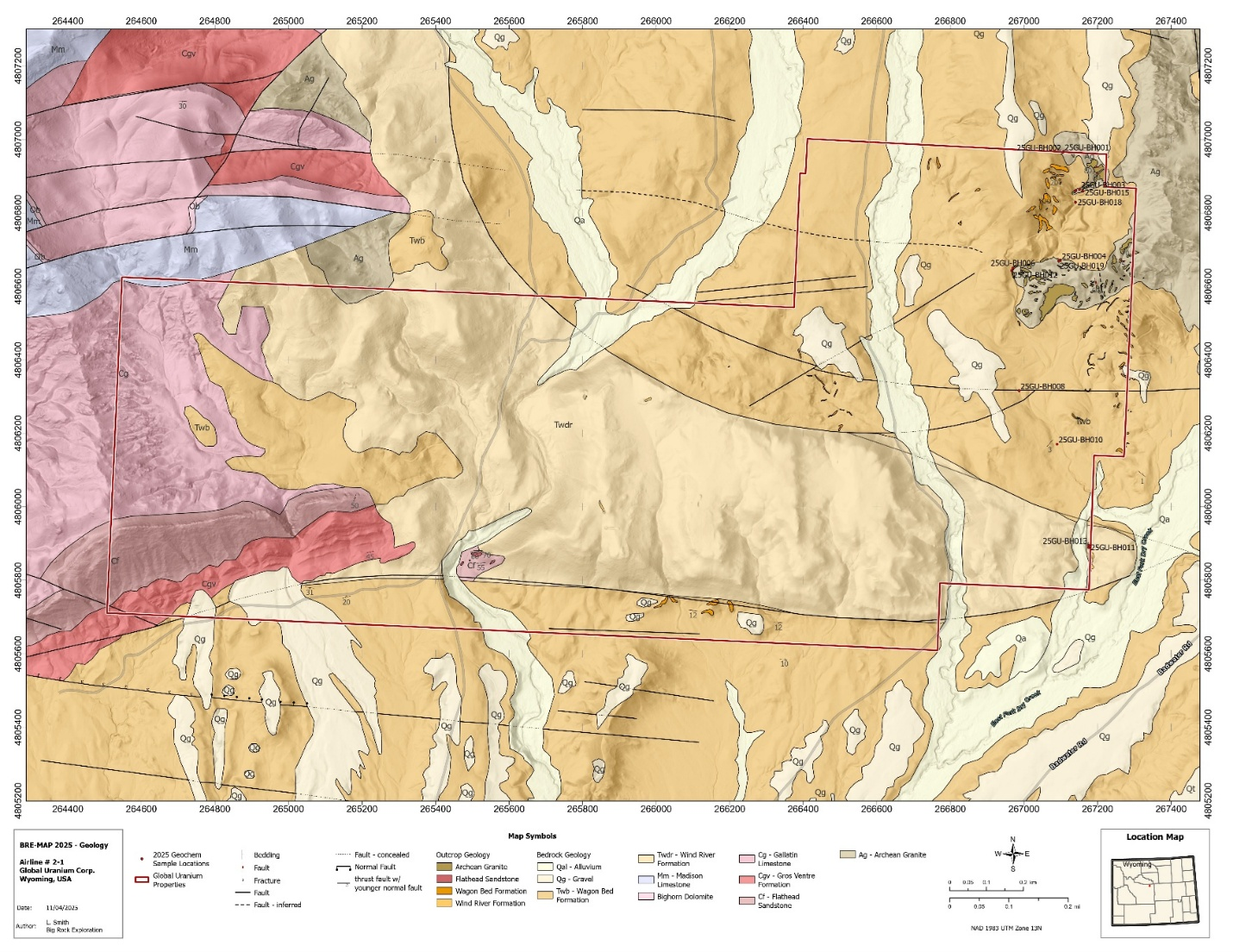
Core Insights - The article highlights the completion of detailed geological mapping at the Airline Project in Wyoming, which enhances the understanding of stratigraphy and structure, supporting future exploration efforts [1][2][5] Geological Mapping - The mapping program, conducted by Big Rock Exploration, took place over one week in late October 2025 and confirmed the widespread presence of the Tertiary Wagon Bed Formation, characterized by tuffaceous sandstones and interbedded tuffs [2] - Archean crystalline basement was identified, including granite and monzogranite, with significant geological features such as pegmatitic dikes and weathering textures [2] - Key stratigraphic contacts were mapped, particularly between the Wagon Bed Formation and the Archean basement, which is crucial for identifying potential uranium deposits [2][3] Priority Horizons - Two priority horizons were identified: the unconformity between the Wagon Bed Formation and Archean granite, and the "Scorpion Unit," an arkosic sandstone horizon with radiometric highs [3] - The unconformity showed signs of anomalous radioactivity and clay alteration, while the Scorpion Unit displayed favorable textures and local structures [3] Future Exploration - The mapping data will be integrated with upcoming radiometric surveys and geochemical assays to refine stratigraphic modeling and drill-target development for 2026 [4] - Additional focused mapping is planned for the eastern and northeastern parts of the property to further explore the unconformity and arkosic sandstone units [4] Company Overview - Global Uranium Corp. is focused on exploring and developing uranium assets in North America, with key projects in Saskatchewan and Wyoming [10]
Skyharbour and JV Partner Orano Announce Extensive Exploration and Drilling Plans for 2026 at Preston Uranium Project
Globenewswire· 2025-12-09 12:00
Core Viewpoint - Skyharbour Resources Ltd. and its joint-venture partner Orano Canada Inc. are set to undertake a significant exploration and drilling program at the Preston Uranium Project in 2026, building on previous successful results and targeting high-priority areas for uranium mineralization [1][4]. Exploration Program Overview - The 2026 exploration campaign will include an Airborne Gravity Gradiometry (AGG) survey covering the northern priority corridor, followed by detailed ground gravity surveys and a summer drilling campaign of approximately 3,500 metres [2][3]. - The AGG survey aims to refine gravity lows, identify structural trends, and delineate potential hydrothermal or alteration-related footprints across the property [2]. Drilling Details - The proposed diamond drilling program will consist of approximately 3,000 to 3,500 metres across about ten helicopter-supported drill holes, each averaging around 300 metres in depth [3]. - Drilling will focus on high-priority anomalies and structural corridors associated with uranium mineralization, particularly in the northern FSAN area and the underexplored Area B conductive corridor [3]. Budget and Objectives - The budget for the 2026 program will cover airborne and ground gravity surveys, drilling, helicopter support, logistics, and analytical work, aimed at advancing geological understanding and generating new drill targets [4]. Previous Exploration Success - The 2025 exploration program at the Preston Uranium Project was completed successfully, involving 5,565 metres of drilling across 17 holes, focusing on high-priority target areas [5][13]. - Notable results from the 2025 program included the confirmation of multiple graphitic shear zones and structural corridors, particularly in the Canoe Lake and FSAN grids, which are now prioritized for further exploration [13]. Joint Venture Structure - Orano Canada Inc. holds a 74.7% interest in the Preston Uranium Project and serves as the operator, while Skyharbour retains a 25.3% minority interest [1][16].
Nexus Uranium Options Great Divide Basin Project to Canamera Energy Metals
Newsfile· 2025-12-08 11:00
Core Viewpoint - Nexus Uranium Corp. has entered into an option agreement with Canamera Energy Metals Corp. for Canamera to earn up to a 90% interest in the Great Divide Basin uranium project in Wyoming [1][2]. Agreement Terms - Canamera will fund exploration and make cash and share payments to Nexus over a four-year period, allowing Nexus to retain a 10% carried interest in the project [2][3]. - The financial commitments include approximately $280,000 in cash, $500,000 in Canamera shares, and $2.75 million in exploration expenditures, all without further capital outlay by Nexus [2][3]. Option Structure - The option structure allows Canamera to acquire a 51% interest initially, with additional options for 20% and 19% to reach a total of 90% [3][5]. - Specific payments include: - $30,000 cash and 500,000 Canamera shares within 5 days of closing - $100,000 cash and $250,000 in exploration expenditures by the 18-month anniversary - $1,000,000 in exploration expenditures by the third and fourth anniversaries, along with additional cash and share payments [7]. Project Overview - The Great Divide Basin project consists of 104 unpatented mining claims covering approximately 2,080 acres in Wyoming's uranium district [9][10]. - The project has historical exploration dating back to the 1970s and is adjacent to Premier American Uranium's Cyclone property [10]. Company Background - Nexus Uranium is a Canadian exploration company focused on uranium projects in North America, holding several projects including the Great Divide Basin in Wyoming [11].

IsoEnergy Provides 2025 Athabasca Basin Exploration Update and Prepares to Launch Winter Exploration Programs Including Drilling at Larocque East
Prnewswire· 2025-12-03 12:00
Core Insights - IsoEnergy Ltd. has provided an update on its summer drill programs at the Larocque East and Hawk projects, reporting significant uranium geochemistry results from both winter and summer drilling campaigns [1][2][3] Larocque East Project - Summer drilling at Larocque East totaled 9,561 meters in 22 holes, bringing the year-to-date total to 15,597 meters in 39 drill holes [1] - Drilling successfully tested potential resource expansion areas and greenfield exploration targets along the Larocque Trend, returning strongly anomalous radioactivity and uranium geochemistry [1][2] - Notable intersections include LE25-194, which intersected 0.872% U3O8 over 0.5 meters, and LE25-207, which returned 1.61% U3O8 over 0.5 meters [1][2][3] - The winter drill hole LE25-202, located 2.8 km east of the Hurricane deposit, returned the strongest uranium intersection to date outside the Hurricane area, with 1.05% U3O8 over 0.5 meters [2][3] Hawk Project - The Hawk project involved four drill holes totaling 3,593 meters, with encouraging geological features intersected, including graphitic gneisses and faults [1][2][3] - HK25-13 and HK25-16 intersected prospective geological elements, while HK25-14 encountered significant structural disruption [2][3] - The project is still in early-stage exploration, with further geochemical data pending [2][3] Upcoming Plans - The company plans to conduct winter drilling at Larocque East, anticipating 5,200 meters in 13 holes, integrating summer exploration results to finalize 2026 drill targets [2][3] - Additional work is planned for 2026, including geophysical surveys at the Evergreen, East Rim, Ranger, Trident, and Hawk projects [2][3] Management Update - IsoEnergy has strengthened its management team with the appointment of Ms. Misty Urbatsch as Vice President, Strategy and Commercial, who brings extensive uranium exploration and marketing experience [2][3]