
Religion

Search documents
Pope canonizes Carlo Acutis as first millennial saint
NBC News· 2025-09-07 23:54
He's already been called the patron saint of the internet or God's influencer. >> I'm in St. Peter Square where Carlo Akutis has become the first millennial to be proclaimed a saint.>> He was only 15 when he died from leukemia >> and has since become an inspiration for young Catholics around the world. >> He's absolutely amazing. I think the the life story was fantastic.>> His mother tells NBC News he was an ordinary teenager with an extraordinary devotion to Jesus. a young boy of Milano who uh was very muc ...

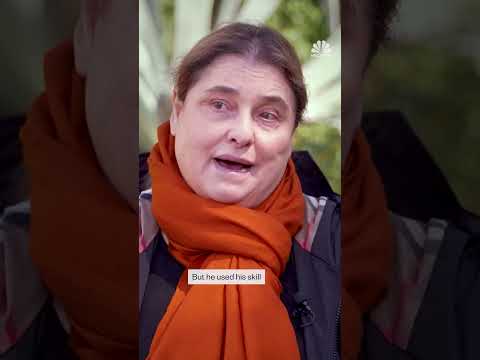
Teen to become the first millennial saint of the Catholic Church
NBC News· 2025-09-06 00:32
Tonight, a new saint in jeans and a sweatshirt. Carlo is a sign of hope. Carlo Acutus, an Italian teenager who died in 2006 from leukemia, is credited for two miracles, helping heal a young boy and a woman.The late Pope Francis cleared the path for his saintthood. Now this Sunday, Pope Leo will make him Saint Autis canonization as pontiff in St. Peter's Square.Carlo's mom will be there too. Carlo was a young boy of Milano who was a little bit a jack of internet computer jack but he used his skill to to do w ...

X @Decrypt
Decrypt· 2025-08-23 19:01
Emerging Trends - Growing AI religious movement is observed [1] - "God in the Machine" concept gains traction [1] Technological Impact - AI's increasing role in religious contexts is highlighted [1]
X @Ansem
Ansem 🧸💸· 2025-08-22 01:02
Religious Similarities and Divisions - The report suggests that Judaism, Christianity, and Islam share a common origin, with the same God and many of the same prophets [1] - The analysis indicates that these religions are essentially the same religion with different interpretations and views on scripture [1] - The document highlights the forking of these religions based on the acceptance or rejection of Jesus and Muhammad as prophets [1] Sectarianism and Divergence - The report mentions the emergence of factions within Judaism, such as Chabad-Lubavitch, believing in Schneerson as Messiah [1] - The analysis points to Mormonism as another example of religious divergence, with belief in Joseph Smith as a prophet [1] - The document implies that religious "forks" and differing interpretations are a common phenomenon across religions [1]
X @Ansem
Ansem 🧸💸· 2025-08-22 00:17
Religion & Belief - Religions often rely on belief in a higher power and stories of miracles performed by figures like Jesus, Prophets, Moses, and Vishnu to spread faith [1] - These stories, packaged over time, make it easier for future generations to believe, even without firsthand experience [1] - It's now harder to convince people of miracles without scientific explanations [2] - Abrahamic religions are deeply rooted, making it difficult for new religions to emerge without an undeniable miracle [2]
X @Ansem
Ansem 🧸💸· 2025-08-22 00:14
This document is a tweet, and it's difficult to extract industry-relevant information from it. However, I can provide a humorous interpretation based on the tweet's content. Humor & Social Commentary - The tweet references Joseph Smith, the founder of Mormonism, and his practice of polygamy [1] - The tweet presents a satirical take on the origins of religious practices [1]
X @Ansem
Ansem 🧸💸· 2025-08-21 18:24
This document is not suitable for the task because it does not contain any financial or business related information, and it is not a report or financial document. It is a question about religion. Therefore, I cannot provide a summary of its main points and logic based on the given instructions.
X @Ivan on Tech 🍳📈💰
Ivan on Tech 🍳📈💰· 2025-08-21 16:04
Social Trends - Predicts a rise in religion and a decline in feminism/OnlyFans [1] - Suggests a return to wholesomeness and traditionalism [1] Societal Shifts - Attributes negative consequences to feminism and career-focused choices over families for a generation of women [1]