Space Economy

Search documents
Global Space Economy Grows to $613 Billion
Bloomberg Television· 2025-07-22 14:18
Space Economy Overview - Global commercial space revenue increased by 8% year-over-year to $613 billion [1] - The private sector accounts for 78% of the space economy, valued at $480 billion in 2024 [1][3] - Government budgets contribute just over $130 billion to the space economy [1] Commercial Sector Breakdown - Position, Navigation, and Timing (PNT) comprises $231 billion of the commercial market [4] - Ground infrastructure and equipment is the second largest service at $123 billion [4] - Both PNT and ground infrastructure subsectors experienced 10% growth year-over-year [4] US Investment and Leadership - The United States is the number one investor in the global space economy across all sectors [6] - US national security investment in space is $49 billion, with over 90% allocated to the United States Space Force [7] - The United States is investing $27 billion in the civil government space economy [7] - The United States launched a record 97 rockets in the first six months of 2025 [8] Golden Dome Project - Golden Dome is a national security initiative valued at $175 billion for the entire development effort [8] - The project aims for a three-year timeline, focusing on mature and existing capabilities [15] - Multiple companies are expected to contribute to the project, covering launch, sensing, tracking, and intercepting capabilities [14]


Space ETFs That Can Launch Your Portfolio Higher
ZACKS· 2025-07-18 18:16
Core Insights - The space economy is experiencing significant growth, driven by innovation and investor enthusiasm, as evidenced by the S&P Kensho Space Index outperforming the S&P 500 [1] Investment Performance - The S&P Kensho Space Index has increased by 51.99% over the past year and 22.26% year to date, while the S&P 500 has gained 12.69% and 7.07% respectively during the same periods [2] Market Projections - Experts predict the global space economy will nearly triple by 2035, reaching approximately $1.8 trillion, fueled by space exploration, tourism, and practical satellite applications [3] Militarization of Space - The militarization of space is becoming crucial for defense operations, with initiatives like President Trump's proposed $175 billion Golden Dome missile defense concept highlighting the trend [4] - Europe’s "ReArm" initiative and NATO's proposal to increase defense spending to 5% of GDP indicate a broader commitment to military investment in space [5] Space Tourism - The space tourism market is projected to reach $10.09 billion by 2030, growing at a CAGR of 44.8% from 2024 to 2030, driven by high net worth individuals and increased R&D investments [6] Climate Control - Space technologies are playing a vital role in climate control, with investments focusing on disaster management and monitoring, enhancing communication networks, and optimizing satellite tracking [7] Investment Vehicles - Space-focused ETFs are gaining traction as investors seek exposure to the growing space economy, particularly in light of the militarization trend [8] - Notable ETFs include ARK Space Exploration & Innovation ETF (ARKX), Spear Alpha ETF (SPRX), Procure Space ETF (UFO), and SPDR S&P Kensho Final Frontiers ETF (ROKT), with ARKX being the most liquid option [10] ETF Performance - ARKX has an asset base of $385.2 billion, the largest among its peers, while SPRX has shown significant performance, gaining 23.96% over the past month [11]

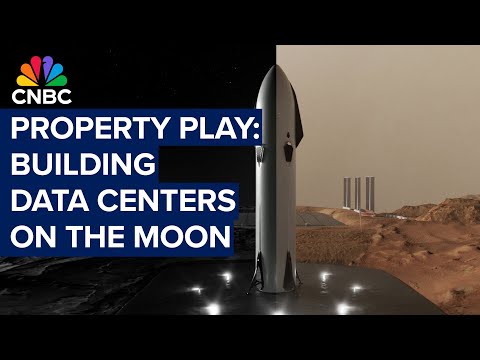
CNBC Property Play: Building data centers on the moon
CNBC Television· 2025-07-16 18:20
Real Estate & Space Industry Trends - Data centers are a rapidly growing sector in real estate, driven by AI, cloud computing, and online activities, but their high energy consumption poses a challenge [1] - Private capital is flowing into the space industry, with new companies emerging to serve various aspects of the sector from both public and private perspectives [3] - The space industry is experiencing a revolution, with companies seeking to monetize space through manufacturing and serving as a base for further space exploration, including potential data center production on the moon [6] - Space offers unlimited power from the sun, unlimited cooling from the vacuum, and unlimited real estate, potentially unlocking constraints faced on Earth and providing clean energy [9] - The current economic environment presents challenges for global development, with stagflation, higher rates, and slower growth making it difficult for developers to make projects financially viable [19][20] Technological Advancements & Infrastructure - Reusable rocket technology is advancing, with potential for 1,000 tons of launch capability, moving towards a million tons per year [32] - Robotics are becoming increasingly advanced and advantageous in the lunar environment due to the challenges of sustaining human life in space [31] - Ethos is developing technology to utilize lunar geological resources, such as anorthosite, to create building materials like synthetic igneous rock, which is twice as strong as concrete, for constructing landing pads, roads, and foundations on the moon [26][27][28][29] Energy & Power Consumption - Data centers are projected to consume a significant portion of US power generation, potentially reaching 40% by 2030, highlighting a serious infrastructure problem [42] - China has a significantly larger installed power base than the US and is investing heavily in solar energy, necessitating the exploration of new, non-Earth-bound power generation methods [44] - The cost of solar energy is declining rapidly, and nuclear energy is gaining traction, suggesting that energy problems will be solved, but the demand for power is infinite [47] Investment & Future Outlook - Capital is seeking great opportunities and returns, with space emerging as a promising area for investment [21] - Infrastructure investments require a long-term perspective, considering future disruptors and their potential interplay with the current world [14] - The space industry is in its early stages, similar to the railroad era, representing a major investment opportunity and creating new "rails" for the future [17]
The Untold Story Of Rocket Lab's Moat
Seeking Alpha· 2025-07-16 18:20
Group 1 - Rocket Lab Corporation (NASDAQ: RKLB) is considered a strong investment in the emerging space economy due to its vertically integrated model, which provides a competitive advantage despite high market multiples [1] - The focus of Pythia Research is on identifying multi-bagger stocks, particularly in the technology sector, by combining financial analysis with insights from behavioral finance and social sciences [1] - The investment strategy emphasizes uncovering breakout opportunities before they become mainstream, leveraging both traditional and unconventional insights to navigate market sentiment and identify emerging trends [1] Group 2 - The approach taken by the company acknowledges that market movements are influenced by perception, emotion, and bias, rather than solely on fundamentals [1] - Investor behavior, such as anchoring to past valuations and herd mentality, creates inefficiencies that can signal the beginning of breakout opportunities [1] - The company analyzes psychological noise in the market, assessing whether volatility is driven by emotion or fundamentals, and seeks to identify companies that are redefining their categories [1] Group 3 - The investment process involves deep research and identifying signals that others may overlook, such as shifts in narrative and early social traction, which can precede significant market moves [1] - The focus is on conviction plays with a favorable risk/reward profile, aiming for limited downside and explosive upside potential [1] - The belief is that the best returns come from recognizing where investor belief lags behind reality [1]


Real estate investors looking to the Moon for data center properties
CNBC Television· 2025-07-15 21:02
Emerging Market - Real estate industry is exploring lunar data centers as a new investment frontier [1] - Hines, a real estate investment firm, views lunar development as similar to the early days of railroads, creating new infrastructure in orbit [2][3] - Ethos is planning lunar construction sites to build data centers [4] Investment & Development - Hines acquired a nearly 250,000 square foot (approximately 23,226 square meters) industrial property in Florida's Space Coast to support space construction [4] - The development includes landing pads, roads, and foundations for data centers [4] Technological Advantage - Lunar data centers offer the advantage of natural cooling and solar power [5]

Could Buying AST SpaceMobile Today Set You Up for Life?
The Motley Fool· 2025-07-11 08:10
Company Overview - AST SpaceMobile is focused on developing a global cellular broadband network in space, which will be accessible via smartphones, differentiating itself from competitors like Starlink that require dedicated hardware [5][6] - The company aims to provide cellular service in regions where traditional infrastructure is too costly or difficult to implement, targeting approximately 5.8 billion mobile subscribers who experience coverage issues [6] Strategic Partnerships - AST SpaceMobile has established strategic partnerships with major telecommunications companies, including a commercial agreement with AT&T that extends through 2030, allowing AT&T to access AST's network and satellite services [7][8] - Verizon Communications has also partnered with AST SpaceMobile, committing $100 million as part of their agreement, alongside collaborations with Vodafone, Rakuten, and Alphabet's Google [9][10] Financial Performance - The company has not yet generated significant revenue and reported a net loss of $300 million last year, with an additional loss of $46 million in Q1 [11] - As of the end of Q1, AST SpaceMobile had $874.5 million in cash and equivalents, which is expected to fund the design, manufacture, launch, and operation of a constellation of 25 BlueBird satellites [13] Market Potential - The space economy is projected to reach $1.8 trillion by 2035, presenting a significant growth opportunity for AST SpaceMobile [2] - Analysts forecast substantial revenue growth for AST SpaceMobile, estimating revenues of $299 million in 2026, $958 million in 2027, and $2.2 billion in 2028, with positive earnings expected by 2027 [14]


Where Will Rocket Lab USA Be in 5 Years?
The Motley Fool· 2025-07-01 08:15
Core Insights - Rocket Lab USA is positioned as a significant player in the modern space race, particularly as a second-most utilized launch provider in the U.S. focusing on small satellite launches with its Electron rocket [1][2] - The company is set to launch its larger Neutron rocket, which is expected to enhance its market position and profitability by accommodating larger payloads [4][5] Group 1: Company Developments - The Neutron rocket is designed to carry payloads of up to 13,000 kilograms, representing a 60-fold increase in capacity compared to the Electron rocket, allowing Rocket Lab to better compete with SpaceX [5] - Rocket Lab plans to launch the Neutron rocket in the second half of this year, although some analysts express skepticism about this timeline, predicting potential delays until mid-2026 or 2027 [7] - The company aims to pursue "every part of the space value chain," with ongoing missions planned for satellite deployments and a focus on becoming a comprehensive end-to-end space-services provider [8][9] Group 2: Strategic Acquisitions - Rocket Lab's acquisition of Mynaric AG will enhance its capabilities in satellite-to-satellite connectivity, supporting high-value contracts such as the $515 million contract with the Space Development Agency [10] - The expected acquisition of Geost in late 2025 will further strengthen Rocket Lab's integrated capabilities in launch services and national security missions [11] Group 3: Financial Outlook - As of March 31, Rocket Lab had a backlog of $1.07 billion, with 56% expected to be recognized as revenue in the next 12 months, compared to last year's revenue of $436 million [13] - The Neutron rocket has been selected for the U.S. Space Force's National Security Space Launch program, which could be worth up to $5.6 billion, extending through June 2029 [14]

European Space Agency's Aschbacher on Funding, Launches, Defense
Bloomberg Television· 2025-06-21 06:00
Space Industry Funding & Investment - Global space economy investment from the public side reached approximately €100 billion last year [5] - The United States accounts for 60% of global public space investment, primarily through NASA and the Space Force [5] - Europe's share of global public space investment is 10%, a factor of six less than the US [5] - For every €1 invested in the Copernicus program, it brings back about €5 into the economy [3] European Space Agency (ESA) Strategy & Development - ESA is preparing for a major funding round in November, seeking increased investment from member states like Germany, France, and Italy [8][9] - ESA aims to foster a competitive space industry landscape in Europe, supporting both large and small companies [20] - ESA is shifting towards becoming an anchor customer for launch services, encouraging industry to develop innovative solutions [22][23] - ESA is developing a program for European resilience from space, focusing on security and defense needs [11] Industry Consolidation & Launch Capability - Airbus, Leonardo, and Thales are in discussions to merge their space businesses, potentially creating a very large company [18][19] - Europe needs more launch capability, exploring new launch services and aiming for new launchers to replace existing ones in the mid-next decade [21][26] - New European launch companies may emerge, but achieving reusability and heavy-lift capabilities like SpaceX will take time, potentially 10-15 years [24][25]

Mission Launches Fuel Rocket Lab's Rally: Should You Buy the Stock Now?
ZACKS· 2025-06-10 13:40
Core Insights - Rocket Lab USA, Inc. (RKLB) has successfully launched multiple missions, including its 65th Electron rocket for BlackSky, showcasing its operational efficiency and reliability in the small satellite launch market [1][10] - The company's stock has surged 66.2% over the past three months, outperforming the aerospace-defense industry, broader aerospace sector, and the S&P 500 [4][10] - The space economy is projected to grow significantly, from $630 billion in 2023 to $1.8 trillion by 2035, enhancing the long-term growth prospects for Rocket Lab and similar companies [6] Company Performance - Rocket Lab has demonstrated a 100% mission success rate in its recent launches, which has likely boosted investor confidence [3] - The company aims to launch over 20 Electron rockets in 2025, indicating strong operational capabilities and future growth potential [8] - Recent estimates suggest RKLB's sales will improve by 32.8% in 2025 and 47.7% in 2026, reflecting positive investor sentiment [12] Financial Estimates - The Zacks Consensus Estimate for RKLB's sales in 2025 is $579.17 million, with a year-over-year growth estimate of 32.77% [13] - Earnings estimates for 2025 and 2026 indicate a year-over-year improvement, although the second quarter of 2025 shows a potential decline [14] Valuation and Market Position - RKLB's forward price-to-sales (P/S) ratio is 19.18X, significantly higher than the industry average of 4.50X, indicating a premium valuation [18] - Other space stocks like Intuitive Machines (LUNR) and Lockheed Martin (LMT) are trading at lower P/S ratios of 6.51X and 1.49X, respectively [19]

Clamoring to Invest in SpaceX but Can't? Consider Buying Stock in This Competitor That Just Upped Its National Defense Game.
The Motley Fool· 2025-06-07 17:16
Core Insights - SpaceX is valued at $350 billion, making it the most valuable privately held company, but its shares are not available for public purchase [1] - Rocket Lab is presented as a viable alternative for investors interested in the space sector, as it operates in a similar niche [2] Group 1: Rocket Lab's Position in the Market - Rocket Lab is the only other company besides SpaceX that can reliably launch rockets at scale, with its Electron program consistently launching every quarter [3] - The company has secured contracts for national defense systems, including HASTE, which tests hypersonic defense capabilities, indicating a growing market for government contracts [4] - Rocket Lab's acquisition of Geost for $275 million positions it to capitalize on lucrative government contracts related to national defense [5] Group 2: Future Growth Potential - Rocket Lab is developing the Neutron rocket, which aims to compete directly with SpaceX's Falcon 9, with commercial launches expected next year [8] - The Neutron rocket could significantly boost Rocket Lab's business, with a proposed contract for two missions in 2026 and participation in the U.S. National Security Space Launch program, which has a budget of $5.6 billion through 2029 [9][10] - Rocket Lab's backlog currently exceeds $1 billion, and successful launches of the Neutron could lead to substantial growth in this backlog over the next decade [11] Group 3: Financial Metrics - SpaceX has a price-to-sales (P/S) ratio of approximately 27, while Rocket Lab's P/S ratio is slightly higher at 28.5, reflecting its recent stock price increase [12] - Despite the potential for revenue growth, Rocket Lab has never made a profit, making its current valuation appear expensive and risky [14]