
贷后管理

Search documents
华夏银行:跋涉零售转型的达尔文时刻
阿尔法工场研究院· 2026-03-18 04:28
Core Viewpoint - The retail transformation of medium-sized joint-stock banks is shifting from "who can expand faster" to "who can manage risks better" [4][21]. Group 1: Credit Card Risk Management - Credit card risk is transitioning from accumulation to decline, with post-loan management becoming a critical aspect of bank governance [5][6]. - Borrowers like Mr. Qiu face challenges in repayment arrangements, highlighting the inadequacy of short-term solutions that do not provide a stable long-term path [6][7]. - As of June 2025, Huaxia Bank's personal loan non-performing balance was 16.235 billion yuan, with a non-performing rate of 2.27%, indicating increased pressure on retail asset quality [7][9]. Group 2: Asset Quality and Management - Huaxia Bank's credit card non-performing assets are concentrated, with a significant portion of 11.287 billion yuan in credit card overdrafts being transferred, representing nearly 70% of its personal non-performing loans [8][9]. - The bank's credit card business is experiencing a contraction, with effective cards decreasing by 8.47% year-on-year and transaction volumes dropping by 15.89% [9][10]. Group 3: Governance and Consumer Complaints - The governance of retail financial products is becoming increasingly important, with complaints about credit card services making up 67% of total consumer complaints [12]. - The handling of debt collection has become a significant friction point for consumers, with 14% of complaints related to debt collection practices [12][13]. Group 4: Regulatory Environment and Industry Changes - New regulations emphasize the responsibility of banks in managing debt collection practices, including restrictions on communication times and the need for transparency in outsourcing [17][20]. - The industry is undergoing a transformation where traditional high-frequency collection methods are becoming less viable, necessitating a reevaluation of credit risk management strategies [20][21]. Group 5: Future Outlook - The future of retail banking will favor models that effectively manage risk outcomes and maintain human-centric boundaries during contraction periods [22].



宣布了!多家银行招收催收人员
Zhong Guo Ji Jin Bao· 2026-02-11 06:34
Core Viewpoint - Several banks, including Everbright Bank and Hunan Sanxiang Bank, are actively recruiting collection personnel, indicating a shift towards more structured and qualified in-house collection teams to enhance post-loan management efficiency [1][4]. Group 1: Recruitment Announcements - Everbright Bank announced a recruitment for three positions in its retail and wealth management department, specifically for loan collection roles, requiring candidates to have at least a bachelor's degree and relevant work experience [2]. - Hunan Sanxiang Bank is also seeking to hire various talents nationwide, including senior collection management and senior electronic collection personnel, with similar educational and experience requirements [2]. - WeBank has posted a job opening for a business operations support role, requiring candidates to have at least five years of experience in outsourced collection management or three years in frontline collection [3]. Group 2: Changes in Collection Practices - The recruitment trends reflect a departure from the previous reliance on third-party collection agencies, which often lacked stringent educational and experience requirements, leading to inconsistent management and quality of service [4]. - The shift towards in-house collection teams is driven by the need for compliance and effective management, as evidenced by complaints regarding aggressive collection practices from third-party agencies [4][5]. - The China Internet Finance Association has issued guidelines to improve collection practices, emphasizing the need for financial institutions to strengthen their internal collection capabilities and manage outsourced services carefully [4]. Group 3: Implications for the Banking Sector - The introduction of qualified personnel in collection roles is expected to enhance the overall strength of collection teams and improve compliance with regulations, thereby increasing the effectiveness of post-loan management [5]. - The transition from outsourced to in-house collection is partly motivated by the challenges faced by financial institutions regarding compliance and penalties associated with inadequate outsourced collection practices [5].

起底宁波银行征信查询“罗生门”:账户注销≠额度注销?
Yang Shi Wang· 2026-01-26 09:32
Core Viewpoint - The dispute between a consumer and Ningbo Bank highlights issues of financial privacy, authorization boundaries, and institutional power in credit reporting practices [1][2][4] Group 1: Consumer Complaints and Bank Responses - A consumer reported that Ningbo Bank continued to query their credit report despite having canceled their "Douyin Fangxin Loan" account over a year ago, leading to claims of unauthorized credit checks [1][2] - Ningbo Bank stated that the consumer's loan limit remains valid until August 2026, and they have not received any request to cancel the credit limit, thus justifying their ongoing credit checks [2][3] Group 2: Regulatory and Compliance Issues - The incident reveals a significant gap between the bank's internal risk management logic and the consumer's understanding of account termination, indicating potential compliance issues within the credit reporting system [2][4] - Experts argue that continued credit checks after account cancellation do not align with the "legitimate and necessary" principles outlined in the Credit Reporting Management Regulations [3][11] Group 3: Broader Industry Implications - The case reflects a broader trend of disputes between financial institutions and consumers regarding credit reporting practices, with several banks facing penalties for similar violations [3][7] - Ningbo Bank's rapid growth and expansion have led to challenges in compliance and risk management, raising concerns about the protection of consumer privacy amid aggressive business strategies [8][9] Group 4: Recommendations for Improvement - Experts suggest that improvements in technology and credit reporting processes are necessary to ensure that account cancellations are promptly updated in credit systems, preventing unauthorized queries [6][10] - The need for a balance between business growth and compliance with consumer privacy rights is emphasized, advocating for a more robust regulatory framework to protect individual credit information [10][11]

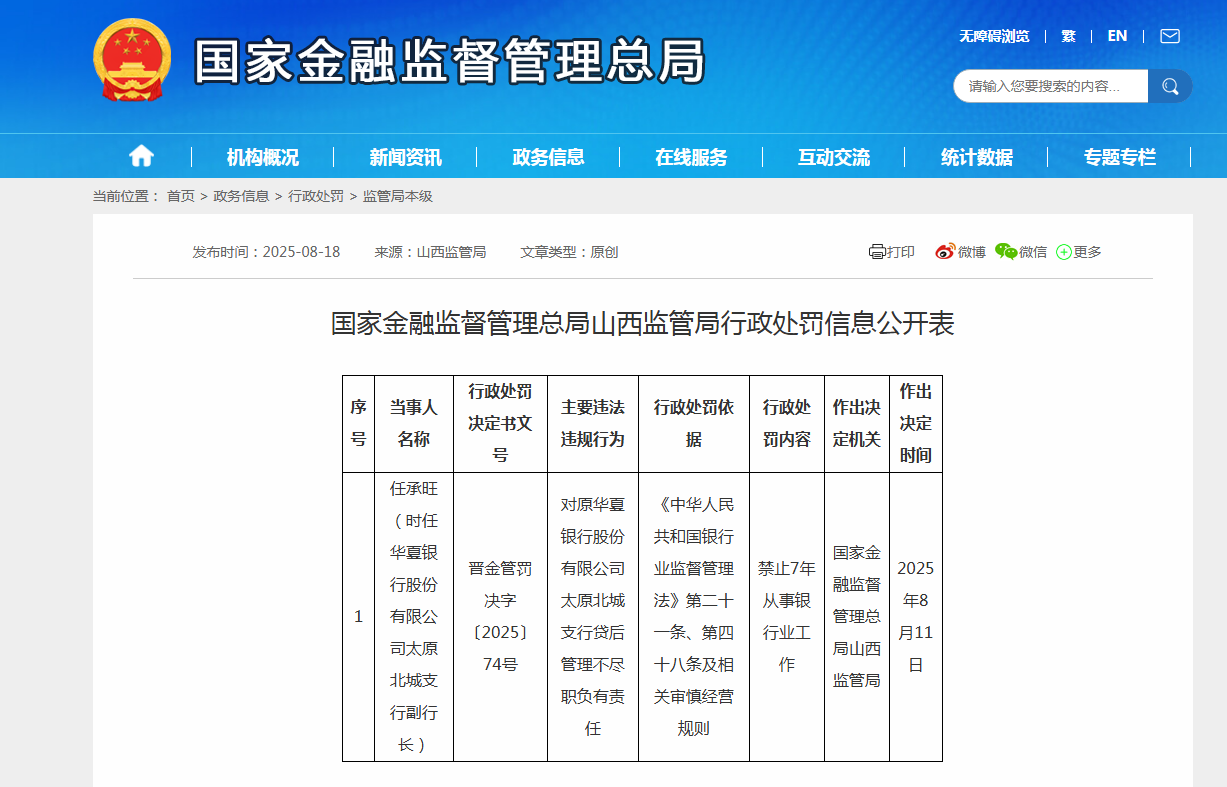
贷后管理漏洞频发!华夏银行多地支行被罚 一副行长遭7年禁业
Qi Lu Wan Bao· 2025-08-19 10:35
Core Viewpoint - The recent administrative penalties imposed on Ren Chengwang, the former deputy branch manager of Huaxia Bank's Taiyuan Beicheng branch, highlight ongoing issues with loan management practices within the bank, leading to a seven-year industry ban for the individual involved [1][3]. Group 1: Administrative Penalties - Ren Chengwang was penalized for inadequate post-loan management, resulting in a seven-year prohibition from the banking industry [1][2]. - Huaxia Bank has faced multiple penalties in a short period, indicating systemic issues in its loan management practices [3][6]. - In July, Huaxia Bank's Taiyuan Xinghualing branch was fined 300,000 yuan for poor post-loan management, while the Shijiazhuang branch was fined 650,000 yuan for various violations, including concealing non-performing loans [3][5]. Group 2: Regulatory Environment - The regulatory authorities have intensified scrutiny over post-loan management, emphasizing the need for banks to establish robust management mechanisms to track loan funds and mitigate potential risks [6]. - The repeated penalties against Huaxia Bank suggest significant vulnerabilities in its loan management processes, which have not effectively prevented violations [6].
消费金融公司被罚背后:贷后管理存在不到位问题
Jin Rong Shi Bao· 2025-08-08 07:52
Core Viewpoint - The consumer finance industry is experiencing significant growth, but companies are facing increasing pressure regarding post-loan management and asset quality, particularly with rising non-performing loans and regulatory scrutiny [1][2]. Group 1: Industry Challenges - Consumer finance companies are major players in the transfer of non-performing loans, with the transaction scale in Q1 2025 being second only to joint-stock commercial banks [1]. - Multiple consumer finance companies, including Zhaolian, Jiexin, and Ping An, have recently listed non-performing asset transfer projects, often at prices below 10% of their original value [1]. - The industry is under dual pressure from rising non-performing loan rates and the need for improved post-loan management, indicating increased risk [1]. Group 2: Regulatory Environment - Regulatory penalties have highlighted issues in post-loan management, with companies like Ant Consumer Finance and China Post Consumer Finance facing fines for inadequate management practices [2]. - The regulatory environment is tightening, requiring financial institutions to adhere strictly to laws and improve internal management mechanisms to ensure market stability [2]. - Common issues leading to penalties include inadequate outsourced collection management and the misappropriation of consumer loans [2]. Group 3: Consumer Protection and Compliance - There are ongoing issues with improper collection practices, including harassment and impersonation by collection agencies, which harm consumer rights and disrupt market fairness [3]. - New regulations prohibit the use of violent or threatening collection methods and require consumer finance companies to adhere to ethical collection practices [3]. - Companies are encouraged to enhance compliance management and risk governance frameworks, integrating consumer protection metrics into their performance evaluations [4]. Group 4: Recommendations for Improvement - Consumer finance companies should strengthen compliance management and establish a dynamic compliance matrix, ensuring consumer protection metrics are included in key performance indicators [4]. - Companies need to implement strict pre-loan audits and utilize big data to monitor fund flows during the loan period, allowing for timely detection of anomalies [4]. - Collaboration with partners should be improved through data sharing, and measures should be taken against those who misuse loan funds, such as account freezes and early loan recovery [4].
贷后管理存在不到位问题
Jin Rong Shi Bao· 2025-05-07 03:10
Core Insights - The consumer finance industry is experiencing significant growth, playing a crucial role in driving consumption upgrades and economic growth [1] - However, consumer finance companies are facing severe challenges in post-loan management, highlighted by the transfer of non-performing assets and regulatory penalties [1][2] - The rise in non-performing loans and the pressure of post-loan management indicate increasing risk for consumer finance companies [1] Group 1: Industry Challenges - Consumer finance companies are major players in the non-performing loan transfer market, with the transaction scale in Q1 2025 being second only to joint-stock commercial banks [1] - Multiple consumer finance companies, including Zhaolian, Jiexin, and Ping An, have recently listed non-performing asset transfer projects, with transfer prices generally below 10% of the original value [1] - Regulatory penalties have been issued to companies like Ant Consumer Finance and China Post Consumer Finance for inadequate post-loan management, indicating a common issue in the industry [2] Group 2: Regulatory Environment - The regulatory environment for consumer finance has tightened, with authorities requiring financial institutions to comply with laws and improve internal management mechanisms [2] - Common issues leading to penalties include inadequate outsourced collection management and the misappropriation of consumer loans [2] - The 2024 Consumer Finance Company Management Measures prohibit the use of improper collection methods, emphasizing the need for compliance in post-loan management [3] Group 3: Recommendations for Improvement - Consumer finance companies should enhance compliance management and establish a risk governance framework, integrating consumer protection metrics into their KPI assessment [4] - Companies need to improve their evaluation mechanisms for partner institutions and ensure that consumer complaints are considered in these evaluations [4] - Strict pre-loan audits and real-time monitoring of fund flows using big data are recommended to prevent the misappropriation of loan funds [4]