4D Reconstruction

Search documents
AI Day直播!免位姿前馈4D自动驾驶世界DGGT
自动驾驶之心· 2025-12-23 00:53
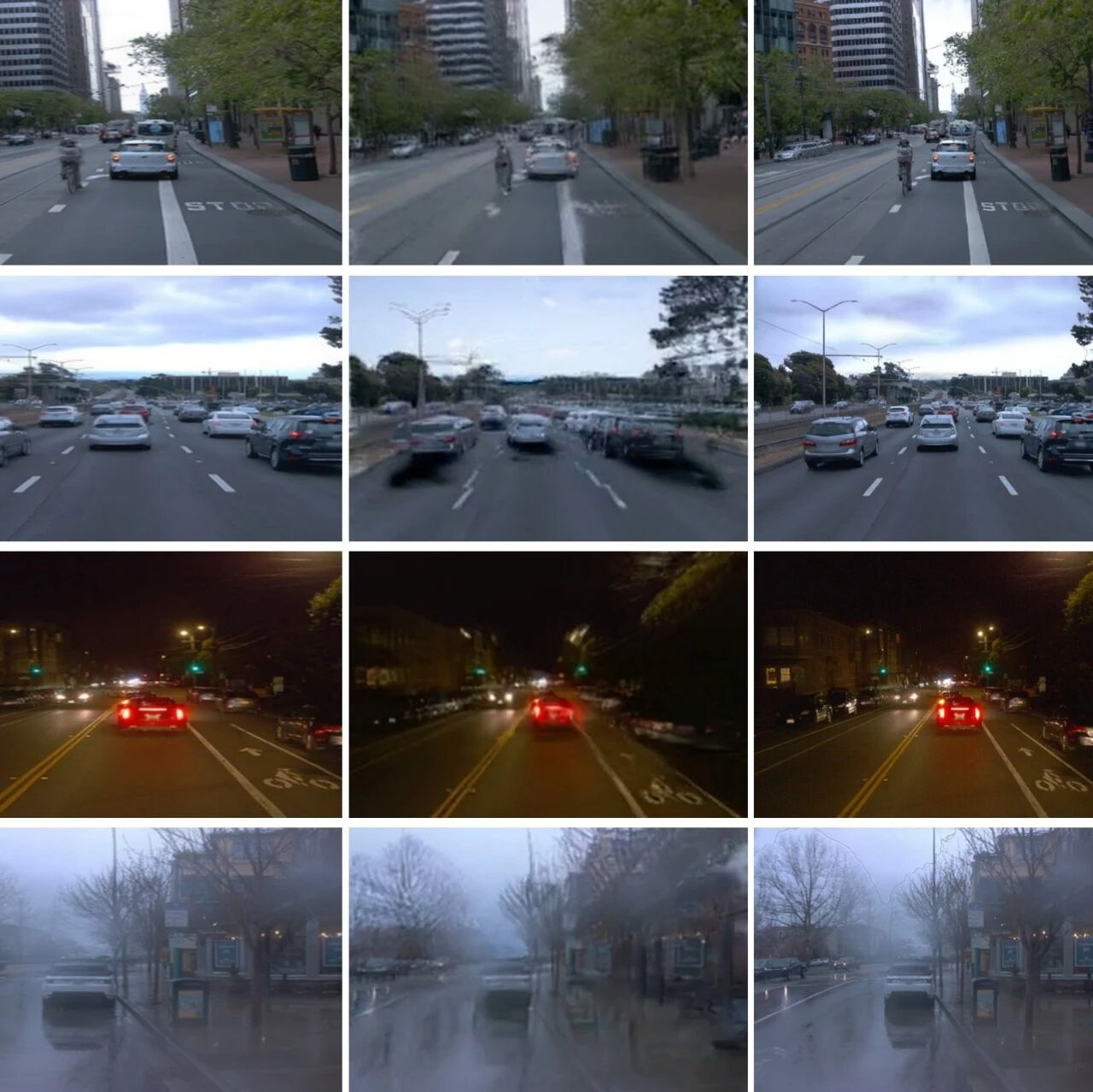
Core Viewpoint - The article discusses the limitations of existing methods for dynamic driving scene reconstruction, emphasizing the introduction of the Driving Gaussian Grounded Transformer (DGGT) as a solution that eliminates the need for camera pose input, enhancing flexibility and scalability [3][4]. Group 1: Methodology and Innovation - The DGGT framework allows for dynamic scene reconstruction directly from sparse, unposed images, redefining camera pose as an output of the model [3]. - The method jointly predicts 3D Gaussian maps for each frame along with camera parameters, utilizing a lightweight dynamic head to decouple dynamic elements and a lifespan head to modulate visibility over time for temporal consistency [4]. Group 2: Performance and Evaluation - The algorithm achieves leading performance in both speed and quality, validated through training and evaluation on large driving datasets such as Waymo, nuScenes, and Argoverse2 [4]. - Results indicate that the DGGT outperforms existing methods in both single dataset training and cross-dataset zero-shot transfer tasks, maintaining good scalability with increasing input frame numbers [4]. Group 3: Applications and Future Directions - The proposed method addresses the inefficiencies in autonomous driving reconstruction and the dependency on high-precision poses, enabling millisecond-level dynamic scene generation and static-dynamic decoupling [9]. - It supports cross-domain generalization and instance-level scene editing, providing an efficient solution for building large-scale world simulators [9].

复旦最新一篇DriveVGGT:面向自动驾驶,高效实现多相机4D重建
自动驾驶之心· 2025-12-17 00:03
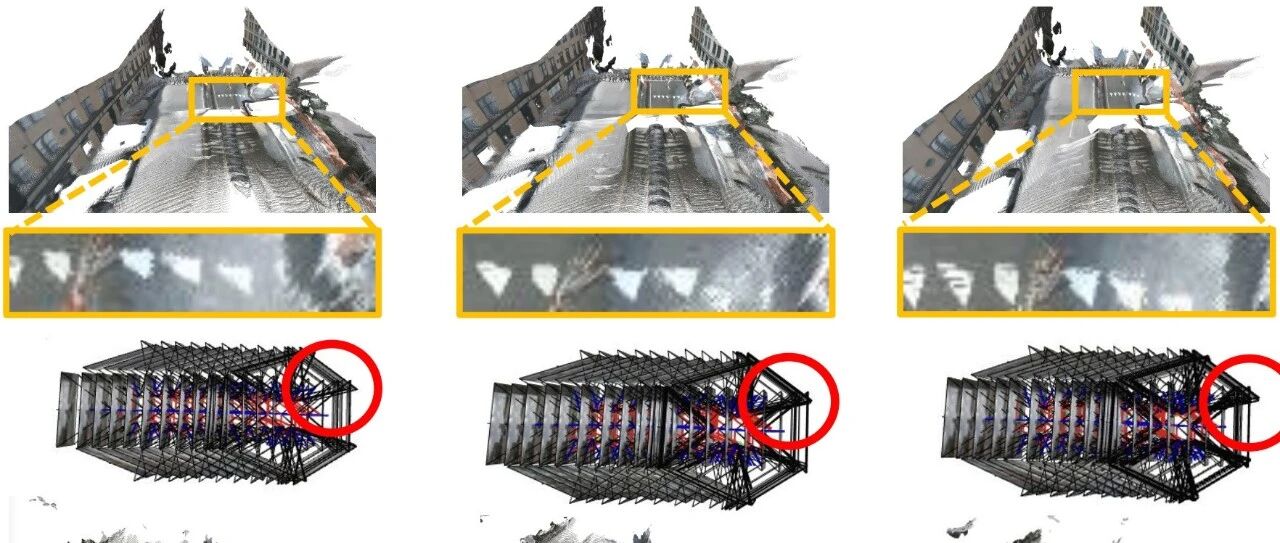
Core Insights - The article discusses the introduction of DriveVGGT, a visual geometry transformer designed specifically for autonomous driving, which significantly enhances geometric prediction consistency and inference efficiency in multi-camera systems [2][9][42] Background - 4D reconstruction is a computer vision task that predicts geometric information from visual sensors, particularly beneficial in autonomous driving and robotics due to its low cost [5] - Traditional reconstruction methods are either iterative, requiring retraining with scene changes, or forward methods, which can directly output predictions without updating model parameters [5] Limitations of Existing Methods - Existing forward methods struggle in autonomous driving scenarios due to low overlap between images captured by different cameras, making it difficult to identify similar features [6] - The relative pose calibration of cameras in autonomous systems is easy to obtain but cannot be directly utilized in forward methods due to scale discrepancies [6] DriveVGGT Model Overview - DriveVGGT integrates relative pose information to improve model performance in geometric tasks like camera pose estimation and depth estimation [10][11] - The model consists of three sub-modules: Temporal Video Attention (TVA), Relative Pose Embedding, and Multi-Camera Consistency Attention (MCA) [11][16] Temporal Video Attention (TVA) - TVA establishes initial geometric relationships between images captured by each camera in a continuous video stream, facilitating effective reconstruction [13][16] Relative Pose Embedding - This module normalizes the relative poses of all cameras to mitigate scale uncertainty, ensuring consistent geometric representation [14][16] Multi-Camera Consistency Attention (MCA) - MCA enhances the interaction between images from different cameras by injecting relative pose information, addressing the instability caused by low overlap [15][16] Experimental Results - DriveVGGT outperformed other models in terms of inference speed and prediction accuracy on the nuScenes dataset, particularly in scenarios with 210 images [24][30] - The model achieved superior depth estimation performance, especially in long sequence scenarios [27] Visualization and Ablation Studies - Visual comparisons demonstrated DriveVGGT's stability in pose prediction across various scenes, while ablation studies confirmed the effectiveness of the proposed modules [31][34] Conclusion - DriveVGGT effectively utilizes relative camera pose information to enhance geometric predictions, achieving better performance and lower computational costs compared to previous methods [42]
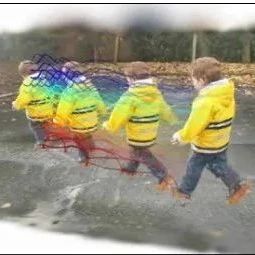
谷歌&伯克利新突破:单视频重建4D动态场景,轨迹追踪精度提升73%!
自动驾驶之心· 2025-07-05 13:41
Core Viewpoint - The research introduces a novel method called "Shape of Motion" that combines 3D Gaussian point technology with SE(3) motion representation, achieving a 73% improvement in 3D tracking accuracy compared to existing methods, with significant applications in AR/VR and autonomous driving [2][4]. Summary by Sections Introduction - The challenge of dynamic scene reconstruction from monocular video is likened to feeling an elephant in the dark due to the lack of information [7]. - Traditional methods rely on multi-view videos or depth sensors, making them less effective for dynamic scenes [7]. Core Contribution - The "Shape of Motion" technique enables the reconstruction of complete 4D scenes (3D space + time) from a single video, allowing for the tracking of object motion and rendering from any viewpoint [9][10]. - Two main innovations include low-dimensional motion representation using SE(3) motion bases and the integration of data-driven priors for a globally consistent dynamic scene representation [9][12]. Technical Analysis - The method employs 3D Gaussian points as the basic unit for scene representation, allowing for real-time rendering [10]. - Various data-driven priors, such as monocular depth estimation and long-range 2D trajectories, are utilized to overcome the under-constrained nature of monocular video reconstruction [11][12]. Experimental Results - The method outperforms existing techniques on the iPhone dataset, achieving a 73.3% accuracy in 3D tracking and a PSNR of 16.72 for new view synthesis [17][18]. - The 3D tracking error (EPE) is reported as low as 0.16 on the Kubric synthetic dataset, showing a 21% improvement over baseline methods [20]. Discussion and Future Outlook - The current method faces challenges such as training time and reliance on accurate camera pose estimation [25]. - Future directions include optimizing training time, enhancing view generation capabilities, and developing fully automated segmentation methods [25]. Conclusion - The "Shape of Motion" research marks a significant advancement in monocular dynamic reconstruction, with potential applications in real-time tracking for AR glasses and autonomous systems [26].