Academic freedom

Search documents
X @The Economist
The Economist· 2025-11-12 13:00
“Academic freedom is the cornerstone of knowledge production in democratic societies,” writes Laura Murphy in a guest essay. “Preserving it requires that universities shelter researchers from the retaliation of authoritarian governments” https://t.co/1LadfSgeN8 ...
What's at risk when federal research funding to universities is cut | 60 Minutes
60 Minutes· 2025-11-10 04:03
Funding & Research Impact - Federal research funding to universities has fueled breakthroughs, but is now being used as leverage by the White House [1] - A funding freeze by the Trump administration affected Harvard research labs, potentially jeopardizing future American discovery [3] - Harvard sued the government and regained funding after a judge ruled the freeze unlawful [10] - Federal grants have made up almost half of Harvard's research funding [16] - Instability of federal funding is making it difficult for researchers to retain and attract staff [23] Political & Ideological Disputes - Universities are accused of anti-semitism and liberal bias, leading to demands for safeguarding conservative voices [2] - Accusations of anti-semitism at Harvard stemmed from student protests over the Gaza war [7] - A survey found that 40% of Jewish staff, faculty, and students felt discriminated against, while 71% of Muslim respondents felt the same [8] - The Trump administration froze over $2 billion in grants to Harvard, mostly for scientific and medical research [9] - Harvard is working to improve existing programs promoting ideological diversity [18] Scientific Innovation & Global Competition - Government support of university research has powered America's scientific supremacy [16] - The US is potentially putting the brakes on scientific innovation while China is progressing rapidly [16] - Gene editing technologies invented at Harvard could help hundreds of millions worldwide with genetic diseases [25]


Why Protecting Freedom of Expression Matters More Than Ever
Bloomberg Originals· 2025-11-05 17:00
Core Values & Principles - USC Annenberg emphasizes freedom of the press, free speech, and free expression as central to its mission, encompassing journalism, public relations, communication, and public diplomacy [1] - Academic freedom, including the freedom to teach, research, and study without interference, is also a key principle [1] - The institution is deeply connected to its industries of practice, ensuring relevance and practical application of knowledge [2] Current Issues & Classroom Dynamics - News events, such as controversies involving Jimmy Kimmel and ABC, the Department of Education's letter regarding academic excellence, and student protests, directly influence classroom discussions [3] - Faculty are adapting their curricula to address current events and encourage students to engage with complex issues [3][4] - Students are actively seeking spaces for thoughtful discussion and critical engagement with challenging topics [4] - The university aims to create spaces for wrestling with complex issues in thoughtful ways, especially in an environment of commodified outrage [4]
X @Nick Szabo
Nick Szabo· 2025-10-07 14:53
Academic Freedom & Free Speech Concerns - The report raises concerns about a professor potentially intimidating students to prevent them from documenting classroom discussions [1][2] - The analysis suggests a possible contradiction in the syllabus, where the professor claims to welcome all viewpoints but simultaneously establishes restrictions that may stifle certain opinions [2] - The report alleges that the professor's definition of "unacceptable" speech could lead to ideological conformity rather than genuine tolerance [2] - The report cites an instance where the professor allegedly derailed a policy proposal due to ideological objections, raising questions about their reasonableness in discourse [3] Legal & Ethical Considerations - The report questions the professor's warning to students about violating Virginia Code § 19.2-69 by recording class discussions, arguing that the statute may not apply in this context [1] - The analysis implies a potential misuse of power by the professor to control the narrative and limit dissenting voices in the classroom [2]
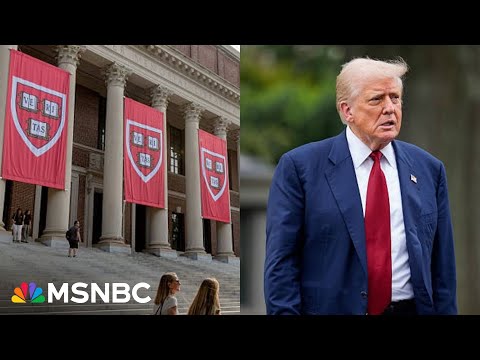
‘Protect the possibilities‘: Harvard profs urge university to ensure academic freedom
MSNBC· 2025-08-03 20:49
Academic Freedom & University Independence - The report highlights concerns over government interference in university affairs, including control over leadership, hiring, curriculum, and research [5][6][13] - Academic freedom is crucial for fostering innovation, effective democracy, and societal progress, with university-funded research yielding a 15-20% return to the government and society [15][16][17] - Universities should maintain the autonomy to make decisions about their governance, teaching, and hiring practices to ensure competition in ideas and admissions [13][14] Disputes & Settlements - The Trump administration has been actively challenging diversity programs and academic freedom at colleges and universities, leading to investigations and potential settlements [1][2][3] - Columbia University settled a civil rights claim with the government for $200 million following accusations of anti-semitism [1] - Brown University agreed to limit trans participation in athletics programs, dismantle its DEI programs, and pay $50 million to state workforce development programs over 10 years [2] - Harvard University was rumored to be considering a settlement of up to $500 million with the Trump administration over alleged civil rights violations related to anti-semitism, but the university president denied that a deal is imminent [3][7] Harvard's Response - Harvard has already taken steps to address concerns, including dismantling diversity offices, centralizing disciplinary powers, suspending certain initiatives, and modifying its Middle Eastern studies program [4] - Nine Harvard professors published a letter outlining values they hope will be protected in negotiations with the Trump administration, emphasizing the importance of university autonomy [4][5][6] - Harvard's president favors resolving disputes with the White House through the courts rather than through financial settlements [8]