Agent Memory

Search documents
AI下半场的战场,从Agent记忆体正式打响
机器之心· 2026-03-12 09:30
最近,一个叫OpenClaw(小龙虾)的开源项目突然爆火,甚至出现线下排队安装的场面。很多人第一次直观地看到,AI不只是chatbot,而是可以真正"动 手"操作电脑、完成复杂任务和个性化工作流的智能体。这意味着AI正在进入下半场,开始走向真实应用,并逐渐进入普通人的日常生活。 如果说上半场的 AI 是在拼模型参数和 benchmark 分数,那下半场真正要解决的,是一个更现实的问题: AI 能不能在真实世界里,持续地干活。 过去几年,大家卷的是 scale、架构、训练 recipe,把 MMLU、数学题、代码题刷到 90%+。但大部分的数据集几乎都是 短上下文、一次性任务 。现实 世界完全不是这样:白领工作、个性化助手、医疗诊断、深度研究,全部都是 长时间、多轮次、以任务为导向或者以用户为核心的交互 的场景。 我们会持续更新最新foundation memory的文章,欢迎关注收藏。 论文标题: Rethinking Memory Mechanisms of Foundation Agents in the Second Half: A Survey 论文链接: https://arxiv.org/pdf/ ...


LLM 的记忆问题「很快」就不再是问题了?
机器之心· 2026-02-15 01:30
本文来自PRO会员通讯内容,文末关注「机器之心PRO会员」,查看更多专题解读。 当前,智能体正经历范式转变,从高效的单任务执行模式,逐步向动态环境下的持续自适应、能力演化与经验积累模式转型。在此背景下,AI Memory 作为核心基石,赋能智 能体保持行为一致性、做出理性决策并实现高效协作。在长期探索中,AI Memory 已经分化为「Agent Memory」与「LLM Memory」两条截然不同的演进路径。 目录 01. OpenClaw 的「长效记忆」为何不代表「AI 拥有持久记忆」? OpenClaw的记忆力表现属于哪种突破?LLM Memory 与 Agent Memory 有何区别?... 02 . AI Memory 的研究视角在如何变化? 2025与2026的综述都在用什么视角解析AI Memory?如何理解 AI Memory 的「4W」分类?... 03 . 近期工作在如何探索 LLM Memory 和 Agent Memory? 2026年的 LLM Memory 与 Agent Memory 研究都在解决哪些问题?... OpenClaw 的「长效记忆」为何不代表「AI 拥有持久记忆」 ...

最火、最全的Agent记忆综述,NUS、人大、复旦、北大等联合出品
机器之心· 2025-12-22 09:55
Core Insights - The article discusses the evolution of memory systems in AI agents, emphasizing the transition from optional modules to essential infrastructure for various applications such as conversational assistants and code engineering [2] - A comprehensive survey titled "Memory in the Age of AI Agents: A Survey" has been published by leading academic institutions to provide a unified perspective on the rapidly expanding yet fragmented concept of "Agent Memory" [2] Forms of Memory - The survey categorizes agent memory into three main forms: token-level, parametric, and latent memory, focusing on how information is represented, stored, and accessed [16][24] - Token-level memory is defined as persistent, discrete units that are externally accessible and modifiable, making it the most explicit form of memory [18] - Parametric memory involves storing information within model parameters, which can lead to challenges in retrieval and updating due to its flat structure [22] - Latent memory exists in the model's internal states and can be continuously updated during inference, providing a compact representation of memory [24][26] Functions of Memory - The article identifies three core functions of agent memory: factual memory, experiential memory, and working memory [29] - Factual memory aims to provide a stable reference for knowledge acquired from user interactions and environmental facts, ensuring consistency across sessions [31] - Experiential memory focuses on accumulating knowledge from past interactions to enhance problem-solving capabilities, allowing agents to learn from experiences [32] - Working memory manages information within single task instances, addressing the challenge of processing large and complex inputs [35] Dynamics of Memory - The dynamics of memory encompass three stages: formation, evolution, and retrieval, which form a feedback loop [38] - The formation stage encodes raw context into more compact knowledge representations, addressing computational and memory constraints [40] - The evolution stage integrates new memories with existing ones, ensuring coherence and efficiency through mechanisms like pruning and conflict resolution [43] - The retrieval stage determines how memory can assist in decision-making, emphasizing the importance of effective querying strategies [41] Future Directions - The article suggests that future memory systems should be viewed as a core capability of agents rather than mere retrieval plugins, integrating memory management into decision-making processes [49][56] - There is a growing emphasis on automating memory management, allowing agents to self-manage their memory operations, which could lead to more robust and adaptable systems [54][62] - The integration of reinforcement learning into memory control is highlighted as a potential pathway for developing more sophisticated memory systems that can learn and optimize over time [58][60]
Approaches for Managing Agent Memory
LangChain· 2025-12-18 17:53
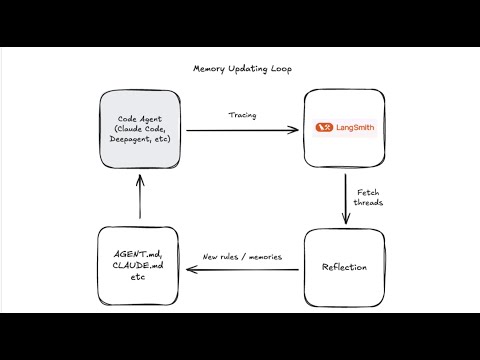
Memory Updating Mechanisms for Agents - Explicit memory updating involves directly instructing the agent to remember specific information, similar to how cloud code functions [2][5][6][29] - Implicit memory updating occurs through the agent learning from natural interactions with users, revealing preferences without explicit instructions [7][19][29] Deep Agent CLI and Memory Management - Deep agents have a configuration home directory with an `agent MD` file that stores global memory, similar to Claude's `cloud MD` [3][4][6] - The `agent MD` files are automatically loaded into the system prompt of deep agents, ensuring consistent memory access [6] - Deep agent CLI allows adding information to global memory using natural language commands, updating the `agent MD` file [5] Implicit Memory Updating and Reflection - Agents can reflect on past interactions (sessions or trajectories) to generate higher-level insights and update their memory [8][9][10][28] - Reflection involves summarizing session logs (diaries) and using these summaries to refine and update the agent's memory [11][12] - Accessing session logs is crucial for implicit memory updating; Langsmith can be used to store and manage deep agent traces [13][14][15] Practical Implementation and Workflow - A utility can be used to programmatically access threads and traces from Langsmith projects [21] - The deep agent can be instructed to read interaction threads, identify user preferences, and update global memory accordingly [24][25] - Reflecting on historical threads allows the agent to distill implicit preferences and add them to its global memory, improving future interactions [26][27][28]