Asymmetric Warfare

Search documents
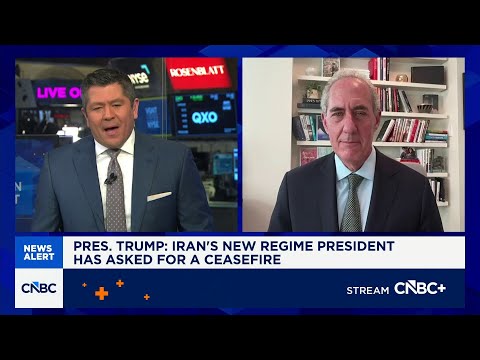
Iran can continue to wreak havoc on the global economy, says CFR's Michael Froman
CNBC Television· 2026-04-01 15:34
Welcome back. The president is posting on this morning on Truth Social that Iran's president has asked for a ceasefire which the US will consider, he says, when the straight of Humus is open free and clear, adding that until then, we're blasting Iran into oblivion. Iran state media has denied that ceasefire request.And of course, ahead of tonight's address about the war by the president. Joining us this morning, Michael Froman, Council of Foreign Relations President, former US Trade Repation. Michael, welco ...

X @Nick Szabo
Nick Szabo· 2026-03-20 18:31
RT OilPrice.com (@OilandEnergy)If Iran responded this forcefully to strikes on South Pars, imagine the escalation risk if Kharg Island were targeted—through which roughly 90% of its crude exports flow.Tehran’s playbook is asymmetric, and it has both the capability and willingness to inflict far greater damage on Gulf energy infrastructure. ...
X @Bloomberg
Bloomberg· 2026-03-04 18:04
Tehran’s asymmetric warfare has dragged its neighbors into the conflict and roiled energy markets. Will it be enough to save the Islamic Republic? https://t.co/n1CAcxIMaA ...
Trump Questions Future Iran Leaders | Balance of Power: Early Edition 3/03/2026
Bloomberg Television· 2026-03-03 20:41
>> LIVE FROM WASHINGTON, D.C., THIS IS "BALANCE OF POWER" WITH JOE MATHIEU AND KAILEY LEINZ. JOE: IT IS D PLUS THREE AS THE WHITE HOUSE WARNS THE WAR WITH IRAN COULD LAST MUCH LONGER THAN MANY FIRST THOUGHT. THE PRESIDENT SAYING WE HAVE THE MUNITIONS TO FIGHT FOREVER. I'M JOE MATHIEU ALONGSIDE KAILEY LEINZ IN WASHINGTON ON THIS DAY FOUR THE WAR. THE MARKETS WORK OF WORRIED ABOUT ALL OF THIS. WE HAVE SEEN SOME REAL IMPROVEMENT IN THE MIDDAY TRADE. KAILEY: AT LEAST WHEN IT COMES TO EQUITIES. A MASSIVE AMOUNT ...

Applied Energetics, Inc Advanced Defense Tech and Accelerating Military Innovation
Seeking Alpha· 2025-10-08 02:57
Core Insights - The discussion is centered around the evolving landscape of asymmetric warfare and the role of Applied Energetics in this new paradigm [3]. Company Overview - Chris Donaghey, the CEO of Applied Energetics, is leading the conversation, highlighting the company's position at the forefront of the revolution in asymmetric warfare [3]. Industry Context - There is a perception among family offices that the industry is still in the early stages of this transformation, indicating significant future potential for companies like Applied Energetics [3].

Weapons company founded by 21-year-old lands a U.S. Army contract
NBC News· 2025-09-05 03:11
Strategic Concerns & Asymmetric Warfare - The US needs to work hard to maintain relevance in the face of China's dominance [1] - Future warfare will involve ultra-large-scale strikes with very cheap assets, potentially millions of drones over populated areas [3][4] - The focus should be on disrupting China's manufacturing advantage in drone production [7] - Asymmetric offset can be achieved by taking out Chinese drone factories, potentially removing millions of quadcopters from the fight [8] Mach Industries' Approach - Mach Industries aims to rethink the future of warfare by mass-producing cheap, deadly drones [5] - The company is developing systems like "Glide" to target enemy industrial bases [8] - "Viper" is a portable Hellfire missile-like system with more payload, launched from a plastic case [9] - Mach Industries is also exploring the use of tens of millions of balloons for various purposes like carrying sensors, communications, and decoys [10] Defense Industry Transformation - New defense startups are focusing on mass-producing autonomous systems from land, sea, and sky [12] - The future of defense is envisioned as more like the automotive industry, with rapid development cycles of months instead of decades [13] - Decentralization of manufacturing is crucial, with numerous small facilities to avoid losing the industrial base in case of war [14]