
Automobile subsidy policy

Search documents
欧洲电动汽车销售回暖 车市销量连续第三年增长
Jin Rong Jie· 2026-01-27 05:50
Core Insights - European car sales have experienced growth for the third consecutive year in 2025, driven by consumer purchases of more affordable electric and hybrid vehicles [1] Group 1: Sales Performance - December saw a 7.6% increase in European car sales, marking the sixth consecutive month of growth [1] - The total new car registrations for the year rose by 2.4% to 13.3 million units [1] - Despite the growth, sales remain approximately 15% lower than pre-pandemic levels [1] Group 2: Electric Vehicle Market - The sales of electric vehicles (EVs) saw a significant increase, with registrations surging by 30%, accounting for about one-fifth of the overall market share [1] Group 3: Market Dynamics - In the first half of 2025, consumer sentiment was cautious due to market volatility and economic uncertainty stemming from Trump's tariff policies, but the second half saw a rebound in registrations [1] - Analysts predict that European car sales may rise again this year, supported by a new round of subsidy policies and the launch of several new-generation models [1]
【周度分析】车市扫描(2025年12月29日-12月31日)
乘联分会· 2026-01-07 08:41
Market Overview - In December 2025, the retail sales of passenger cars in China reached 2.296 million units, a year-on-year decrease of 13%, but a month-on-month increase of 3%. Cumulatively, retail sales for the year amounted to 23.779 million units, reflecting a year-on-year growth of 4% [1][5] - The wholesale volume for passenger cars in December 2025 was 2.759 million units, down 10% year-on-year and down 8% month-on-month. The cumulative wholesale for the year was 29.524 million units, showing a year-on-year increase of 9% [1][8] New Energy Vehicle (NEV) Performance - Retail sales of new energy vehicles in December 2025 reached 1.387 million units, a year-on-year increase of 7% and a month-on-month increase of 5%. Cumulatively, retail sales for the year were 12.859 million units, up 18% year-on-year [1][5] - The wholesale volume of new energy vehicles in December was 1.554 million units, a year-on-year increase of 3% but a month-on-month decrease of 9%. The cumulative wholesale for the year was 15.31 million units, reflecting a year-on-year growth of 25% [1][5] Production Trends - In the first four weeks of December, the production of pure fuel light vehicles was 905,000 units, down 29% year-on-year and down 16% month-on-month. The production of hybrid and plug-in hybrid vehicles totaled 525,000 units, down 26% year-on-year and down 21% month-on-month [2] Weekly Sales Trends - The average daily retail sales for the first week of December were 42,000 units, down 32% year-on-year and down 8% month-on-month. The second week saw an average of 67,000 units, down 17% year-on-year but up 9% month-on-month. The third week recorded 77,000 units, down 11% year-on-year and up 9% month-on-month. The fourth week had 90,000 units, down 12% year-on-year and down 15% month-on-month. The fifth week experienced a surge to 123,000 units, up 17% year-on-year and up 2% month-on-month [4][5] Policy Impact - The tightening of trade-in and scrapping subsidy policies has led to a cautious attitude among dealers, contributing to a decline in retail sales in November. However, the release of the new subsidy policy for 2026 is expected to stimulate demand and support a strong start in January 2026 [6][11] Global Market Share - In the first eleven months of 2025, China accounted for 68.4% of the global market share for new energy passenger vehicles, with a significant contribution to the global increase in sales [12][13]


2026年汽车“国补”来了! 上限不变,按车价比例补贴
Nan Fang Du Shi Bao· 2025-12-31 04:43
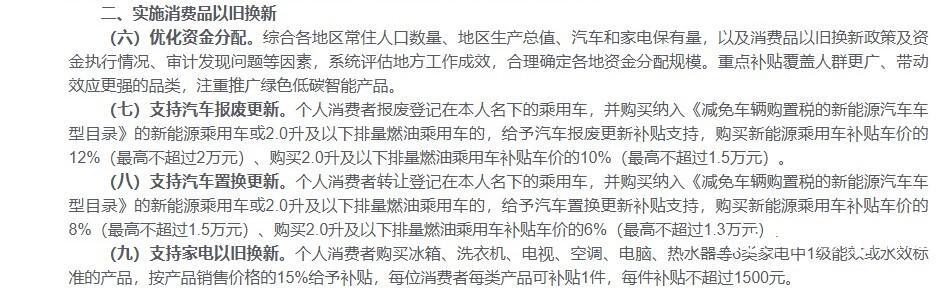
Core Viewpoint - The National Development and Reform Commission and the Ministry of Finance have issued a notice regarding the implementation of large-scale equipment updates and consumer goods replacement policies in 2026, continuing subsidies for scrapping and replacing vehicles, with a shift from fixed subsidies to percentage-based subsidies based on vehicle prices to better meet consumer demand for vehicle upgrades [1][2]. Group 1: Vehicle Scrapping and Replacement Subsidies - The notice supports vehicle scrapping updates, providing subsidies for personal consumers who scrap their registered passenger cars and purchase new energy passenger cars or fuel passenger cars with an engine capacity of 2.0 liters or below. The subsidy for new energy vehicles is 12% of the vehicle price (up to 20,000 yuan), while for fuel vehicles, it is 10% (up to 15,000 yuan) [1][2]. - The notice also supports vehicle replacement updates, offering subsidies for personal consumers who transfer their registered passenger cars and purchase new energy passenger cars or fuel passenger cars with an engine capacity of 2.0 liters or below. The subsidy for new energy vehicles is 8% of the vehicle price (up to 15,000 yuan), and for fuel vehicles, it is 6% (up to 13,000 yuan) [2]. Group 2: Market Outlook and Implications - Industry experts are optimistic about the car market in 2026, predicting a strong start in January, with stable subsidies for high-end electric vehicles likely to boost their growth, while lower-priced electric vehicles may see a significant decrease in subsidy amounts, leading to substantial market changes [2]. - The new subsidy calculation method encourages consumers to replace old cars rather than purchase new ones, which is expected to increase the supply of used cars and positively impact the used car export market [2]. - According to industry calculations, under the new subsidy regulations, consumers can receive the maximum subsidy when purchasing new energy vehicles priced at 166,700 yuan or above and fuel vehicles priced at 150,000 yuan or above [4].
汽车政策专家:2026汽车行业展望
2025-12-15 01:55
Summary of Key Points from the Conference Call Industry Overview - The conference call focuses on the automotive industry, specifically the policies surrounding vehicle replacement and subsidies in China, particularly the "old-for-new" vehicle replacement policy which is set to continue until 2027 with a target of recycling 9 million vehicles by 2027, doubling the amount from 2023 [1][2]. Core Insights and Arguments - The total funding for the "old-for-new" program is projected to be approximately 300 billion yuan for 2024-2025, with an expected increase to 400 billion yuan in 2026, of which about 10% (around 40 billion yuan) will be allocated to new energy vehicles [1][2]. - Local governments are expected to implement differentiated subsidy policies, with cities like Guangzhou already offering subsidies of 20,000 yuan for new energy vehicles and 15,000 yuan for fuel vehicles [1][3]. - The national government will provide the main funding support for the "old-for-new" program, distributing funds to local governments at a 9:1 ratio for vehicle scrapping and replacement [1][4]. - The subsidy standards may see an increase in technical requirements, with higher thresholds for vehicle registration years and emission standards, although the per-vehicle subsidy amount may slightly decrease to cover more consumers [1][6][7]. Additional Important Content - The "old-for-new" subsidy policy has significantly stimulated domestic automotive sales over the past year, and the continuation of this policy is expected to be confirmed before the Spring Festival in 2026 [2]. - Local governments are likely to relax purchase restrictions and promote policies to encourage rural areas to adopt new energy vehicles, with a target of establishing 28 million charging facilities by 2027 to support 80 million electric vehicles [2][11][15]. - The government has set a requirement for public vehicle procurement to be at least 30% for new energy vehicles, which is expected to further boost sales in this segment [12]. - The market supervision authority aims to maintain market order by combating malicious promotions and false advertising, encouraging healthy competition among enterprises [13][14]. - The national plan includes establishing over 100,000 high-power charging stations by 2027, with ongoing pilot projects for charging and battery swapping [15]. - The "14th Five-Year Plan" emphasizes the development of new energy and intelligent connected vehicles, aiming for a market share of 70-80% for new energy vehicles by 2030 [19]. This summary encapsulates the key points discussed in the conference call regarding the automotive industry's future, particularly focusing on government policies, funding, and market dynamics.