
Autonomous Labs

Search documents
Ginkgo Bioworks Launches Ginkgo Cloud Lab, Powered by Autonomous Lab Infrastructure
Prnewswire· 2026-03-02 13:00
Core Insights - Ginkgo Bioworks has launched Ginkgo Cloud Lab, an interface that allows researchers to utilize the company's autonomous lab infrastructure via a web browser [1] - The Cloud Lab operates on proprietary Reconfigurable Automation Carts (RACs), which integrate robotic arms, maglev transport tracks, and industrial software to create a flexible lab environment [1] - The initial launch features an AI-driven agent named EstiMate, enabling scientists to submit protocols in natural language and receive immediate compatibility assessments and pricing [1] - This initiative is part of Ginkgo's strategic shift in 2026 to transition all R&D services to its autonomous lab, Nebula, while phasing out traditional lab benches [1] Company Overview - Ginkgo Bioworks focuses on making biology easier to engineer, offering autonomous laboratories that enhance productivity by replacing manual lab work with robotics [1] - The company invites researchers from academia and global biopharmaceutical firms to test the Cloud Lab and submit protocols for development [1] - Ginkgo's autonomous lab services are also available through contract research services, enhancing its market offerings [1]



Ginkgo Bioworks (DNA) - 2025 Q4 - Earnings Call Transcript
2026-02-26 22:32
Financial Data and Key Metrics Changes - In Q4 2025, cell engineering revenue was $26 million, down 26% compared to Q4 2024, with a total of 109 revenue-generating programs, a 4% decrease year-over-year [15][16] - For the full year 2025, cell engineering revenue was $133 million, down from $174 million in 2024, primarily due to customer program rationalization [15][16] - Total Adjusted EBITDA in Q4 2025 was -$36 million, an improvement from -$57 million in Q4 2024, while for the full year, it was -$167 million, up from -$293 million in 2024 [20][21] - Cash burn in Q4 2025 was $47 million, down from $55 million in Q4 2024, and for the full year, it was $171 million, a 55% decrease from $383 million in 2024 [22][24] Business Line Data and Key Metrics Changes - The biosecurity business generated $7 million in revenue in Q4 2025 and $37 million for the full year, with an operating loss improvement of 60% in Q4 2025 compared to 2024 [17][20] - Cell engineering R&D expenses decreased 44% in Q4 2025 to $28 million, and for the full year, it decreased 42% to $159 million [18][19] Market Data and Key Metrics Changes - The company is focusing on the autonomous lab market, which is expected to transform biotechnology and is seen as a high-value area for investment [3][4] - The federal government and pharmaceutical companies are significant pools of research spending, with the NIH spending $40 billion annually on lab work [31][62] Company Strategy and Development Direction - The company plans to divest its biosecurity business to focus investments on autonomous labs, aiming to demonstrate capabilities through a large autonomous lab in Boston [4][11] - The strategy includes booking sales of autonomous labs to national labs and biopharma, with a notable $47 million deal with Pacific Northwest National Laboratory [6][31] - The company aims to improve cost efficiency while investing in AI robotics and software for autonomous labs, with a cash burn guidance of $125 million to $150 million for 2026 [24][25] Management's Comments on Operating Environment and Future Outlook - Management expressed confidence in the potential of autonomous labs to replace traditional manual laboratories, emphasizing the importance of long-term orientation over short-term revenue targets [28][29] - The company highlighted the need for flexibility in lab operations and the potential for AI to enhance research productivity [59][60] Other Important Information - The company has made significant strides in reducing cash burn and controlling spending, setting a solid foundation for future investments [13][14] - The autonomous lab is positioned as a solution to save overhead costs and increase research productivity for biopharma and national labs [59][60] Q&A Session Summary Question: What is the outlook for revenue guidance in 2026? - The company will not provide revenue guidance for 2026, focusing instead on cash burn as a better reflection of ongoing services and investments in autonomous labs [24][25] Question: How does the company plan to commercialize autonomous labs? - The company plans to build autonomous labs for customers and offer cloud lab services, allowing scientists to outsource small lab work directly [61][62]
Ginkgo Bioworks (DNA) - 2025 Q4 - Earnings Call Transcript
2026-02-26 22:32
Financial Data and Key Metrics Changes - In Q4 2025, cell engineering revenue was $26 million, down 26% from Q4 2024, with a total of 109 revenue-generating programs, a 4% decrease year-over-year [16] - For the full year 2025, cell engineering revenue was $133 million, down from $174 million in 2024, primarily due to customer program rationalization [16] - Total Adjusted EBITDA in Q4 2025 was -$36 million, an improvement from -$57 million in Q4 2024, while for the full year, it was -$167 million, up from -$293 million in 2024 [21][22] - Cash burn in Q4 2025 was $47 million, down from $55 million in Q4 2024, and for the full year, it was $171 million, a 55% decrease from $383 million in 2024 [23] Business Line Data and Key Metrics Changes - The biosecurity business generated $7 million in revenue in Q4 2025 and $37 million for the full year, with an operating loss improvement of 60% in Q4 compared to 2024 [18][21] - Cell engineering R&D expenses decreased 44% in Q4 2025 to $28 million, and for the full year, it decreased 42% to $159 million [19][20] Market Data and Key Metrics Changes - The company plans to focus on the autonomous lab market, which is expected to transform biotechnology and attract significant investment from both federal and private sectors [3][32] - The federal government, including the NIH, spends approximately $40 billion annually on lab work, indicating a substantial market opportunity for autonomous labs [32] Company Strategy and Development Direction - The company intends to divest its biosecurity business to concentrate investments on autonomous labs, aiming to demonstrate capabilities through a large autonomous lab in Boston [4][6] - The strategy includes systematic decommissioning of traditional lab setups to transition to a fully autonomous lab model, showcasing its potential to major pharmaceutical companies [5][30] - The company aims to book sales of autonomous labs to national labs, biopharma, and research universities, with a notable $47 million deal already secured [6][32] Management's Comments on Operating Environment and Future Outlook - Management expressed confidence in the potential of autonomous labs to replace traditional manual laboratories, emphasizing the importance of long-term investment over short-term revenue targets [27][30] - The outlook for 2026 includes a focus on cost efficiency while investing in AI and robotics to enhance autonomous lab capabilities, with expected cash burn guidance set between $125 million and $150 million [24][25] Other Important Information - The company has made significant strides in reducing cash burn and improving cost efficiency, setting a solid foundation for future investments [26] - The autonomous lab initiative is positioned as a key technological foundation for the company over the next decade, with plans to expand lab capacity significantly [35][36] Q&A Session Summary Question: What is the company's long-term growth outlook? - The company is focusing on investing in autonomous labs, with a strategic shift away from short-term revenue targets to long-term capabilities and market leadership in this emerging field [27][30] Question: How does the company plan to commercialize autonomous labs? - The company will build autonomous labs for customers and offer cloud lab services, allowing scientists to engage with the technology before committing to larger investments [62][66]
Ginkgo Bioworks (DNA) - 2025 Q4 - Earnings Call Transcript
2026-02-26 22:30
Financial Data and Key Metrics Changes - In Q4 2025, cell engineering revenue was $26 million, down 26% from Q4 2024, with a total of 109 revenue-generating programs, a 4% decrease year-over-year [15][16] - For the full year 2025, cell engineering revenue was $133 million, down from $174 million in 2024, with a significant reduction in cash burn from $383 million in 2024 to $171 million in 2025, a 55% decrease [13][22] - Total Adjusted EBITDA for Q4 2025 was -$36 million, an improvement from -$57 million in Q4 2024, while for the full year, it was -$167 million, down from -$293 million in 2024 [20][21] Business Line Data and Key Metrics Changes - The biosecurity business generated $7 million in revenue in Q4 2025 and $37 million for the full year, with an operating loss improvement of 60% in Q4 2025 compared to 2024 [16][20] - Cell engineering R&D expenses decreased by 44% in Q4 2025 to $28 million, and for the full year, it decreased by 42% to $159 million, attributed to restructuring efforts [18][19] Market Data and Key Metrics Changes - The company is focusing on the autonomous lab market, which is expected to transform biotechnology, with significant interest from federal government spending and biopharma sectors [31][63] - The company plans to commercialize autonomous labs through direct sales and cloud lab services, targeting a market that includes $40 billion to $60 billion in pharma research spending [62][63] Company Strategy and Development Direction - The company intends to divest its biosecurity business to focus investments on autonomous labs, aiming to demonstrate capabilities through a large autonomous lab in Boston [4][11] - The strategy for 2026 includes cost efficiency while investing in AI robotics and software to enhance autonomous labs, with a cash burn guidance of $125 million to $150 million [23][24] Management's Comments on Operating Environment and Future Outlook - Management expressed confidence in the potential of autonomous labs to replace traditional manual laboratories, emphasizing the importance of long-term investment over short-term revenue targets [27][29] - The company highlighted the successful collaboration with OpenAI, showcasing advancements in AI-driven scientific experimentation [30] Other Important Information - The company has made significant strides in reducing cash burn and improving operational efficiency, setting a solid foundation for future investments in autonomous labs [14][22] - The company is actively engaging with top pharma customers and government entities, indicating strong market interest in its solutions [67] Q&A Session Summary Question: What is the outlook for revenue guidance in 2026? - The company will not provide revenue guidance for 2026, focusing instead on cash burn as a better reflection of ongoing services and investments in autonomous labs [23] Question: How does the company plan to commercialize autonomous labs? - The company plans to build autonomous labs for customers and offer cloud lab services, allowing scientists to engage with the technology before committing to larger investments [62][66]
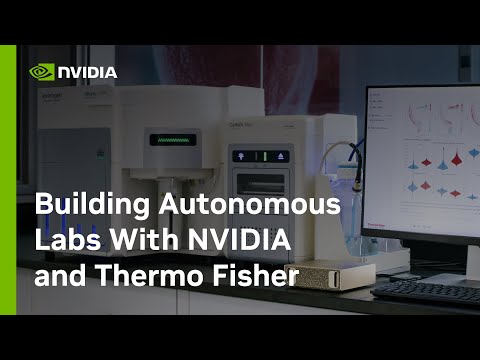
Building Autonomous Labs with NVIDIA and Thermo Fisher Scientific
NVIDIA· 2026-01-12 15:15
For centuries, lab instruments have allowed [music] us to observe the machinery of life. Today, they're doing something more profound, [music] generating the data that's fueling the next generation of digital biology. And as lab environments grow in complexity, AI agents are stepping in, not just [music] to measure, but to act. Thermoffisher and Nvidia are embarking on a journey to build [music] this fundamental AI lab infrastructure.AI agents created with NVIDIA Nematron and Nemo agent toolkit [music] help ...


AI in 2026: 3 Predictions For What’s To Come (a16z Big Ideas)
a16z· 2025-12-31 14:00
Welcome to part three of our 2026 big idea series. Oliver Shu explores how autonomous labs and AI are revolutionizing scientific discovery and changing how we conduct research and accelerate breakthroughs. Brian Kim reveals how AI is evolving beyond mere productivity tools to become the connective tissue and consumer applications, transforming how we interact and engage.And David Haber discusses how AI is reinforcing business models, creating compounding advantages that separate leaders from followers. My n ...

Ginkgo Bioworks (DNA) - 2025 Q3 - Earnings Call Transcript
2025-11-06 22:30
Financial Data and Key Metrics Changes - In Q3 2025, Ginkgo reported a cash position of $462 million with no bank debt, reflecting a significant reduction in quarterly cash burn by 75% from $114 million in Q3 2024 to $28 million in Q3 2025 [4][11] - Total adjusted EBITDA for Q3 2025 was negative $56 million, down from negative $20 million in Q3 2024, primarily due to a $21 million shortfall related to a Google Cloud contract and a $45 million non-cash revenue from a prior customer agreement [10][12] Business Line Data and Key Metrics Changes - Cell engineering revenue was $29 million in Q3 2025, a 61% decrease compared to Q3 2024, with a 5% decrease in revenue-generating programs attributed to ongoing program rationalization [6][8] - Biosecurity revenue generated $9 million in Q3 2025, with a segment gross margin of 19% [7] Market Data and Key Metrics Changes - The company reaffirmed its overall revenue guidance for 2025, projecting total revenue between $167 million and $187 million, with cell engineering revenue expected to be between $117 million and $137 million, and biosecurity revenue expected to be at least $40 million [12] Company Strategy and Development Direction - Ginkgo aims to deliver robotics and software for autonomous labs at customer sites, expand its frontier autonomous lab in Boston, and provide best-in-class CRO services leveraging in-house robotic infrastructure [2][3] - The company is focusing on AI's impact on biotechnology, particularly through reasoning models and automation, to enhance laboratory efficiency and reduce costs [13][20] Management's Comments on Operating Environment and Future Outlook - Management expressed confidence in navigating the macro environment while continuing to execute core objectives, emphasizing the importance of investing in automation and AI tooling for future growth [12][40] - The management highlighted the need for the U.S. to invest in robotic infrastructure to compete with China's growing biotech sector [19][20] Other Important Information - Ginkgo has made significant strides in reducing costs while maintaining a strong cash position, allowing for future investments in growth [4][40] - The company is actively building a community around AI models trained on biological data through initiatives like the Antibody Developability Competition [24][26] Q&A Session Summary Question: Impact of U.S. government shutdown on Ginkgo's business - Management indicated that the shutdown has not significantly impacted the company, as grants and funding continue to flow [41] Question: Development and rollout path for the rack system - Management expressed excitement about the scalability and productization of the rack system, aiming for broader adoption in the next 18 months [42][44] Question: Ideal revenue mix by 2030 - The company envisions an 80-20 revenue mix favoring tools over services by 2030, with a focus on becoming a dominant provider of general-purpose R&D infrastructure [50][51] Question: Details on the Google Cloud contract reset - Management provided insights on favorable terms negotiated with Google, reducing future commitments and extending the contract period [52][53] Question: AI's role in R&D landscape - Management discussed the potential of AI and robotics to transform drug discovery and laboratory operations, enabling researchers to pursue multiple hypotheses simultaneously [56][58]