Back to Basics Strategy

Search documents
Dave & Buster's(PLAY) - 2026 Q4 - Earnings Call Transcript
2026-03-31 22:00
Financial Data and Key Metrics Changes - Total revenue for Q4 2025 was $530 million, with a net loss of $40 million or $1.15 per diluted share, and an adjusted net loss of $12 million or $0.35 per diluted share [24] - Adjusted EBITDA for the quarter was $111 million, resulting in an adjusted EBITDA margin of 21% [24] - Comparable store sales decreased by 3.3% year-over-year in Q4 2025, but would have decreased only 1.5% excluding the impact of extreme winter weather [21][24] - The company expects to generate more than $100 million in free cash flow during FY 2026 [19][30] Business Line Data and Key Metrics Changes - Food and beverage (F&B) same-store sales increased approximately 7% during Q4 2025, with positive trends continuing into 2026 [10][21] - Special events revenue grew nearly 7% in Q4 2025 [21] - The percentage of guests opting for the eat and play combo improved significantly, growing from roughly 10% in Q1 2025 to approximately 16% in Q4 2025 [11] Market Data and Key Metrics Changes - The company has opened two new domestic stores in Q4 2025, bringing the total for the year to 11 new stores [27] - Internationally, the company opened its fourth franchise location in the Dominican Republic and plans to open three more in Delhi, India, Perth, Australia, and Mexico City, Mexico [27][28] Company Strategy and Development Direction - The company is focused on a "back to basics" strategy, emphasizing improvements in marketing, food and beverage offerings, and new game introductions [4][5][18] - Plans for FY 2026 include launching at least 10 new games and attractions, with a focus on culturally relevant IPs to drive traffic [12][13] - The company aims to maintain strict capital expenditure discipline, planning to spend no more than $200 million in CapEx during 2026 [19][30] Management's Comments on Operating Environment and Future Outlook - Management expressed confidence in the ability to grow same-store sales, revenue, and adjusted EBITDA in FY 2026, despite external macroeconomic pressures [6][62] - The company is optimistic about leveraging upcoming events like the FIFA World Cup to drive traffic and sales [9][64] - Management acknowledged the challenges posed by consumer sentiment and macroeconomic factors but emphasized a focus on internal strategies to drive growth [33][62] Other Important Information - The company has made significant progress in strengthening its leadership team and improving operational execution to enhance guest experience [15][16] - The remodel program is expected to generate attractive returns, with remodel stores outperforming non-remodel stores by approximately 700 basis points [17][21] Q&A Session Summary Question: Insights on consumer behavior and impact of macro factors - Management noted the difficulty in parsing the impact of macroeconomic factors versus holiday shifts, indicating a need to wait for clearer data post-spring break [33] Question: Impact of value promotions on margins - Management confirmed that value promotions have not led to margin erosion, as increased guest engagement has resulted in higher food and beverage sales [35][36] Question: Amusement business performance and future initiatives - Management acknowledged past mistakes in not investing in amusements and expressed confidence that new game introductions will drive traffic and sales growth [43][45] Question: Marketing strategy changes for 2026 - The marketing strategy will focus on product quality, customer insights, and a balanced media mix to effectively reach target audiences [48][49] Question: Free cash flow guidance and margin expectations - Management did not provide specific EBITDA guidance but emphasized that growing same-store sales will drive margin growth [54][55] Question: Strategic rationale for continued store growth - Management highlighted the importance of maintaining competitive advantage and ensuring high returns on new store investments while being mindful of same-store sales growth [88][92]

Castellum AB (publ) (CWQXY) Discusses Back to Basics Strategy Focused on Profitability and Portfolio Rotation Transcript
Seeking Alpha· 2025-11-28 10:53
Core Viewpoint - The company has announced a new strategy called "Back to Basics," focusing on core real estate management practices [2][3]. Company Strategy - The "Back to Basics" strategy emphasizes returning to the fundamental principles of managing real estate, particularly in the commercial sector [3]. - The company predominantly owns properties in Sweden, with approximately 92% of its assets located in the country, indicating a strong focus on the Swedish market [3]. Geographic Focus - While the company plans to maintain its primary focus on Sweden, it does not rule out the possibility of increasing or decreasing its presence in other geographic areas, including Finland, Denmark, and Norway through its subsidiary Entra [4].



Trump's Tariffs Have No 'Material Impact' On The Business, Says Kroger: Raising Prices Would Be 'A Last Resort' - Kroger (NYSE:KR)
Benzinga· 2025-09-12 06:12
Core Insights - Kroger Co. is aggressively lowering prices on over 3,500 products to attract cost-conscious shoppers, reflecting a "back to basics" strategy amid mixed second-quarter earnings [1][2] - The company raised its full-year sales forecast, indicating confidence in its pricing strategy and operational improvements [1][5] Pricing Strategy - The strategic price investments aim to simplify the value proposition for customers facing economic pressures, with a focus on lower prices and simpler promotions [2] - Kroger's CEO emphasized the importance of quality and value, alongside better store conditions and service [2] Profit Margin Management - Kroger is committed to maintaining stable profit margins, with the CFO stating the goal for the full-year gross margin rate to be "relatively flat" [3] - The company plans to fund discounts through cost-cutting and productivity improvements, ensuring it remains "margin neutral" [3] Economic Environment - Kroger is navigating external economic challenges, including inflation concerns, but reports that tariffs have not had a material impact on its business [4] - The company aims to keep prices low for customers, considering price increases only as a last resort [4] Financial Performance - In the second quarter, Kroger reported adjusted earnings per share of $1.04, exceeding analyst expectations, with quarterly sales of $33.94 billion, slightly below consensus [4] - The full-year adjusted EPS outlook has been raised to $4.70–$4.80, compared to the previous range of $4.60–$4.80, with adjusted identical sales expected to rise by 2.7% – 3.4% [5] Stock Performance - Kroger's stock rose 0.30% on Thursday and has increased 8.54% year-to-date, with a 21.79% rise over the past year [6]


Why Dollar General May Be Retail's Most Undervalued Rebound
MarketBeat· 2025-06-02 12:22
Core Insights - Dollar General has experienced a significant stock price increase of approximately 30% over the past three months, rising from around $85.00 to about $97.00 [1] - The company is implementing a "Back to Basics" strategy aimed at addressing past operational challenges and focusing on growth [2][11] - Analysts are increasingly optimistic about Dollar General's turnaround, with several firms raising their price targets for the stock [6][8] Strategy and Operational Improvements - The "Back to Basics" strategy includes smarter inventory management, enhancing the shopping experience through store remodels, and controlling shrinkage to protect profitability [3][4] - Dollar General aims to increase operating margins to 6-7% by 2028 or 2029, up from 4.2% reported in Fiscal 2024 [5] - The company plans to expand its fresh food offerings and open 575 new stores in the U.S. and up to 15 in Mexico in Fiscal 2025 [7] Financial Outlook - The current price-to-earnings (P/E) ratio is around 16, with a forward P/E of about 17, indicating potential value for investors if the turnaround is successful [9] - UBS Group and other analysts have raised their price targets for Dollar General, reflecting growing confidence in the company's future performance [8] Upcoming Events - The first-quarter Fiscal 2026 earnings report, expected around June 3, 2025, will be crucial in validating the turnaround narrative and building investor confidence [10][16]


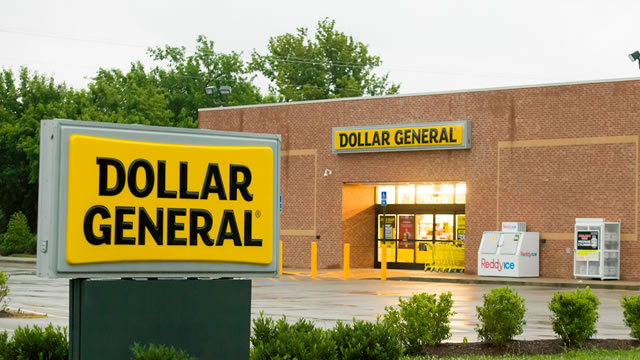
Dollar General Shifts Focus To Stability, But Analysts Flag Profitability Pressures
Benzinga· 2025-03-14 17:50
Core Insights - Dollar General Corp reported better-than-expected fourth-quarter earnings, with an EPS of $0.87, which included a significant charge of $0.81 related to store portfolio review and closures. Excluding these charges, the EPS would have exceeded consensus expectations of $1.51 [1][2] Financial Performance - The company achieved a 1.2% comparable store sales growth, surpassing the consensus of 0.9%, leading to a 4.5% year-over-year revenue increase to $10.30 billion, exceeding the expected $10.26 billion [2] - Gross margin was reported at 29.4%, slightly above expectations, while SG&A expenses increased due to the portfolio review. Overall inventories decreased by 4%, with a 6.5% reduction on a per-store basis [2] Future Guidance - For 2025, Dollar General guided an EPS range of $5.10 to $5.80, which is slightly below the consensus of $5.83. The company anticipates flat EPS growth in 2025 due to increased real estate projects, store closures, and sales challenges in the first quarter [3][6] - Positive factors include increased sales from upper-income consumers and plans to expand the same-day delivery partnership with DoorDash to 10,000 stores [3] Analyst Ratings and Market Position - Piper Sandler analyst Peter Keith maintained a Neutral rating and raised the price target from $79 to $81, while Telsey Advisory Group analyst Joseph Feldman reiterated a Market Perform rating with a price target of $85.00 [1][5] - Analysts noted that Dollar General is transitioning from a growth retailer to a more mature one, focusing on slower unit growth and enhancing in-store operations [5][6] Challenges and Concerns - Analysts expressed concerns regarding sluggish comparable store growth, unclear EPS growth trajectory, and potential tariff impacts on lower-income customers [4] - Profitability may face challenges from promotions, a shift towards consumables, and rising costs, including wages, incentive compensation, and utility expenses [7]