
Capital Outflows

Search documents
X @Bloomberg
Bloomberg· 2026-03-23 12:00
China plans to increase the amount of money that approved investors can channel into overseas assets as Beijing loosens its control over capital outflows https://t.co/vqVETFBp60 ...
X @Bloomberg
Bloomberg· 2026-02-15 11:48
ECB President Christine Lagarde said on Sunday that creating incentives for investments in Europe is a better approach to prevent capital outflows to other regions than imposing taxes. https://t.co/8FvITqDRjB ...
USDT Demand Stalls in January, Signaling Capital Outflows from the Market
Yahoo Finance· 2026-01-22 09:09
Core Insights - The stablecoin market has experienced a significant slowdown in growth, with issuers minting billions of dollars daily becoming a rarity in recent months, raising concerns about future market conditions [1] - The market capitalization of USDT has sharply declined, with growth dropping from approximately $15 billion to around $3.3 billion since late November [2] - A strong correlation exists between USDT market cap changes and Bitcoin price movements, indicating that liquidity growth is crucial for Bitcoin's performance [3] Market Capitalization Trends - The 60-day market cap change for USDT has not turned negative yet, but recent market signals indicate potential warnings for the future [4] - The market capitalization of USDT (ERC-20) has decreased over the past month, with USDT trading consistently below $1, suggesting capital outflows and reduced interest from stablecoin holders [5] - Tether Treasury's recent burn of 3 billion USDT, the largest in three years, reflects caution among large players amid macroeconomic uncertainties [6] Investor Sentiment - Observations suggest that significant market exits may be occurring, as indicated by comments from investors about large players leaving the market [7] - Current signals are still early and not definitive, but if they continue, the stablecoin market's stagnation at around $308 billion in total capitalization could shift into a corrective phase [7]
Could India Cash In on the Weak Rupee?
Bloomberg Television· 2025-12-19 06:48
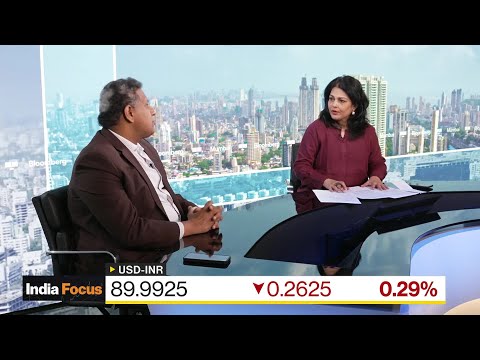
Rupee Performance and Influencing Factors - The Indian Rupee (INR) experienced weakness, becoming one of the worst-performing currencies this year, despite interventions [5] - Capital outflows, weak capital inflows (the weakest since the global financial crisis), and the absence of an India-U S trade deal are key factors driving Rupee weakness [4][5][6] - The Reserve Bank of India (RBI) intervened by buying bonds with 500 billion Rupees to calm the markets, which provided short-term relief [2] - Increased tolerance by the RBI for a weaker Rupee level is aimed at attracting capital inflows [7] Rupee Forecast and RBI Strategy - Forecasts suggest the Rupee could weaken to between 93 and 95 levels in the first part of 2026 [4][5] - The RBI is expected to shift its strategy to smoothing the Rupee's movements rather than defending a specific level in 2026 [9] - The RBI will likely use opportunities to rebuild its foreign exchange reserves [8] Economic Impact and Policy Implications - A weakening Rupee can act as a shock absorber, allowing monetary and fiscal policy to focus on growth and jobs [13][14] - While a weaker Rupee provides incremental support for exporters, Indian exporters are primarily price takers [15][16] - Low global commodity prices should limit the negative impact of a weaker Rupee on imports [17][18] - The government should focus on domestic levers of growth, such as consumption, and consider further tax cuts [20] - The government should focus on structural issues like ease of doing business and tax consistency to attract investments [23]

X @Bloomberg
Bloomberg· 2025-09-10 16:24
Argentina is seeking to roll over trillions of pesos in local debt on Wednesday, a crucial test in its push to stem capital outflows and shore up its battered currency https://t.co/MYHaHgT75G ...
X @Bloomberg
Bloomberg· 2025-08-18 03:00
China’s capital outflows hit a record in July, driven by mainland investors’ aggressive buying of Hong Kong assets following new market liberalization measures https://t.co/IIzGPo54SY ...
X @Cointelegraph
Cointelegraph· 2025-08-06 20:00
🇨🇳 JUST IN: China tests stablecoins, raising concerns over capital outflows and U.S. dollar dominance. https://t.co/vpAUfkQzHe ...
X @Bloomberg
Bloomberg· 2025-07-01 04:48
China has increased the amount of money that approved investors can put into overseas assets for the first time since May last year as its relaxes its control over capital outflows https://t.co/CsRhy5Peog ...