Commercial Space Station

Search documents
LIVE! The Future of NASA Press Conference
The Launch Pad· 2026-03-25 09:54
Heat. Heat. N.NASA Ignition, where agency leadership charted the path forward to accomplish President Trump's national space policy. I'm Bethany Stevens, NASA senior adviser and press secretary, and I will be your moderator for today's news conference. Joining this live event are administrator Jared Isaacman, associate administrator Amit Shhatria, acting administrator exploration systems development mission directorate Lorie Glaze, Moonbase program executive Carlos Garcia Galan, LEO program manager Dana Wig ...

Vast CEO Max Haot on raising $500M in new investment round
CNBC Television· 2026-03-06 14:51
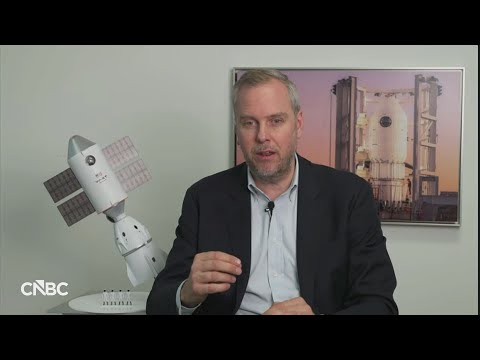
Vast CEO Max Haot joins CNBC's Morgan Brennan to discuss the commercial space station developer's first significant investment round, the future of human inhabitation in space, how his company differs from competitors, and more. ...
Voyager Technologies (NYSE:VOYG) FY Conference Transcript
2026-02-11 20:52
Summary of Voyager Technologies FY Conference Call Company Overview - **Company**: Voyager Technologies (NYSE: VOYG) - **Industry**: Aerospace and Defense, Space Solutions - **IPO Date**: June 2025 - **Key Management**: - Dylan Taylor (CEO) - Matt Kuta (President) - Wallace Lockery (Chief Strategy Officer) - **Funding**: Over $400 million in cash and $200 million in undrawn credit facilities for M&A and organic growth [16][19] Core Business Segments 1. **Starlab**: - A commercial space station to replace the ISS by 2030 - Joint venture with Airbus, Mitsubishi, Palantir, and MDA - Unique single-module design to reduce costs and execution risks - Expected to generate $4 billion in annual revenue and $1.5 billion in annual free cash flow over 30 years [31] - Launch planned for 2029, with capacity to monetize quickly [29][30] 2. **Defense and National Security**: - Focus on mission management and operations for ISS traffic - Development of technologies for lunar exploration and national security applications - Emphasis on solid rocket motor technologies for next-gen interceptors [23][25] 3. **Space Solutions**: - Providing core products like sensors, electronics, and processing for space infrastructure [25] Financial Guidance - Projected **25% organic CAGR** from IPO to 2030, augmented by M&A [18] - Starlab expected to own ±60% of its operations, with potential dilution from external capital [31] Competitive Landscape - Competing under NASA's Commercial LEO Development Program (CLD) with companies like Blue Origin, Northrop Grumman, and Axiom Space - Received $218 million in funding from NASA for CLD phase one [33] - Anticipates a down-select in the next phase, with NASA likely to choose two providers [34] Technology and Innovation - Voyager operates as a technology company with a low capital intensity model, investing about **20% of revenue in R&D** [17] - Development of throttleable solid rocket motors, enhancing maneuverability and efficiency for missile defense systems [57][68] - Engaging with various defense contractors for potential technology integration [70] International Expansion and Partnerships - Actively pursuing international partnerships, particularly in microgravity research and production capabilities [75] - Focus on reshoring critical chemical production for munitions, with plans to build the first U.S. black powder factory in 30 years [76] Key Takeaways - Voyager Technologies is positioned as a disruptive force in the aerospace and defense industry, focusing on innovative solutions and strategic partnerships - The company is on track for significant growth, particularly with the Starlab project, which is expected to meet increasing demand for commercial space operations - The emphasis on technology integration and international collaboration highlights Voyager's commitment to expanding its market presence and capabilities [18][19][31][75]
Voyager Technologies, Inc. (VOYG): A Bull Case Theory
Yahoo Finance· 2025-12-04 17:05
Core Thesis - Voyager Technologies, Inc. is positioned as a dual-focus defense and space company with significant growth potential through its national security subcontracting operations and the Starlab commercial space station project, which is set to replace the ISS by 2030 [2][3][4] Business Overview - The core defense business generates most near-term revenue by supplying propulsion systems for LMT's Next Generation Interceptor (NGI) missile program and providing ISR, AI/ML software, and space infrastructure services [2] - Voyager's near-term growth is supported by a pipeline of additional programs valued at approximately $2.7 billion, with expectations to onboard a second program by 2026 [2] Strategic Acquisitions and Partnerships - Operational expertise and strategic acquisitions, including Nanoracks, Valley Tech Systems, and BridgeComm, enhance Voyager's technology stack and program credibility [3] - Multinational partnerships with companies like Airbus, Mitsubishi, MDA Space, and Palantir provide strategic advantages, positioning Voyager favorably against competitors such as Axiom Space, Blue Origin, and Vast Space [4] Valuation and Price Target - A sum-of-the-parts valuation indicates that VOYG's core business is valued at 7.5 times one-year forward sales, with Starlab contributing additional call-option value, leading to a price target of $58 and a bull case of $84 within two years [5] - Potential catalysts for growth include funding announcements for Starlab, clarity on the Golden Dome RFP, additional defense program awards, and strategic valuation uplifts [5] Investment Opportunity - Voyager represents a compelling growth opportunity with immediate defense exposure and transformative long-term upside, despite risks related to program execution and funding timing [5]
X-Energy’s Kam Ghaffarian on Nuclear Power, AI, and the Space Tech Race
CNBC Television· 2025-11-28 20:51
Space Economy Growth & Vision - The space economy is at an inflection point, experiencing rapid growth, driven by commercial space activities and private companies [1][2][5] - By the end of the decade, a fully commercial space station, built by Axiom Space, is expected to be in orbit before the International Space Station retires, with the first module launching by early 2027 [3][4] - The ultimate destiny for humanity is interstellar travel, with the moon and Mars serving as stepping stones [16] - By 2050, the vision includes hourly launches to a space city above Earth, daily launches to the moon, and weekly launches to Mars, with quarterly launches to Proxima Centauri [18] Commercial Space Opportunities - Opportunities exist in low Earth orbit (LEO) for orbital data centers, semiconductors, pharmaceuticals, and bioprinting due to the unique environment of space [10][12] - AI data centers in space are a growing area, with companies like AWS pioneering in this field [13][14] - Mining on the moon, particularly for helium-3, presents economic and national security opportunities [16] Human Spaceflight & International Collaboration - Access to space is becoming more affordable, attracting interest from numerous countries, with Axiom Space having worked with 11 countries and being oversubscribed [6] - Space missions inspire the next generation, as demonstrated by the 350 million people under 16 in India who tuned in to a mission [8] Power & Nuclear Energy - Nuclear energy is crucial for space habitation and interstellar travel, with X-Energy developing small modular reactors [20][24] - X-Energy has signed deals with Amazon AWS for initially 5 gigawatts, potentially growing to 10 gigawatts, and with Centricon in the UK to power AI data centers [21] - Safe space nuclear power is necessary for lunar surface operations, nuclear electric propulsion, and nuclear thermal propulsion to shorten travel times to other planets [24]

Axiom Space CEO on retiring the International Space Station
Bloomberg Television· 2025-08-22 21:08
ISS Retirement Timeline - The ISS is scheduled to retire by the end of 2030, although it has already been extended beyond its original 2024 expiration date [1][2] - There is confidence that the ISS will be decommissioned by 2030 [2] - Extending the ISS's lifespan by the government is viewed positively [2] Competitive Landscape - If a commercial solution like Axiom Space is not operational by the time the ISS is decommissioned, the only other space station in operation will be the Chinese station [3] - The Chinese space station represents a significant competitive and strategic threat [3] - The US risks ceding diplomatic leadership and influence to China if it lacks a commercial space station alternative [3]