Coral Reefs

Search documents
Why sharks and rays keep our oceans alive | Louisa Graf | TEDxDeakin Uni Melbourne
TEDx Talks· 2025-12-22 17:17
Environmental Impact & Conservation - Over one-third (33%) of all shark and ray species are threatened with extinction worldwide, equating to over 400 species [3] - Declining shark and ray populations have been linked to the functional extinction of seagrass meadows in the Indian Ocean and threaten coral reefs in Australia [4][5] - Sharks and rays play a crucial role in regulating the ocean's ecosystem and maintaining its balance [15] Research & Biodiversity - There are over 50 species of sharks and rays in Port Philip Bay, Australia, many of which are meso predators [8] - Research focuses on tracking shark and ray movements using small trackers and underwater listening stations to understand their role in the marine ecosystem [11][12] - Muscle biopsies are used to analyze the diet of sharks and rays, providing insights into their ecological roles [13] Threats & Human Impact - Overfishing is the number one threat to sharks and rays globally [17] - Shark products are present in everyday items like pet food, supplements, and skincare [17][18] - Three billion people rely on marine and coastal resources for their livelihoods, highlighting the importance of ocean conservation [15] Ocean's Role - The ocean provides 50% of the air we breathe, emphasizing the critical role of marine ecosystems [15]


Invisible Threads: How Coral Reefs Connect to Your Life | Asha Nagar | TEDxAlpha School Austin Youth
TEDx Talks· 2025-09-10 16:39
Environmental Impact & Interconnectedness - Marine ecosystems, including coral reefs, produce over half of the Earth's oxygen [2] - The loss of coral reefs exacerbates global warming, leading to warmer summers and stronger storms [3] - Climate regulation and carbon reduction are significantly impacted by the health of coral reefs [4] - The interconnectedness of global ecosystems means issues seemingly distant have direct impacts on daily life [1][2][8][9][10] Socio-Economic Consequences - Declining fish populations due to coral reef degradation can lead to rising grocery bills [5] - The disappearance of coral reefs poses a threat to livelihoods, homes, and cultural heritage [6] - Communities face potential displacement due to stronger storms linked to coral reef loss [6] Call to Action & Responsibility - Individuals can contribute to coral reef preservation by choosing reef-friendly products and reducing their carbon footprint [7] - Recognizing the far-reaching impacts of environmental issues empowers individuals to take responsibility [9] - Indifference to environmental issues is no longer a viable option due to global interconnectedness [10]

The Silent Collapse Beneath the Waves | Reyansh Ambani | TEDxSeasonsStreet
TEDx Talks· 2025-08-08 15:06
Environmental Impact of Coral Reefs - Coral reefs support up to 25% of all marine life, despite covering less than 1% of the ocean floor [3] - Coral reefs protect coasts from hurricanes, support economies through tourism and fishing, and regulate the global climate by storing carbon [3] - Rising ocean temperatures, even by one or two degrees, cause coral bleaching, leading to coral starvation and death [4] - Corals in contact with plastic have an 89% higher chance of contracting a disease [5] Potential Solutions - Coral gardening, involving growing coral fragments in underwater nurseries and transplanting them onto damaged reefs, shows great improvement in various locations [7] - Cloud brightening, spraying fine droplets of seawater into the sky to reflect sunlight, is being experimented with to cool oceans and help coral survive heat waves [8] - Reducing greenhouse gas emissions and plastic consumption globally is crucial for coral reef preservation [9] Call to Action - Support reef restoration through donations and volunteer work [11] - Raise awareness and promote action regarding coral reef conservation [11] - Choose reef-safe products, including sunscreen and seafood, to protect the oceans [11]

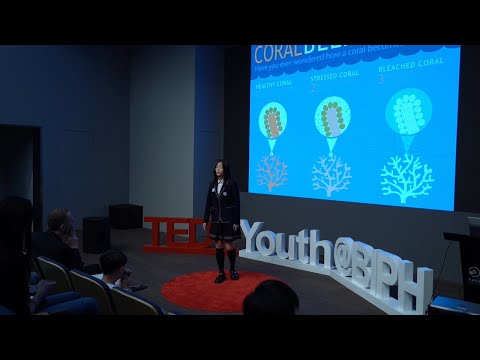
The Silent Crisis of Coral Reefs | Kimi Wong | TEDxYouth@BIPH
TEDx Talks· 2025-06-30 16:59
Environmental Impact & Risks - Coral reefs, vital ecosystems, are disappearing rapidly due to rising ocean temperatures [1][2] - A temperature increase of just 1 degree Celsius is devastating coral reefs that have existed for 500 million years [3] - Coral reefs, despite covering only 02% of the ocean floor, are home to 25% of all marine fish [4] - The world has witnessed a 50% decline in coral population over the past century [6] - Scientists predict that by 2050, coral populations could be gone if ocean conditions remain unchanged [6] Economic & Social Relevance - Coral reefs provide nurseries for fish, benefiting coastal communities [5] - They hold potential cures for diseases like cancer, acting as pharmacies [5] - Coral reefs act as storm shields, protecting against hurricanes, storms, and typhoons [5] Call to Action & Mitigation - Coral bleaching is occurring more frequently, every six years instead of every 25 years [9] - Individual actions, even small ones, can create significant change [11] - Spreading awareness about coral reefs is crucial for their conservation [12]