Discount Rate

Search documents
You probably shouldn't wait till 70 to claim Social Security. Here's math to open your eyes (but nobody likes to show)
Yahoo Finance· 2025-11-29 12:30
Core Viewpoint - Delaying Social Security benefits until age 70 is often recommended for maximizing retirement income, but recent analyses suggest that this may not be the best option for everyone due to various financial factors [1][3][4]. Group 1: Financial Implications of Delaying Benefits - Claiming Social Security benefits at age 62 results in lower monthly payments compared to waiting until age 67 for full benefits, or age 70 for a 24% increase in monthly benefits [2]. - Financial planners typically advocate for delaying claims until age 70, but this advice may overlook individual circumstances and financial realities [3][6]. Group 2: Alternative Perspectives on Claiming Age - Some financial experts argue that age 70 is not necessarily the most financially advantageous age to start benefits, especially for individuals with a low discount rate or those who expect to live significantly beyond their life expectancy [4]. - Recent calculations challenge the notion that most individuals who claim benefits before age 70 are making a mistake, suggesting that earlier claims could be more beneficial for certain retirees [5]. Group 3: Assumptions in Financial Planning - The recommendation to delay benefits is based on simplified assumptions that do not accurately reflect the financial situations of most retirees, according to financial advisor Derek Tharp [6]. - Tharp highlights that traditional calculations assume future dollars hold the same value as today's dollars, which may not be realistic for retirees who invest in low-return assets, thus ignoring potential opportunity costs [7].
X @Investopedia
Investopedia· 2025-07-28 12:01
Definitions - The term "discount rate" has two different meanings [1] - It can refer to the interest rate the Federal Reserve charges banks for short-term loans [1] - It is also used in future cash flow analysis [1]
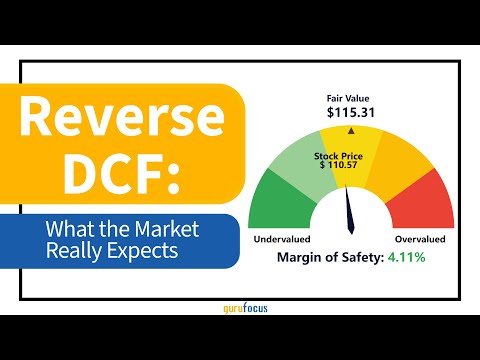
Reverse DCF Explained – Find Out What the Market’s Pricing I
GuruFocus· 2025-06-12 18:23
Model Assumptions & Inputs - The DCF model defaults to a discount rate of the current 10-year Treasury rate plus 6%, currently at 11% [1] - Earnings per share (EPS) is used as a default input to estimate future earnings in the reverse DCF model [2] - Free cash flow and adjusted dividend models are available as options [2] Reverse DCF Model Analysis - The reverse DCF model determines the growth rate needed to justify the current stock price [3] - For Brown, the model suggests a future growth rate of 1948% per year for the next 10 years to justify the current stock price [3] - Brown's average EPS growth over the last 10 years was 2220% [3] - The expected growth is smaller than the past growth, suggesting it is potentially achievable, but relies on assumptions [4] Key Considerations - The business needs to be predictable and consistent in the future [5] - Future growth should be similar to past growth [5] - Changes to the discount rate can significantly impact the valuation [5] - Future interest rates and the length of the growth stage are unknown assumptions [5] - Both DCF and reverse DCF models rely on numerous assumptions [1][5]