EEG technology

Search documents
CeriBell, Inc.(CBLL) - 2025 Q1 - Earnings Call Transcript
2025-05-08 21:32
Financial Data and Key Metrics Changes - Total revenue for Q1 2025 was $20.5 million, reflecting a 42% increase from $14.4 million in Q1 2024 and an 11% increase from Q4 2024 [7][24] - Gross margin for Q1 2025 was 88%, compared to 86% in the prior year [25] - Net loss for Q1 2025 was $12.8 million, or a loss of $0.36 per share, compared to a loss of $8.5 million, or a loss of $1.56 per share in Q1 2024 [27] Business Line Data and Key Metrics Changes - Product revenue for Q1 2025 was $15.6 million, a 41% increase from $11 million in Q1 2024 [25] - Subscription revenue for Q1 2025 was $4.9 million, representing a 45% increase from $3.4 million in Q1 2024 [25] Market Data and Key Metrics Changes - As of March 31, 2025, the company had 558 active accounts, an increase of 29 during the first quarter [9] - The company estimates it currently serves about 3% of the U.S. population that could benefit from its technology [12] Company Strategy and Development Direction - The company aims to expand its account acquisition team to 55 territory managers by mid-2025 [13] - The focus remains on increasing awareness of the clinical and economic benefits of its products through direct engagement with clinicians and marketing initiatives [14] - The company plans to conduct a limited commercial release of its pediatric algorithm, with a full launch anticipated in subsequent years [19] Management's Comments on Operating Environment and Future Outlook - Management expressed confidence in achieving profitability using current cash on hand despite a dynamic trade environment [9] - The company expects full-year 2025 total revenue to range from $83 million to $87 million, up from prior guidance of $81 million to $85 million [28] - Management acknowledged potential impacts from increased tariffs but remains confident in maintaining gross margins in the mid-80% range [29][30] Other Important Information - The company received FDA clearance for its pediatric seizure detection algorithm, expanding its addressable patient population [15] - The company is one of only 51 companies to receive FedRAMP high authorization, validating its cybersecurity standards [10] Q&A Session Summary Question: What is driving the raise in guidance by more than the beat? - Management indicated that greater confidence in account acquisition and management strategies led to the guidance increase [35] Question: Can you elaborate on potential mitigation actions regarding tariffs? - Management mentioned strategies such as automation, cost negotiation with vendors, and potential reshoring plans to mitigate tariff impacts [41] Question: Will pediatric clarity contribute to the 2025 guidance? - Management confirmed that pediatric clarity will not impact the 2025 guidance but sees meaningful expansion potential in future years [48] Question: What is the opportunity for expansion within the customer base? - Management estimates a 70% opportunity for further penetration within existing accounts [66] Question: How is the competitive landscape? - Management stated that while there are emerging competitors, the company remains a clear category leader with unmatched technology and clinical evidence [70]
Cognitive Enhancement Wearable Technology Patent Landscape Report, 2017-2023 & 2024-2032 with Patent Profiles of Abbott Laboratories, IBM, Nestec, University of California, and Koninkl Philips Electronics
Globenewswire· 2025-03-04 15:36
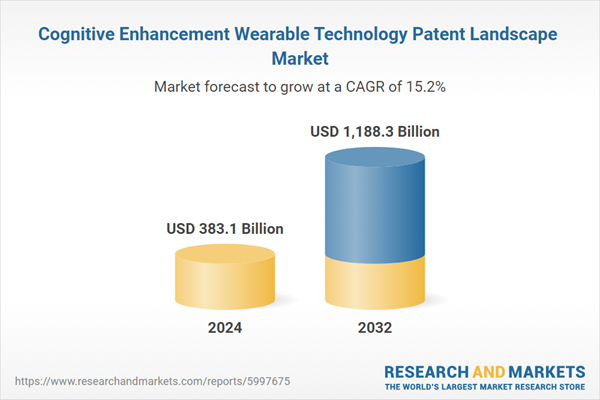
Market Overview - The cognitive enhancement wearable technology market was valued at USD 332.6 billion in 2023 and is projected to grow at a CAGR of 15.2%, reaching USD 1.18 trillion by 2032 [1][19]. - The estimated market value in 2024 is USD 383.1 billion, with a forecasted value of USD 1,188.3 billion by 2032 [19]. Patent Landscape - The market is characterized by a dynamic patent landscape, with significant innovations in EEG and neurostimulation technologies, advanced miniaturization, and digital integration driving extensive patent filings [2][9]. - The United States leads with over 600 patents, followed by Europe with approximately 500 patents, and Asia-Pacific with 450 patents [4][13]. Key Companies - Abbott Lab is a leader in the patent landscape with over 300 patents filed historically and 120 currently in progress, focusing on advanced EEG and neurostimulation technologies [15]. - IBM Corporation has filed 250 patents historically and is pursuing 100 patents, emphasizing miniaturized and user-friendly devices [16]. - Nestec SA holds 200 patents historically and 90 currently active, focusing on the integration of wearable devices with digital platforms [17]. Technology Analysis - EEG technology dominates the cognitive enhancement wearable technology segment, with over 400 patents filed historically and 150 currently active [10]. - Headbands lead the device type segment with over 300 patents filed historically and 120 currently active, reflecting their convenience in consumer and clinical settings [11]. Future Projections - The patent landscape is expected to see over 200 additional patents focusing on advancements in EEG technology and over 180 additional patents for headband designs [10][11]. - Future projections for Abbott Lab suggest over 150 additional patents, while IBM Corporation anticipates around 130 more patents [15][16].