Greenhouse Gas Emission Reduction

Search documents
Alamos Gold Announces Island Gold District Expansion to 20,000 TPD, Creating One of Canada’s Largest and Lowest Cost Gold Mines with Attractive Economics, including 69% After-Tax IRR and $12.2 Billion NPV at $4,500/oz Gold
Globenewswire· 2026-02-04 00:38
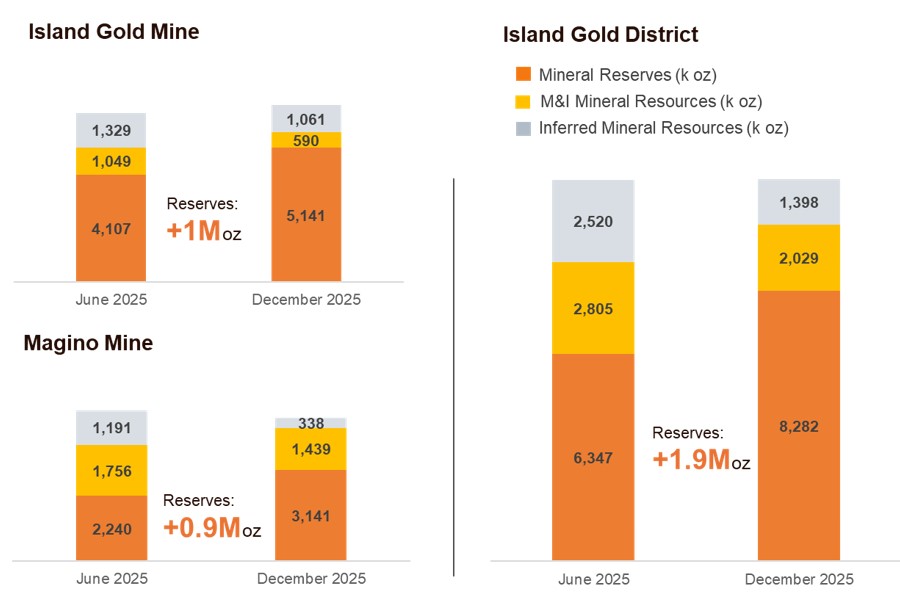
Core Viewpoint - Alamos Gold Inc. has reported significant advancements in its Island Gold District operation, including a 30% increase in Mineral Reserves and an expansion of the Magino mill to 20,000 tonnes per day, which is expected to enhance production and profitability, positioning it as one of Canada's largest and most profitable gold operations [1][2]. Production and Economic Highlights - The IGD Expansion is projected to increase average annual production to 534,000 ounces over the next 10 years, a 27% increase from the Base Case Life of Mine Plan [3][4]. - The total gold production is expected to rise from 5,836,000 ounces in the Base Case to 7,963,000 ounces under the Expansion Study [4]. - Average mine-site all-in sustaining costs (AISC) are anticipated to decrease by approximately 31% to $1,025 per ounce over the initial 10 years post-expansion [3][47]. Mineral Reserves and Resources - The IGD Expansion Study has increased the Proven and Probable Mineral Reserves to 8.3 million ounces, a 30% increase from the previous estimate of 6.3 million ounces [7][19]. - Underground Mineral Reserves have risen by 25% to 5.1 million ounces, while open pit Mineral Reserves increased by 40% to 3.1 million ounces [8][9]. Capital Expenditure - Growth capital for the IGD Expansion is estimated at $542 million, focusing on the Magino mill expansion and accelerated underground development, with total growth capital expected to reach $704 million [55][56]. - The capital for the mill expansion to 20,000 tpd is estimated at $200 million, with significant spending anticipated in 2026 and 2027 [57][58]. Environmental Impact - The IGD Expansion is expected to achieve a 56% reduction in greenhouse gas emissions per ounce produced, further decreasing the emission intensity to 70% lower than the industry average [36][47]. Operational Improvements - The expansion will include enhancements to the Magino mill circuit, such as a new truck dump configuration and a centralized gyratory crusher, aimed at improving processing efficiency and reducing costs [22][40]. - The transition to shaft operations is expected to stabilize costs and improve mining efficiency, with underground mining rates projected to increase to 3,000 tpd by 2029 [23][29]. Financial Projections - The after-tax net present value (NPV) of the IGD Expansion is estimated at $8.2 billion at a long-term gold price of $3,200 per ounce, increasing to $12.2 billion at a price of $4,500 per ounce [13][14]. - The after-tax internal rate of return (IRR) is projected at 53% based on the $3,200 gold price and 69% at $4,500 [14][18]. Summary of Costs - Total cash costs are expected to average $682 per ounce over the initial 10 years post-expansion, reflecting a significant decrease from previous estimates [47][51]. - Open pit mining costs are projected to average C$4.85 per tonne, while underground mining costs are expected to average C$135 per tonne [48][51].


Solvay integrates sustainability-linked features in all short-term liquidity reserves
Globenewswire· 2025-09-25 15:45
Core Points - Solvay has amended its €1.1 billion multilateral revolving credit facility and €0.3 billion bilateral revolving credit facilities to include sustainability-linked features, aligning with its For Generations roadmap and commitment to reducing greenhouse gas emissions [1][2] - The amendments link the company's borrowing costs to its climate goals, specifically targeting ambitious greenhouse gas emission reduction targets across Scope 1, 2, and 3 emissions [2] - The CFO of Solvay emphasized that integrating sustainability into the financing strategy enhances the company's focus on climate change, a key aspect of its For Generations strategy [3] Company Overview - Solvay is a pioneering chemical company with a history dating back to 1863, employing around 9,000 people and generating €4.7 billion in underlying net sales in 2024 [5] - The company is committed to delivering innovative and sustainable solutions that address essential global needs, including air and water purification, food preservation, health protection, and sustainable materials [5] - Solvay aims for a transition to a carbon-neutral future by 2050, highlighting its dedication to sustainability and a fair transition [5]

Nokia signs revolving credit facility with its pricing mechanism linked to the company's sustainability targets
GlobeNewswire News Room· 2025-06-30 07:00
Core Viewpoint - Nokia has signed a EUR 1.5 billion five-year multicurrency revolving credit facility with a pricing mechanism linked to its sustainability targets, replacing a previous EUR 1,412 million agreement from 2019 [1][9]. Group 1: Sustainability Targets - The sustainability targets for the revolving credit facility include the reduction of absolute Scope 1 and 2 greenhouse gas emissions and the reduction of absolute Scope 3 GHG emissions, with annual observation periods impacting pricing adjustments for the following year [2][9]. - Nokia is committed to achieving a Net-Zero target by 2040, which has been validated by the Science Based Targets initiative (SBTi) [4]. Group 2: Financing Strategy - Nokia's financing strategy is closely linked to its sustainability strategy, building on previous initiatives such as the sustainability-linked guarantee facility in 2022 and the sustainable finance framework launched in 2023 [3][9]. - The new revolving credit facility reflects strong support from key banking partners, aligning financing with sustainability priorities [6][7]. Group 3: Operational Approach - Detailed operational approaches to reducing GHG emissions are outlined in Nokia's Net-Zero climate transition plan, which includes commitments and actions for decarbonization [5]. - Nokia published its 2024 Annual Sustainability Statement in March 2025, adhering to the EU Corporate Sustainability Reporting Directive and European Sustainability Reporting Standards [5].