
Industry Rotation

Search documents
【机构观债】2026年1月债市交投转淡 信用利差下行
Xin Hua Cai Jing· 2026-02-06 04:37
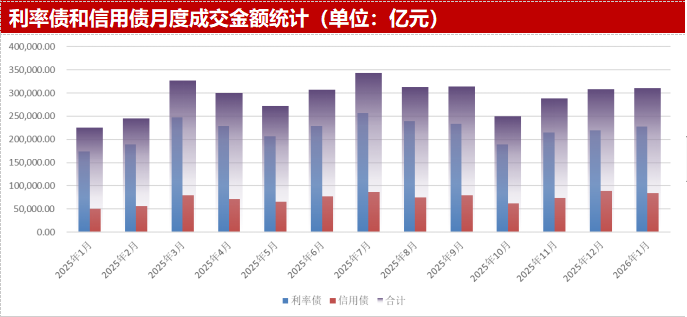
Core Viewpoint - The bond secondary market experienced a slight cooling in trading activity in January 2026, with total transactions amounting to 358,682.06 billion yuan, a month-on-month decrease of 4.80%, but a year-on-year increase of 27.95% due to the timing of the Spring Festival [1][3]. Trading Activity - In January, the total transaction amount in the bond secondary market was 358,682.06 billion yuan, reflecting a month-on-month decline of 4.80% but a significant year-on-year increase of 27.95% [1]. - The trading volume of interest rate bonds reached 227,087.36 billion yuan, showing a year-on-year growth of 30.40% and a month-on-month increase of 3.34%, indicating strong trading resilience [3]. - Credit bonds (excluding interbank certificates of deposit) had a transaction amount of 83,606.03 billion yuan, with a year-on-year increase of 64.88% but a month-on-month decrease of 6.02%, contributing to the overall cooling of market activity [3]. Credit Spread Analysis - The credit spread narrowed to 38.11 basis points by the end of January, down 4.21 basis points from the previous month and 27.72 basis points from the same period last year, supported by the central bank's liquidity injections [2][3]. - Most industries saw a narrowing of credit spreads, with the largest reduction in the basic chemical industry at 24.39 basis points, while the household appliances and electronics sectors experienced widening spreads [4]. Industry-Specific Insights - As of January 30, 2026, the highest credit spreads were observed in the household appliances, real estate, and power equipment sectors, while the lowest were in the telecommunications and public utilities sectors [4]. - The credit spread for urban investment bonds shifted from an upward trend to a downward trend, narrowing by approximately 8 basis points in January, with most regions experiencing reduced volatility [4]. Market Outlook - The bond market is expected to maintain a pattern of liquidity support and structural differentiation, likely resulting in a stable trading environment [5][6]. - Post-Spring Festival, market liquidity is anticipated to gradually return to normal, with the central bank expected to continue a prudent monetary policy to ensure stable liquidity [6]. - Structural differentiation will persist, with industry rotation in the credit bond market and regional disparities in urban investment bonds, influenced by economic and fiscal strength [6].

印度量化策略机构所有权趋势——哪些领域拥挤以及机会在哪里?
Bernstein· 2025-05-13 10:55
Ownership Trends - As of March 2025, Foreign Institutional Investors (FIIs) owned 18.1% of BSE 500 stocks, down from a peak of 22% in 2014, while Domestic Institutional Investors (DIIs) owned 17.2%, the highest in 18 years[7][11] - In Q1 2025, DIIs increased their ownership in large-caps to 18.2% from 17.8%, mid-caps to 15.2% from 14.9%, and small-caps to 14.1% from 13.4%[8][16] Sector Exposure - FIIs increased exposure to Financials while reducing it in Consumer Staples, Consumer Discretionary, Healthcare, and Technology[3] - Retail investors increased their ownership in small-caps to 13.6% from 13.4% but reduced it in large-caps to 7.7% from 7.8%[10] Crowding and Alpha Opportunities - Stocks with significant increases in institutional ownership have underperformed the market by -3.5% to -3.8% per annum since 2006, indicating crowding behavior[4][35] - Under-owned stocks have historically generated alpha of 1.2% to 3.6% per annum since 2006, suggesting potential investment opportunities[4][42] Industry Rotation Strategy - A strategy of going long on the three least crowded and short on the three most crowded industries has yielded 5% annualized returns since 2009, with a notable increase to 29% post-COVID[52][56] - In Q1 2025, the crowded industry cohort was down -12.2%, while the market was down -4.6%, highlighting the risks associated with crowded sectors[4][52] Current Market Insights - The least crowded industries currently include Media, Steel, and Energy, while the most crowded are concentrated in Financials, particularly Banking and Asset Management[4][54] - The retail investor class remains the largest in small-caps, owning 13.6% compared to mutual funds at 11.2% and FIIs at 11.4%[10]