Job retraining program

Search documents
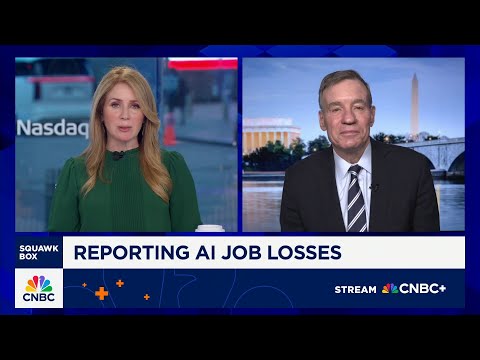
Sen. Warner on AI job losses: Recent college grad unemployment could hit 25% if we do nothing
CNBC Television· 2025-11-20 13:22
AI and Job Displacement Concerns - AI is expected to transform the economy, eliminating jobs, particularly entry-level positions, while creating new ones downstream [1] - Recent college graduate unemployment is currently at 9%, and could rise to 25% if no action is taken [1][7][11][18][19] - Big banks are already cutting internship programs and hirings by 50%, with further cuts planned for next year [4] Proposed Solutions and Responsibilities - A bipartisan bill is introduced to require companies and the federal government to report AI-related job data, including losses, to the labor department [1] - The AI community should contribute to and help design retraining programs to bridge the gap between job losses and the creation of new AI-centric jobs [1][2][4][8][9][13] - The AI community should acknowledge the level of job dislocation and work with the government on solutions [2][4][8][9][13] Funding and Contribution Models - The AI community should make a contribution to address job dislocation, potentially through a public-private initiative [10][13][14] - The contribution could come from various entities, including those using AI (e.g., big banks) or those providing AI technology (e.g., large language model providers, chip manufacturers) [15] - The discussion revolves around whether this contribution should be mandatory (a tax) or voluntary [10] Government and Industry Collaboration - Government's response should involve working with the AI community to design job training and retraining programs [8][13][18] - Historical job retraining programs, such as the Trade Assistance Act in the early 1990s, were not effective [3][13] - Engaging with the AI community at the front end of the transformation is crucial to creating effective solutions [13] Data and Reporting - Good data on AI-related job losses is essential to understanding the situation and informing policy [1][7] - Reporting requirements should apply to everyone engaged in AI, not just tech companies [15] - The use of data should be transparent, and concerns exist that if it's perceived as being used for a tax, companies may be less honest in their reporting [6][10] AI's Broader Impact - AI is expected to bring significant benefits and a productivity boom across various industries [16][17] - The benefits of AI should accrue to all of industry, potentially leading to increased profits and profit margins for companies [17] - Redistribution of profits through taxes is a consideration [17][18] Federal vs State Regulation - There is a debate on whether AI regulation should be at the federal or state level [20][21] - A single national standard with preemption around AI is favored by some, but others believe state pressure is needed to prompt Congressional action [21]