
Lock-in effect

Search documents
For the first time in years, more homeowners have a 6% mortgage rate than a 3% one. That’s great news for frustrated buyers.
Yahoo Finance· 2026-01-08 17:02
But by the end of 2025, more homeowners had crossed over to the other side, taking on mortgages with rates of 6% or more.The “ lock-in effect ,” where homeowners who didn’t want to give up their relatively low rates refused to sell their homes, effectively froze the housing market. That lack of inventory for sale pushed home prices up, creating affordability challenges for all but the wealthiest of buyers. Many would-be homeowners have been forced to delay buying their first house: The median age of a first ...
“Locked-in” Homeowners Nevertheless Pay Off Below-4% Mortgages: their Share Drops to Lowest since Q4 2020
Wolfstreet· 2026-01-04 01:25
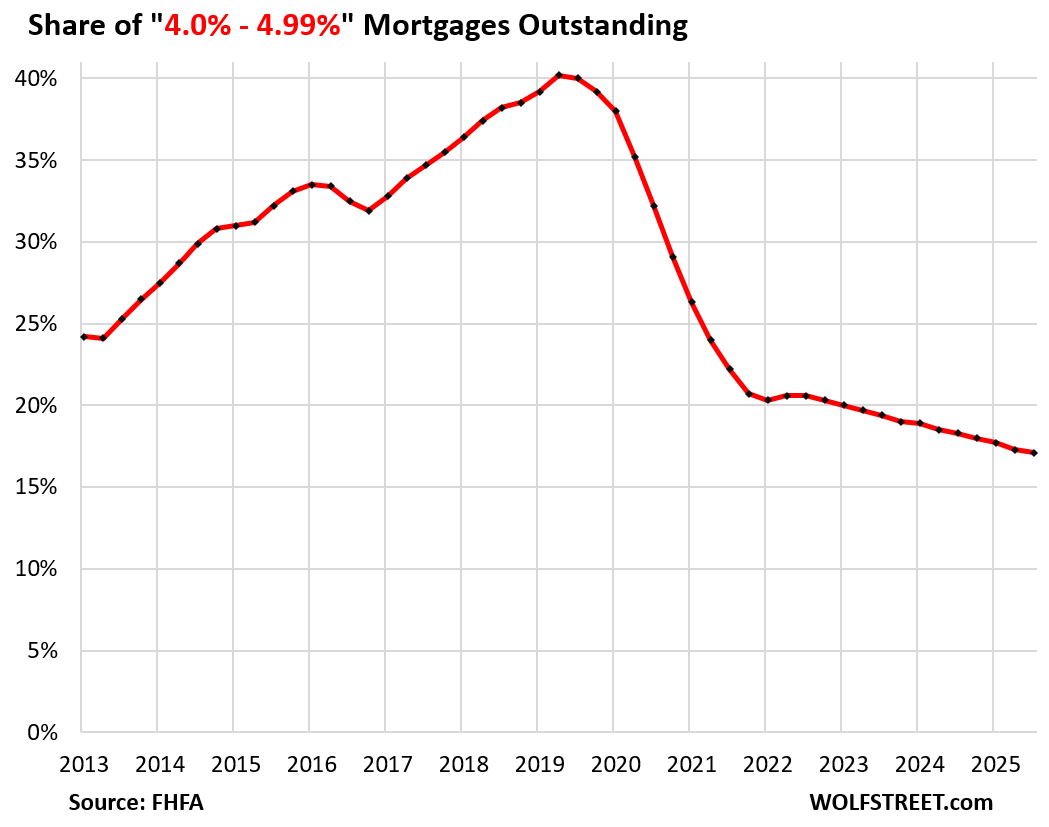
Core Insights - The share of below-3% mortgages has decreased to 20.0% in Q3, the lowest since Q1 2021, down from 24.6% at the peak in Q1 2022 [1] - The overall share of mortgages below 4% has dropped to 51.5%, the lowest since Q4 2020, as homeowners are selling their homes due to life changes [5] - The share of 6%-plus mortgages rose to 21.2% in Q3, the highest since Q3 2015, indicating a significant shift in the mortgage landscape [17] Mortgage Rate Trends - The share of 3% to 3.99% mortgages has declined to 31.5%, the smallest since Q2 2019, reflecting a broader trend of rising mortgage rates [2] - The share of 4.0% to 4.99% mortgages has decreased to 17.1%, the lowest since 2013, showing that many homeowners have refinanced into lower-rate categories [12] - The share of Adjustable-Rate Mortgages (ARMs) has remained low, dipping to 4.0% in Q3, down from over 10% in 2013 [8] Market Dynamics - The "lock-in effect" is causing homeowners with ultra-low interest rates to hesitate in selling their homes, impacting real estate transactions and mortgage originations [21][22] - Despite the lock-in effect, life events are still prompting some homeowners to sell, gradually unlocking the housing market [25] - The ultra-low mortgage rates, which were below inflation, contributed to a significant increase in home prices, creating a challenging environment for potential buyers [20][26][27]

Pulte Cites ‘Portable Mortgages’ After 50-Year Idea Panned
Yahoo Finance· 2025-11-12 16:19
Core Insights - The Federal Housing Finance Agency (FHFA) is exploring the concept of portable mortgages to address housing market challenges, particularly the "lock-in effect" that discourages homeowners from selling their properties due to low existing mortgage rates [1][2] Group 1: Portable Mortgages - Portable mortgages would enable homeowners to transfer their current mortgage rates to new homes, potentially alleviating the stagnation in home sales caused by homeowners' reluctance to give up favorable rates [1] - The FHFA has not provided specific details on how portable mortgages would function, but the concept is seen as a response to the high cost of housing and rising mortgage rates [1][2] Group 2: Market Context - The urgency for mortgage innovation is highlighted by the significant increase in home prices and the doubling of mortgage rates since the pandemic, with current rates at 6.22%, significantly higher than the 3% rates from a few years ago [2] - Recent state and local elections showed Republicans losing by larger margins than expected, with affordability concerns being a key issue for voters, further emphasizing the need for effective housing solutions [2]
Your boomer parents are probably living in a house too big for them. They’re frozen in place because of taxes, top economists say
Yahoo Finance· 2025-09-27 08:33
Core Insights - The outdated capital gains tax caps are identified as a significant factor contributing to the "lock-in effect" in the housing market, preventing millions of homes from being sold and impacting families in need [1][4] Group 1: Lock-in Effect - Many empty-nest seniors are "locked in" to larger homes due to the fear of incurring steep capital gains taxes, which discourages them from downsizing [2][3] - This issue is particularly severe in high-cost metro areas, where selling even modest homes can lead to substantial tax bills, resulting in a misallocation of housing resources [3][4] Group 2: Tax Code and Solutions - The capital gains exclusion caps established by the Taxpayer Relief Act of 1997 have not been adjusted for inflation or home price growth, leading to significant tax burdens for homeowners wishing to move [4][6] - Proposals suggest indexing the exclusion caps to inflation or home price growth, which could alleviate the lock-in effect and increase housing inventory by enabling empty nesters to downsize [6] Group 3: Economic Implications - The phenomenon of "everyday millionaires" highlights that many Americans, despite having inflated asset values, cannot afford the taxes associated with selling their homes, further complicating the housing market [5] - A hypothetical example illustrates that a widow selling her home could face over $100,000 in taxes, which represents more than 20% of her downsizing proceeds, emphasizing the financial impact of the current tax structure [7]
