Mineral Reserve Growth

Search documents
Jaguar Mining Reports Updated Significant 49% Increase in Mineral Reserves at Pilar Mine, Reinforcing Long Term Growth Strategy
Accessnewswire· 2026-04-01 01:10
Core Viewpoint - Jaguar Mining Inc. reported a significant 49% increase in mineral reserves at its Pilar Mine, totaling 286,000 ounces, reinforcing its long-term growth strategy through successful drilling programs and geological model reinterpretation [2][4][5]. Group 1: Mineral Reserves Update - The updated mineral reserve estimate for the Pilar Mine now totals 286,000 ounces, contained in 2,494 thousand tonnes at an average grade of 3.57 g/t Au, representing a net increase of 94,000 ounces compared to the previously reported 192,000 ounces [4][5][20]. - The reserve growth was primarily driven by the BA and BFs orebodies, confirming the continuity and scale of the Pilar mineralized system [7][19]. - The updated mineral reserves at the Pilar Mine are distributed across various orebodies, with BA Orebody contributing 66,000 ounces, BFs Orebodies 141,000 ounces, SW Orebody 33,000 ounces, Torre Orebody 18,000 ounces, and other orebodies 29,000 ounces [8][20]. Group 2: Operational Performance - Throughout 2025, the Pilar Mine was Jaguar's sole operating asset, producing 40,012 ounces of gold with stable recoveries of approximately 89% [9][10]. - Operational activities included planned investments in underground infrastructure, which are expected to support long-term operational continuity, safety, and efficiency [10][11]. - The performance of the Pilar Mine in 2025 is viewed as a demonstration of the asset's robustness, providing a stable operating base while advancing technical work required for future growth [11]. Group 3: Future Plans - The company plans to advance a targeted directional drilling program of approximately 5,000 meters at the Pilar Mine in 2026, focusing on depth extensions at the BA orebody and continuity within the BFs orebody [24][25]. - The objectives of the 2026 exploration program include testing extensions of the BA orebody at depth and improving geological confidence in deeper portions of the mine [24][25]. - The company remains focused on operational stability, disciplined capital deployment, and sustainable long-term growth [8][26].


Alamos Gold Announces Island Gold District Expansion to 20,000 TPD, Creating One of Canada's Largest and Lowest Cost Gold Mines with Attractive Economics, including 69% After-Tax IRR and $12.2 Billion NPV at $4,500/oz Gold
Globenewswire· 2026-02-04 00:38
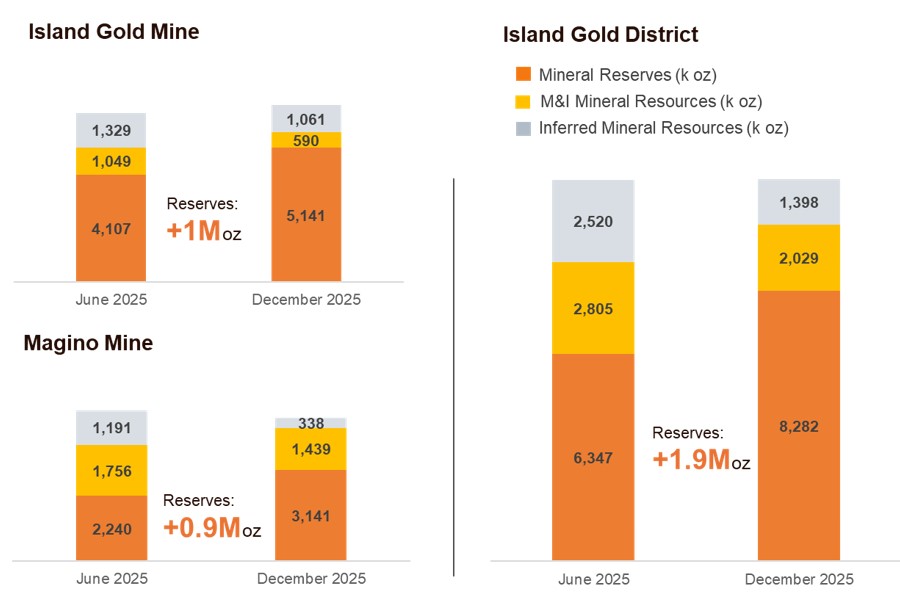
Core Viewpoint - Alamos Gold Inc. has reported significant advancements in its Island Gold District operation, including a 30% increase in Mineral Reserves and an expansion of the Magino mill to 20,000 tonnes per day, which is expected to enhance production and profitability, positioning it as one of Canada's largest and most profitable gold operations [1][2]. Production and Economic Highlights - The IGD Expansion is projected to increase average annual production to 534,000 ounces over the next 10 years, a 27% increase from the Base Case Life of Mine Plan [3]. - The total gold production is expected to rise from 5,836,000 ounces in the Base Case to 7,963,000 ounces under the Expansion Study [5]. - Average mine-site all-in sustaining costs (AISC) are expected to decrease by approximately 31% to $1,025 per ounce over the initial 10 years post-expansion [3][50]. Mineral Reserves and Resources - The IGD Expansion Study indicates a total Proven and Probable Mineral Reserve of 8.3 million ounces, a 30% increase from the previous estimate of 6.3 million ounces [8][21]. - Underground Mineral Reserves increased by 25% to 5.1 million ounces, while open pit Mineral Reserves rose by 40% to 3.1 million ounces [9][10]. Capital Expenditure and Financial Metrics - Growth capital for the IGD Expansion is estimated at $542 million, with total growth capital, including remaining Phase 3+ Expansion spending, expected to reach $704 million [60]. - The after-tax net present value (NPV) of the project is estimated at $8.2 billion at a long-term gold price of $3,200 per ounce, increasing to $12.2 billion at a price of $4,500 per ounce [14][15]. Environmental Impact - The project aims for a 56% reduction in greenhouse gas emissions per ounce produced, building on a 30% reduction already achieved compared to the industry average [4][38]. Operational Improvements - The expansion includes enhancements to the Magino mill, such as a new parallel circuit with a capacity of 10,000 tpd, which will double the overall capacity to 20,000 tpd [22][48]. - The transition to shaft operations is expected to improve mining efficiency and reduce costs, with underground mining rates projected to increase to 3,000 tpd by 2029 [25][31].


Alamos Gold Announces Island Gold District Expansion to 20,000 TPD, Creating One of Canada’s Largest and Lowest Cost Gold Mines with Attractive Economics, including 69% After-Tax IRR and $12.2 Billion NPV at $4,500/oz Gold
Globenewswire· 2026-02-04 00:38
Core Viewpoint - Alamos Gold Inc. has reported significant advancements in its Island Gold District operation, including a 30% increase in Mineral Reserves and an expansion of the Magino mill to 20,000 tonnes per day, which is expected to enhance production and profitability, positioning it as one of Canada's largest and most profitable gold operations [1][2]. Production and Economic Highlights - The IGD Expansion is projected to increase average annual production to 534,000 ounces over the next 10 years, a 27% increase from the Base Case Life of Mine Plan [3][4]. - The total gold production is expected to rise from 5,836,000 ounces in the Base Case to 7,963,000 ounces under the Expansion Study [4]. - Average mine-site all-in sustaining costs (AISC) are anticipated to decrease by approximately 31% to $1,025 per ounce over the initial 10 years post-expansion [3][47]. Mineral Reserves and Resources - The IGD Expansion Study has increased the Proven and Probable Mineral Reserves to 8.3 million ounces, a 30% increase from the previous estimate of 6.3 million ounces [7][19]. - Underground Mineral Reserves have risen by 25% to 5.1 million ounces, while open pit Mineral Reserves increased by 40% to 3.1 million ounces [8][9]. Capital Expenditure - Growth capital for the IGD Expansion is estimated at $542 million, focusing on the Magino mill expansion and accelerated underground development, with total growth capital expected to reach $704 million [55][56]. - The capital for the mill expansion to 20,000 tpd is estimated at $200 million, with significant spending anticipated in 2026 and 2027 [57][58]. Environmental Impact - The IGD Expansion is expected to achieve a 56% reduction in greenhouse gas emissions per ounce produced, further decreasing the emission intensity to 70% lower than the industry average [36][47]. Operational Improvements - The expansion will include enhancements to the Magino mill circuit, such as a new truck dump configuration and a centralized gyratory crusher, aimed at improving processing efficiency and reducing costs [22][40]. - The transition to shaft operations is expected to stabilize costs and improve mining efficiency, with underground mining rates projected to increase to 3,000 tpd by 2029 [23][29]. Financial Projections - The after-tax net present value (NPV) of the IGD Expansion is estimated at $8.2 billion at a long-term gold price of $3,200 per ounce, increasing to $12.2 billion at a price of $4,500 per ounce [13][14]. - The after-tax internal rate of return (IRR) is projected at 53% based on the $3,200 gold price and 69% at $4,500 [14][18]. Summary of Costs - Total cash costs are expected to average $682 per ounce over the initial 10 years post-expansion, reflecting a significant decrease from previous estimates [47][51]. - Open pit mining costs are projected to average C$4.85 per tonne, while underground mining costs are expected to average C$135 per tonne [48][51].
Alamos Gold Provides Exploration Update Across Key Projects Including Extending Mineralization Beyond Mineral Reserves at Lynn Lake and Intersecting High-Grade Mineralization at Qiqavik
Globenewswire· 2026-01-28 11:55
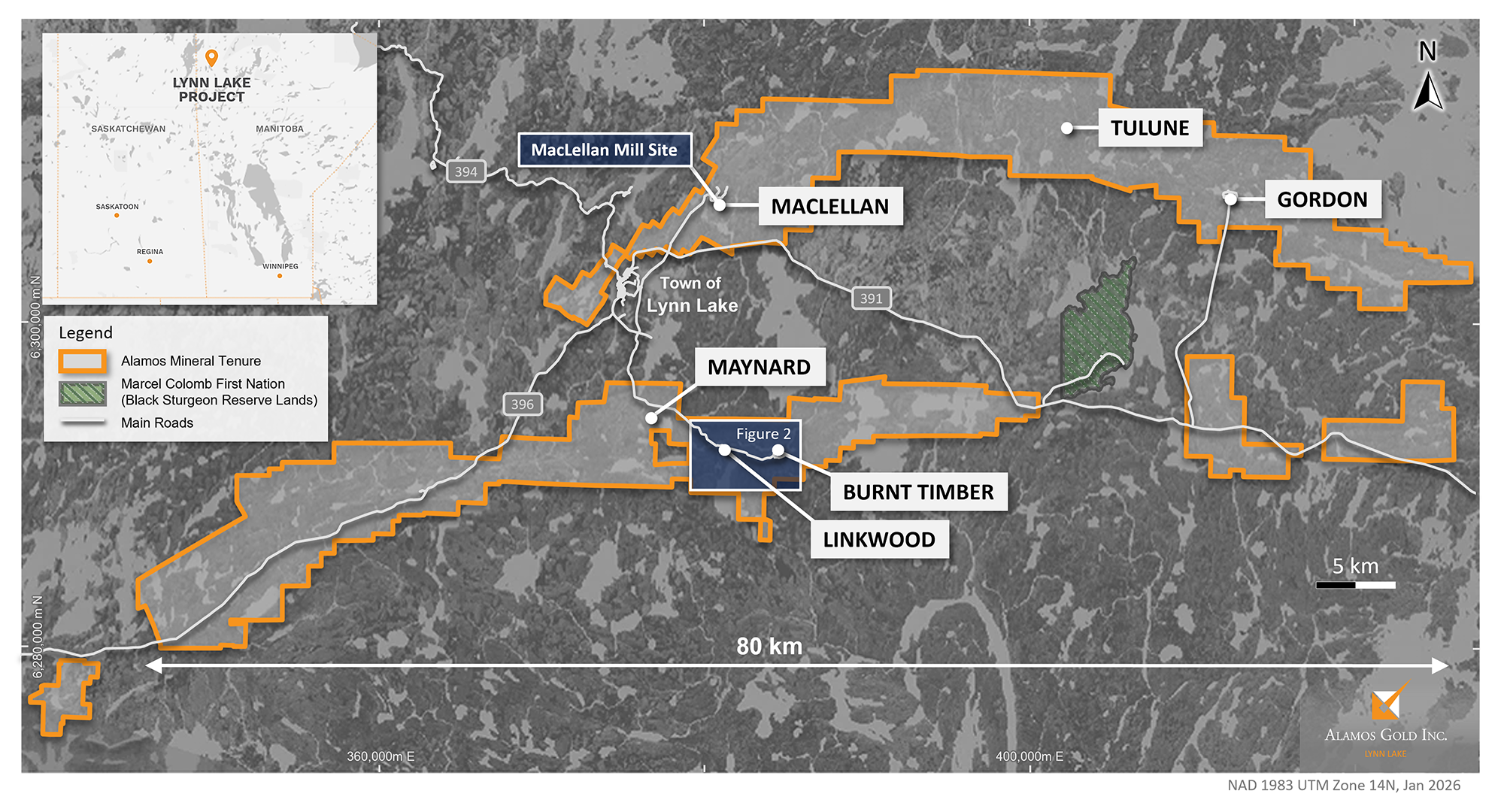
Core Insights - Alamos Gold Inc. reported successful results from its 2025 exploration program at the Lynn Lake and Qiqavik Gold projects, indicating potential for increased mineral reserves and resources [1][2] Lynn Lake Project Exploration Highlights - The exploration focused on the Linkwood and Burnt Timber satellite deposits, which are expected to enhance the mine life and production rates of the Lynn Lake project [3][19] - A total of $3.4 million was spent on exploration at Lynn Lake in 2025, with 7,268 meters of drilling completed [13] - Total Mineral Reserves for the Lynn Lake District increased by 42% to 3.3 million ounces grading 1.29 g/t Au [14] - Significant gold intercepts included 21.70 g/t Au over 5.25 m and 27.68 g/t Au over 6.26 m [6][22] Qiqavik Project Exploration Highlights - The 2025 drill program at Qiqavik was the first since its acquisition in 2024, with 72% of the holes reporting gold grades above 1.0 g/t Au [8][37] - The program confirmed the presence of high-grade gold mineralization across multiple targets, indicating significant discovery potential [9][39] - Notable results included 36.10 g/t Au over 0.65 m and 2.06 g/t Au over 14.95 m [10][11] Future Exploration Plans - The 2026 exploration program will focus on further defining the geometry and extent of mineralized structures at both Lynn Lake and Qiqavik projects [43][49] - There is potential for underground mining at the MacLellan and Gordon deposits, which remain open at depth [24][25] Regional Exploration Potential - The Lynn Lake project covers 58,000 hectares with significant exploration potential, including the Maynard and Tulune regional targets [31][32] - The Maynard target has shown promising gold mineralization over a 750 m strike length, while the Tulune discovery has extended broad zones of near-surface gold mineralization over a 2 km strike length [32][33]
Eldorado Gold grows reserves by 5%
MINING.COM· 2025-11-26 17:22
Core Viewpoint - Eldorado Gold has increased its mineral reserve base, supporting a strong production outlook for the coming years, with shares experiencing a slight increase [1][4]. Group 1: Mineral Reserves - Total reserves as of the end of September are estimated at 371.7 million tonnes grading 1.05 grams per tonne gold, equating to approximately 12.5 million ounces of contained gold, which is a 5% increase from the same time last year [1]. - The reserve increase is primarily attributed to the Lamaque complex in Quebec, which saw a 25% increase in reserves estimates, the highest since its acquisition in 2017 [2]. - Reserves at the Kisladag mine in Türkiye rose by 11% due to a higher gold price assumption and mine optimization, while reserves at Olympias in Greece increased slightly beyond depletion, driven by updated resource modeling [3]. Group 2: Production Outlook - The updated reserve estimates strengthen the company's foundation and support a robust production outlook for the next decade, with an average mine life of 13 years [5]. - The updated reserves reflect a higher gold price assumption of $1,700 per ounce compared to last year's $1,450 per ounce, reinforcing the resilience of Eldorado's portfolio [5]. Group 3: Exploration and Growth Strategy - The company has achieved a near 21% increase in inferred mineral resources due to exploration success in Canada and Greece, reinforcing its strategy to extend mine life and advance near-mine opportunities [6]. - In 2026, the company plans to continue investing in organic growth through exploration, focusing on mine life extension at existing operations and pursuing new discoveries in Canada and Türkiye [7].


SSR Mining(SSRM) - 2025 Q3 - Earnings Call Transcript
2025-11-04 23:02
Financial Data and Key Metrics Changes - In Q3, the company produced 103,000 gold equivalent ounces at an all-in sustaining cost (AISC) of $2,359 per ounce, with a full-year production of 327,000 gold equivalent ounces expected to finish within the guidance range of 410,000-480,000 ounces [8][9] - The net income attributable to shareholders was $65.4 million, or $0.31 per diluted share, while adjusted net income was $68.4 million, or $0.32 per diluted share [9][10] - Free cash flow before changes in working capital was $72 million, indicating strong margins despite ongoing investments [10] Business Line Data and Key Metrics Changes - Marigold produced 36,000 ounces of gold at an AISC of $1,840 per ounce, with expectations for a strong Q4 [11] - CC&V produced 30,000 ounces of gold at an AISC of $1,756 per ounce, generating nearly $115 million in asset-level free cash flow since acquisition [13] - Seabee produced 9,000 ounces at an AISC of $3,003 per ounce, with expectations for incremental improvement in Q4 [14] - Puna produced 2.4 million ounces of silver at an AISC of $1,354 per ounce, continuing solid performance [15] Market Data and Key Metrics Changes - The average realized gold price was above $3,500 per ounce for the quarter [9] - The company ended the quarter with $409 million in cash and total liquidity exceeding $900 million, ensuring capacity to fund growth initiatives [8][9] Company Strategy and Development Direction - The company is focused on advancing organic development projects and is optimistic about the potential of Hod Maden, which is considered one of the most compelling undeveloped copper-gold projects in the sector [5][16] - The company is committed to a restart at Çöpler and is in close communication with government authorities for approvals [7][28] - The strategy remains focused on building core jurisdictions and seeking value-accretive opportunities through M&A [44] Management's Comments on Operating Environment and Future Outlook - Management expects a stronger Q4, primarily driven by Marigold and CC&V, despite challenges faced in Q3 [20] - The company is making good progress on key projects and is well-positioned for a strong close to the year [17] - There is a noted increase in public support for the reopening of Çöpler, which may aid in regulatory discussions [28] Other Important Information - The Cripple Creek and Victor technical report is expected to be published soon, providing insights into mineral reserves and expansion potential [5] - The company has spent $44 million on Hod Maden this year and remains on track for full-year growth capital guidance of $60-$100 million [5][16] Q&A Session Summary Question: Expectations for Q4 and production spillover from Marigold - Management confirmed that Q4 strength is expected from Marigold and discussed strategies for handling fines encountered at Red Dot [20][21] Question: Clarification on lower grades at Seabee - Management explained that lower grades were due to increased material from the gap hanging wall, which was lower than expected [24] Question: Update on Çöpler and community support - Management detailed ongoing discussions with regulators and noted increased public support for reopening, which may help but is not the primary driver for regulatory approval [28] Question: Guidance and spending at Hod Maden - Management indicated that spending at Hod Maden is on track to meet guidance and emphasized the importance of the upcoming technical report for project approval [35][42] Question: Strategy for growth and M&A - Management reiterated a consistent strategy focused on organic growth and selective M&A opportunities, emphasizing the importance of due diligence [44]