Nickel Exploration

Search documents
First Atlantic Nickel Announces Expanded 4-Kilometer Strike Length at RPM Zone from DTR Surface Sampling at Pipestone XL Nickel Alloy Project
Globenewswire· 2025-10-21 10:00
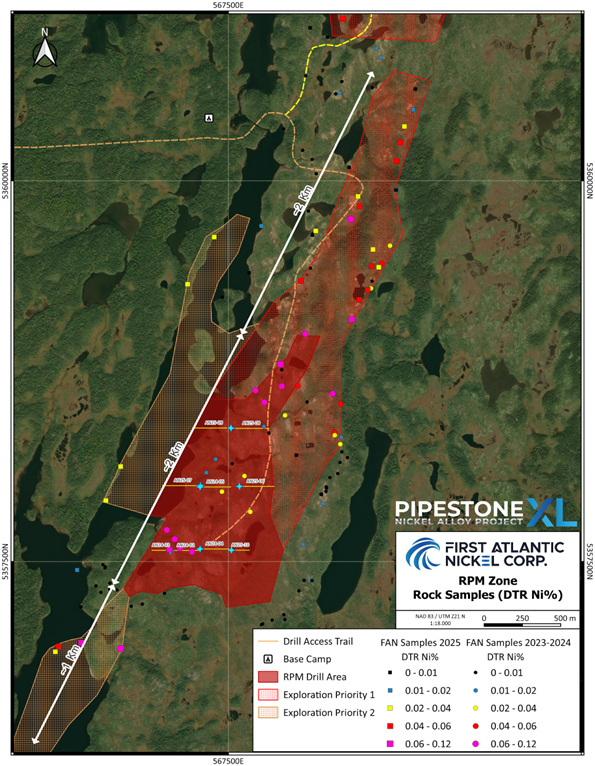
Core Insights - First Atlantic Nickel Corp. has successfully expanded the RPM Zone target area to a continuous 4-kilometer strike length within the 30-kilometer nickel trend at its Pipestone XL Nickel Alloy Project, confirming awaruite mineralization over a north-south strike length of 800 meters [1][4][5] Group 1: Exploration and Sampling Results - The systematic DTR surface sampling program has doubled the strike length of the RPM Zone target area to approximately 4 kilometers, with an additional 2 kilometers of continuous mineralization identified to the north [4][5] - Surface sampling results from the northern extension show comparable DTR nickel values to the initial RPM discovery area, with an average DTR grade of 0.12% magnetically recoverable nickel [2][6] - A new southern extension of approximately 1 kilometer has been identified, where previously mapped volcanic units have been reclassified as ultramafic peridotites hosting awaruite mineralization [8][9] Group 2: Geological Insights and Future Drilling Plans - Phase 2X drilling and geological mapping have defined a westward-dipping ultramafic structure hosting awaruite nickel mineralization, indicating that future drilling will target eastward to effectively test the true width of the mineralized zone [5][11] - A regional deformation structure beneath Pipestone Pond has been interpreted, providing a new structural framework that opens additional exploration opportunities for both north-south strike extensions and further expansion westward [13][14] - Positive DTR results from peridotite outcrops west of Pipestone Pond have expanded the potential RPM target width to approximately 1.2 kilometers, significantly broader than the previously defined 750-meter width [9][10] Group 3: Awaruite Characteristics and Strategic Importance - Awaruite, a naturally occurring nickel-iron-cobalt alloy, has an average nickel grade of approximately 76%, significantly exceeding the typical 25% nickel grade of pentlandite, making it easier to concentrate [21][22] - The sulfur-free nature of awaruite eliminates the need for conventional processing methods, reducing environmental impacts and enhancing the potential for sustainable nickel production [22][30] - The U.S. Geological Survey has recognized the strategic importance of awaruite deposits, noting their potential to alleviate prolonged nickel concentrate shortages [31]