Parts shortage and cost increase

Search documents
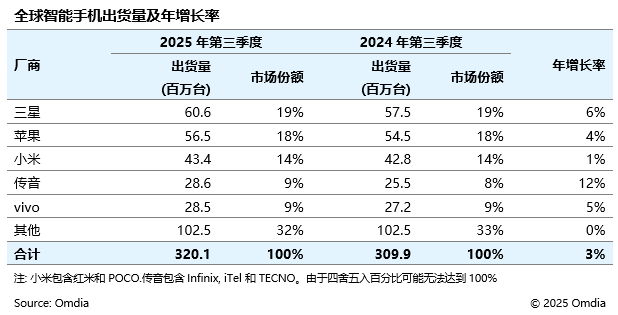
Omdia:第三季度全球智能手机市场出货量同比增长3% 达3.201亿台
智通财经网· 2025-10-30 06:15
Core Insights - The global smartphone market is projected to reach 320.1 million units in Q3 2025, reflecting a 3% year-over-year growth, driven by increased shipments from major brands like Samsung, Apple, Transsion, and Lenovo [1][2]. Company Performance - Samsung maintains its position as the global leader with shipments of 60.6 million units, a 6% increase year-over-year, supported by strong sales of its high-end Galaxy Z Fold7/Flip7 and mid-range Galaxy A07 and A17 models [5]. - Apple shipped 56.5 million units, marking a 4% year-over-year growth, with the iPhone 17 series performing well due to enhanced storage options and strong demand in emerging markets [5]. - Transsion has risen to the fourth position globally, achieving a 12% year-over-year increase in shipments after completing inventory adjustments [6]. - Xiaomi's shipments reached 43.4 million units, showing a modest 1% growth, with regional performance offsetting declines in the Chinese market [5]. - Vivo ranked fifth, benefiting from strong performance in the Indian market and surpassing Huawei in market share within China [6]. Regional Market Trends - The North American and Greater China markets experienced a year-over-year decline in shipments, while regions like Asia-Pacific, the Middle East, and Africa saw robust growth, contributing to the overall recovery of the global smartphone market [9]. - Africa recorded a significant 25% year-over-year increase in shipments, largely due to Transsion's increased market investment following inventory adjustments [9]. - The Asia-Pacific region achieved a 5% year-over-year growth, marking the highest quarterly performance since Q4 2021 [9]. Market Outlook - The global smartphone market is exhibiting a polarized growth trend, with both low-end (under $100) and high-end (over $700) segments expanding, while the mid-range market remains weak [10]. - Despite the recovery in Q3, challenges such as component shortages and rising costs are expected to impact the industry, potentially leading to increased prices for new products and dampening demand in the low-end market [10]. - Manufacturers are likely to adopt various strategies to address these challenges, including prioritizing high-margin models and enhancing supply chain negotiation power to maintain profitability [10].